


How the UAE E-Invoice System Is Changing Business Invoicing
For many finance teams, invoicing has traditionally meant creating a document, sending it to a customer, recording the transaction, and later checking whether the payment or accounting entry was completed. That workflow can work well at a smaller scale, but it becomes more complicated when businesses operate across several systems and handle large transaction volumes.
The UAE is now moving toward a more structured approach to electronic invoicing. The UAE e-invoice system is built around structured invoice data that can be exchanged electronically between businesses and reported to the Federal Tax Authority. Businesses preparing for the transition can review an e-invoicing system for UAE businesses while assessing how their existing accounting and billing processes may need to change.
The change is therefore bigger than replacing paper invoices with digital documents. Businesses need to consider their data, accounting systems, service-provider arrangements, internal workflows, and implementation deadlines.
What Makes the UAE E-Invoice System Different?
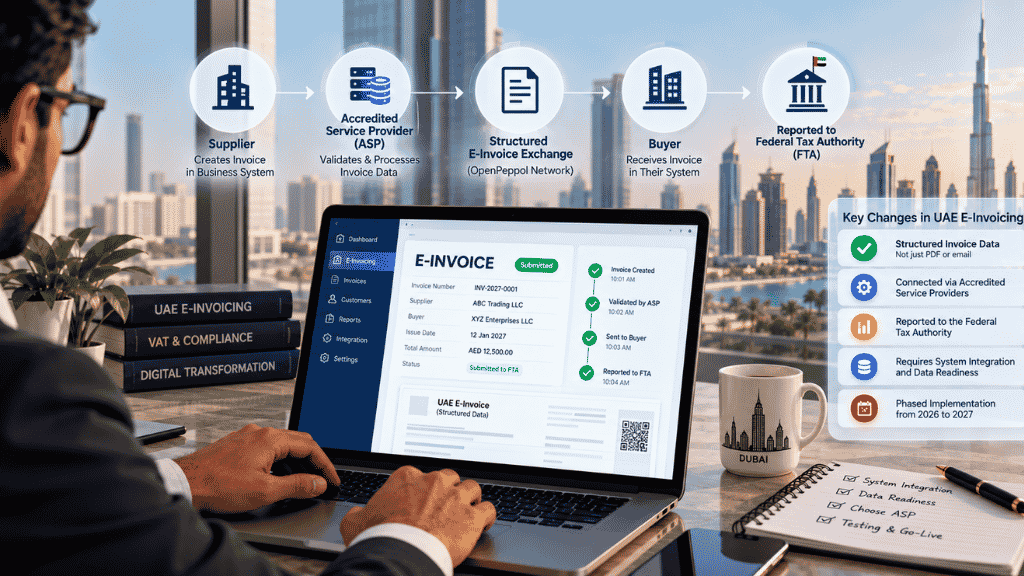
An electronic invoice under the UAE framework is structured data that is issued and exchanged electronically between a supplier and buyer and reported electronically to the Federal Tax Authority. A PDF, scanned copy, image, Word document, or invoice sent by email does not qualify as an e-invoice simply because it was delivered electronically.
This distinction is important when businesses evaluate their current invoicing setup. A company may already create invoices through accounting software and send them by email, but that does not necessarily mean its existing process meets the requirements of the UAE framework.
The system is based on the international OpenPeppol standard and uses Accredited Service Providers to facilitate electronic invoice exchange. This approach is intended to improve interoperability and create a more consistent way of handling structured invoice information.
When Do Businesses Need to Implement It?
The UAE is using a phased implementation approach. Businesses with annual revenue of AED 50 million or more have a mandatory implementation date of 1 January 2027. The deadline to appoint an Accredited Service Provider for this group was extended to 30 October 2026.
Businesses with annual revenue below AED 50 million have a 1 July 2027 implementation date and must appoint an Accredited Service Provider by 31 March 2027. In-scope government entities have the same provider appointment deadline and an implementation date of 1 October 2027.
Voluntary implementation has been available from 1 July 2026, allowing businesses to begin preparing before their mandatory phase.
These deadlines mean that businesses should not leave software evaluation until the final months. Integration testing, data preparation, employee training, and process changes can all take time.
What Happens When an E-Invoice Is Issued?
The UAE framework uses a multi-corner model for electronic invoice exchange.
A simplified process starts with the supplier creating an invoice through its business system. The invoice information is then sent through the supplier's Accredited Service Provider. It is exchanged with the buyer's Accredited Service Provider and made available to the buyer, while the relevant information is also reported to the Federal Tax Authority.
This means the invoicing process becomes more connected than a conventional email-based workflow.
For businesses, the practical question is how their existing ERP, accounting, billing, inventory, or other systems will connect to this process. A new invoicing system that cannot work effectively with existing business applications could create additional manual work.
Where Businesses May Need to Make Changes
The transition can affect several areas of a company's finance operation.
The first is invoice data. Customer information, tax details, product records, invoice numbers, dates, amounts, and other relevant information need to be accurate and consistent.
The second is system integration. Businesses should identify every application involved in creating, approving, recording, or reconciling invoices. This may include ERP systems, accounting platforms, billing software, inventory applications, and custom business tools.
The third is exception handling. Finance teams need a clear process for dealing with rejected or incorrect invoice information. If errors are discovered only after information has moved through several systems, resolving them can become more complicated.
The fourth is staff readiness. Employees who currently create and review invoices may need to understand new workflows, invoice statuses, validation messages, and escalation procedures.
What Should Businesses Check Before Selecting a Solution?
Software selection should start with the company's actual workflow rather than a generic list of features.
Businesses should consider:
• Whether the system can work with their existing ERP or accounting software.
• Whether invoice data can be prepared in the required structured format.
• How the system identifies incomplete or incorrect information.
• Whether it can handle the company's expected transaction volume.
• How invoice status and exceptions are tracked.
• What security and access controls are available.
• How the system can adapt to future regulatory or technical changes.
• What implementation and technical support is available.
Businesses should also distinguish between ordinary invoicing software and the wider e-invoicing infrastructure required under the UAE framework.
Understanding the Role of Accredited Service Providers
Accredited Service Providers, or ASPs, have an important role in the UAE e-invoicing framework. The Ministry of Finance maintains an official list of accredited providers and updates it as the accreditation process progresses.
A business therefore needs to consider both its internal invoicing technology and the Accredited Service Provider through which its electronic invoices will be exchanged.
For example, a company may retain its existing ERP while using an appropriate e-invoicing platform to connect its invoice data with the required electronic exchange process. The exact technical arrangement will depend on the business's systems and the provider it selects.
This is one reason businesses should assess UAE e-invoicing technology in the context of their complete finance workflow rather than viewing e-invoicing as a standalone billing function.
A Simple Preparation Approach
Businesses can make the transition easier by breaking the work into manageable stages.
Start by identifying the applicable implementation deadline. Next, map the current invoice workflow from creation to accounting and reconciliation. Then review the systems involved and identify gaps in integration or data quality.
After that, businesses can compare suitable solutions and Accredited Service Providers. Testing should follow before the mandatory implementation date, including normal transactions as well as error and rejection scenarios.
It is also useful to involve finance and IT teams together. Finance staff understand the operational workflow, while technical teams can assess integrations, data exchange, security, and system dependencies.
FAQ
What is the UAE e-invoice system?
It is a structured electronic invoicing framework through which invoice data is exchanged electronically and reported to the UAE Federal Tax Authority.
Is a PDF invoice an e-invoice in the UAE?
No. A PDF, scanned document, image, Word file, or email invoice does not qualify as an e-invoice by itself.
When does mandatory e-invoicing begin in the UAE?
Businesses with annual revenue of AED 50 million or more must implement it from 1 January 2027. Businesses below AED 50 million have a 1 July 2027 implementation date.
What is an Accredited Service Provider?
An Accredited Service Provider is a provider accredited by the UAE Ministry of Finance to provide electronic invoicing services within the UAE framework.
Can businesses keep their existing accounting software?
Existing accounting or ERP systems may continue to be used where they can be appropriately integrated with the e-invoicing process. The required approach depends on the business's technology environment.
The UAE e-invoice system is ultimately a change in how invoice information moves through a business, not simply a change in invoice appearance. Companies that assess their existing systems, clean their data, plan integrations, and test their workflows ahead of the applicable deadline will be better positioned to make the transition without disrupting everyday finance operations.

 English
 French
 Spanish
 Portuguese
 Deutsch
 Turkish
 Dutch
Dutch
 Italiano
 Russian
 Romaian
 Portuguese (Brazil)
 Greek
Greek
 Bengali