


Could 5G IoT Redefine the Future of Connected Healthcare?
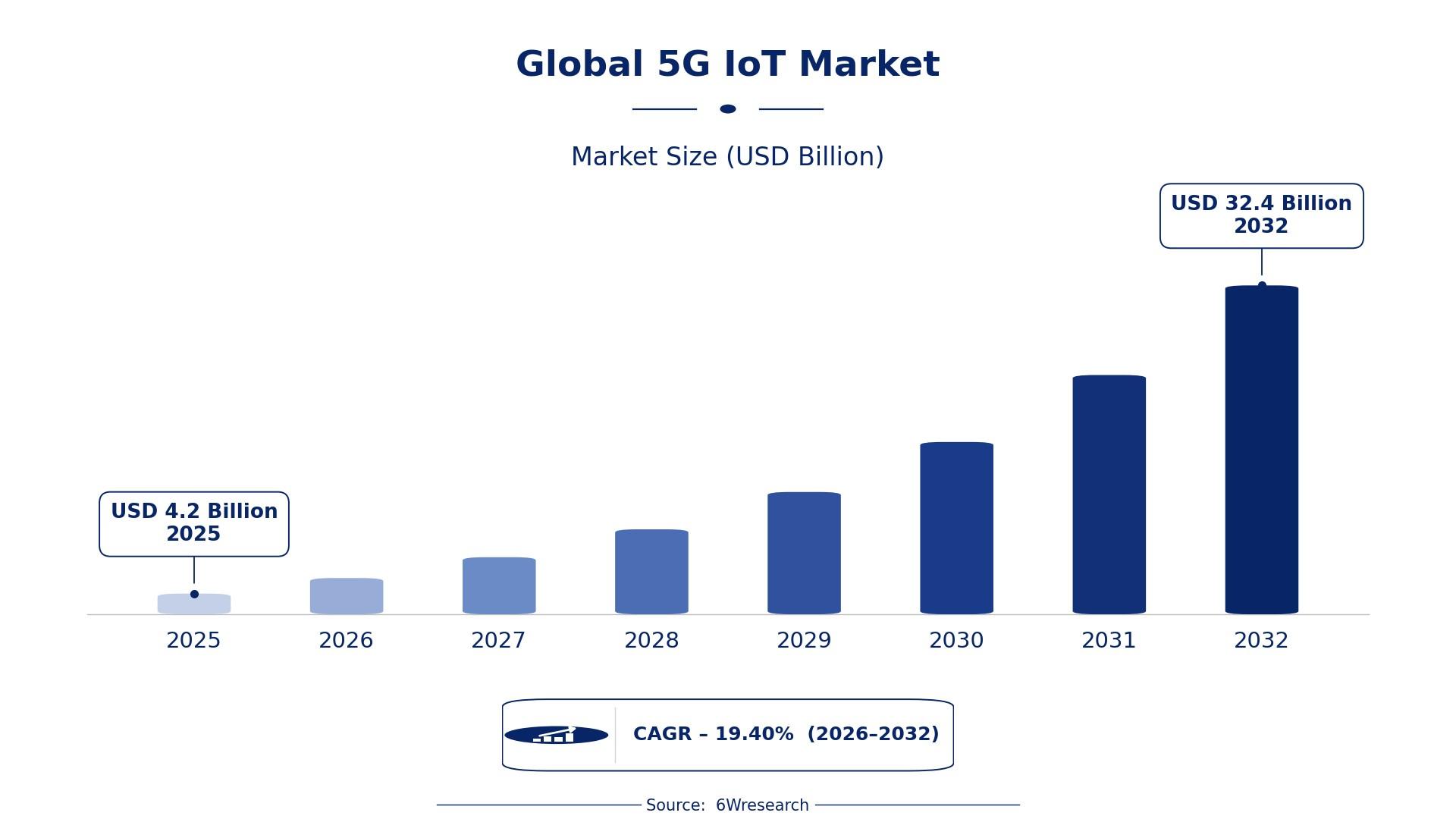
Healthcare is rapidly becoming more connected, and the 5G IoT Market is creating new possibilities for communication between medical devices, patients, healthcare professionals, and digital platforms. The combination of 5G connectivity and Internet of Things technologies can support applications ranging from remote patient monitoring to connected medical equipment. 6Wresearch projects the global 5G IoT Market to grow from USD 4.2 billion in 2025 to USD 32.4 billion by 2032, reflecting a CAGR of 19.40% during 2026–2032.
Why Does Healthcare Need Better Connectivity?
Modern healthcare increasingly depends on connected devices. Wearable monitors, hospital equipment, emergency systems, and remote-care platforms can generate continuous streams of information.
However, connected healthcare requires more than simply collecting data. Medical applications may require timely communication, reliable connectivity, and secure transmission.
5G can support these requirements by providing high-speed wireless communication and lower latency for compatible applications.
Remote Patient Monitoring
One of the most interesting applications is remote patient monitoring.
Wearable and connected medical devices can collect information such as heart rate, oxygen levels, temperature, and other health-related indicators. These measurements can potentially be transmitted to healthcare platforms for analysis.
For patients who require regular observation, connected monitoring could reduce dependence on frequent physical visits while helping healthcare professionals access information remotely.
This can be particularly relevant for home healthcare and telemedicine models.
Connected Hospitals
The concept of a smart hospital extends beyond patient monitoring.
Hospitals can deploy connected systems for:
-
Medical equipment tracking
-
Asset management
-
Environmental monitoring
-
Staff communication
-
Patient-flow management
-
Emergency response
-
Inventory monitoring
For example, connected tracking systems can help hospital administrators identify the location of critical equipment. Sensors can also monitor environmental conditions in specialized areas.
5G and Medical Robotics
Another developing application involves robotics.
Robotic systems can assist healthcare facilities with logistics, rehabilitation, diagnostics, and other specialized functions. Reliable wireless connectivity can support communication between robotic systems and centralized control platforms.
As technologies develop, 5G-enabled environments could also support more sophisticated remote and robotic applications.
The objective is not simply faster connectivity. It is the creation of an environment where multiple connected systems can exchange information efficiently.
Edge Computing Could Improve Response Times
Healthcare generates enormous amounts of data. Sending every piece of information to a centralized cloud platform may not always be the most efficient approach.
Edge computing enables processing closer to the source of data. In healthcare environments, this could help connected systems analyze information locally before sending selected data to centralized platforms.
For time-sensitive applications, reducing communication delays can be valuable.
Cybersecurity Remains Essential
Healthcare organizations handle sensitive information, making cybersecurity one of the most important considerations in connected healthcare.
As more medical devices become connected, organizations need to consider:
-
Device authentication
-
Data encryption
-
Network segmentation
-
Software updates
-
Access management
-
Monitoring of connected endpoints
A larger connected ecosystem can also create more potential security vulnerabilities. Therefore, cybersecurity needs to be incorporated into 5G IoT deployments from the beginning rather than added later.
Healthcare Could Become More Distributed
Traditional healthcare is often centered around hospitals and clinics. Connected technologies can support a more distributed model in which patients, doctors, devices, and healthcare platforms remain connected across locations.
6Wresearch identifies healthcare as a rapidly growing end-user area, with the segment projected to expand at a 23% CAGR from 2026 to 2032.
This growth reflects increasing interest in remote healthcare solutions, telemedicine, and connected medical technologies.
The Road Ahead
The future of connected healthcare will depend on the interaction of 5G, IoT devices, artificial intelligence, edge computing, cloud platforms, and cybersecurity.
Rather than treating each technology separately, healthcare organizations are increasingly looking at integrated digital ecosystems.
The 5G IoT Market therefore represents more than a connectivity opportunity. It can become an enabling layer for healthcare systems seeking greater connectivity, remote monitoring capabilities, and digitally coordinated services.
Who We Are
About 6Wresearch: 6Wresearch is a commercial strategy and growth advisory firm founded in 2011 and headquartered in New Delhi, India, with partners across Southeast Asia and the Middle East & Africa. The firm has delivered over 20,000 commercial engagements for over 2,000 organizations, including Fortune 500 companies, government agencies, and multilateral institutions such as the World Bank and the Asian Development Bank. Backed by proprietary market research and advanced analytics, 6Wresearch combines sector expertise with data-driven intelligence to help organizations navigate market complexity and drive sustainable growth. These capabilities explain why organizations trust 6Wresearch Global Market Research & Consulting Firm for reliable commercial insights and confident decision-making.
Our Proprietary Platform: 6W Export GTM
6W Export GTM is 6Wresearch's proprietary trade intelligence and go-to-market platform, built on UN Comtrade data and enhanced with 6Wresearch's in-house analytical and simulation models, including system dynamics-based forecasting. Unlike broad, sector-level market sizing tools, 6W Export GTM operates at the individual product level down to specific HS codes and micro-segments to identify precise, actionable export opportunities by country and product pair, including markets where trade currently does not exist. This granular, simulation-driven approach allows 6W Export GTM to surface opportunities that sector-wide analysis typically misses, positioning it among a small number of platforms globally offering this depth of product-and-country-specific export intelligence.

 English
 Arabic
 French
 Spanish
 Portuguese
 Deutsch
 Turkish
 Italiano
 Russian
 Romaian
 Portuguese (Brazil)
 Greek
Greek
 Bengali