


Can 5G Infrastructure Turn Today’s Cities into Smarter Digital Ecosystems?
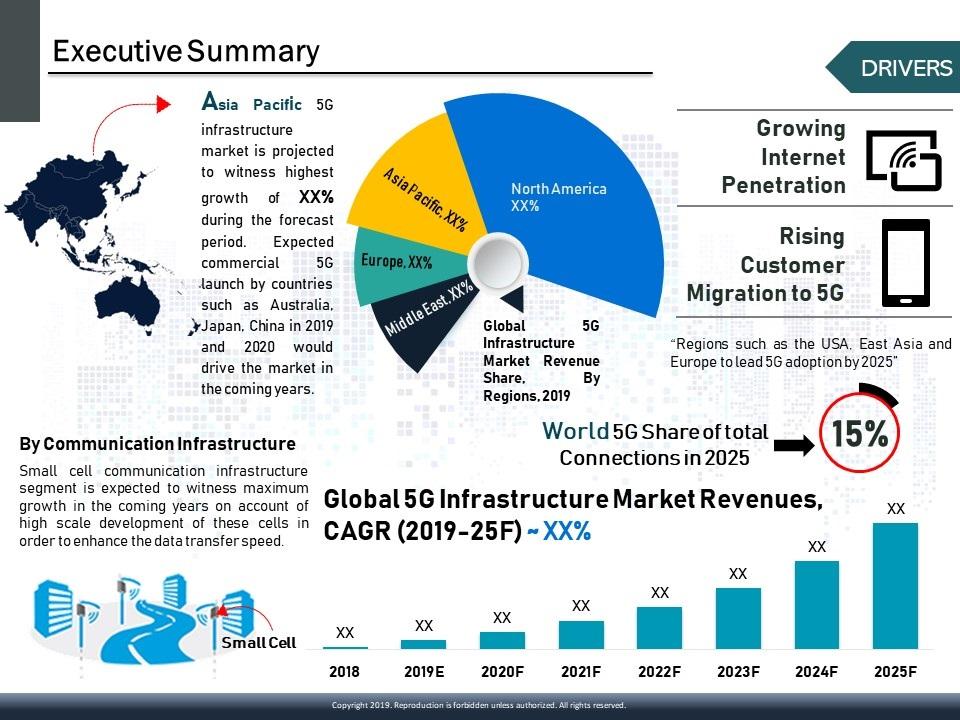
The 5G Infrastructure Market is attracting attention as cities worldwide look for better ways to manage transportation, public services, buildings, utilities and communication systems. Urban populations generate enormous amounts of data every day, and connected technologies are becoming increasingly important for managing this complexity. By combining high-speed wireless connectivity with technologies such as edge computing and intelligent devices, 5G infrastructure can become an important component of future smart-city ecosystems.
The City Is Becoming a Connected Network
A modern city contains countless digital touchpoints. Traffic signals communicate with control systems, surveillance cameras generate continuous video streams, public transport systems share location information, and smart buildings monitor energy consumption.
Each application has different connectivity requirements. Some need high bandwidth, while others require dependable low-latency communication or support for large numbers of devices.
5G infrastructure can help create a common connectivity environment for these applications.
Small Cells for Dense Urban Areas
One of the interesting characteristics of 5G deployment is the growing importance of smaller network cells. Dense locations such as shopping districts, airports, stadiums, business centers and transportation hubs can generate significant traffic.
Small cells can supplement broader macro-cell networks by providing additional capacity in high-demand areas. This approach can help network operators manage concentrated connectivity requirements.
For cities, this can support applications involving:
-
Connected traffic systems.
-
Smart parking.
-
Public transportation.
-
Connected street lighting.
-
Security and surveillance.
-
Environmental monitoring.
Edge Computing Changes the Equation
Connectivity alone is not enough for many intelligent-city applications. Data also needs to be processed efficiently.
Mobile edge computing can bring computing resources closer to connected devices. Instead of sending every piece of information to a distant data center, certain workloads can be processed closer to where the data originates.
This can be useful for applications that depend on quick responses. For example, traffic-management systems may need to react rapidly to changing road conditions, while connected security systems may require fast processing of video or sensor information.
Smarter Transportation Networks
Transportation represents one of the most visible opportunities for connected infrastructure.
A 5G-enabled transportation ecosystem could allow vehicles, traffic infrastructure and management platforms to exchange information more efficiently. This can support applications such as traffic monitoring, fleet management, connected vehicles and intelligent public transportation.
For logistics operators, improved connectivity can also help track vehicles and assets across complex supply chains.
Intelligent Buildings
Buildings are also becoming increasingly digital. Sensors can monitor temperature, lighting, occupancy, equipment performance and energy usage.
5G connectivity can provide another communications option for these systems, particularly where large numbers of devices need to communicate.
When combined with automation platforms, connected building infrastructure can help facility managers gain better visibility into building operations.
Challenges for Urban Deployment
Deploying 5G infrastructure throughout cities is not without challenges. Network operators must coordinate equipment installation with local authorities, property owners and infrastructure providers.
There are also considerations related to spectrum, backhaul connectivity, cybersecurity, power requirements and equipment placement.
Urban networks can become highly complex because different applications may have different performance and reliability requirements.
The Business Opportunity
The development of smart-city infrastructure creates opportunities for a wide range of companies. Telecom operators, equipment manufacturers, cloud providers, software developers, systems integrators and IoT companies can all participate in the ecosystem.
The opportunity is not limited to selling network equipment. Companies can develop platforms and services around analytics, security, automation, edge computing and connected infrastructure management.
A Connected Future
The future city will depend on many technologies working together rather than on one network technology alone. 5G can provide an important connectivity layer, while cloud computing, artificial intelligence, IoT and edge computing can transform the information carried across that network.
As urban environments become more digitally connected, infrastructure capable of supporting large numbers of devices and data-intensive applications will become increasingly relevant.
5G infrastructure could therefore become part of the foundation on which future smart-city services are built.
Who We Are
About 6Wresearch: 6Wresearch is a commercial strategy and growth advisory firm founded in 2011 and headquartered in New Delhi, India, with partners across Southeast Asia and the Middle East & Africa. The firm has delivered over 20,000 commercial engagements for over 2,000 organizations, including Fortune 500 companies, government agencies, and multilateral institutions such as the World Bank and the Asian Development Bank. Backed by proprietary market research and advanced analytics, 6Wresearch combines sector expertise with data-driven intelligence to help organizations navigate market complexity and drive sustainable growth. These capabilities explain why organizations trust 6Wresearch Global Market Research & Consulting Firm for reliable commercial insights and confident decision-making.
Our Proprietary Platform: 6W Export GTM
6W Export GTM is 6Wresearch's proprietary trade intelligence and go-to-market platform, built on UN Comtrade data and enhanced with 6Wresearch's in-house analytical and simulation models, including system dynamics-based forecasting. Unlike broad, sector-level market sizing tools, 6W Export GTM operates at the individual product level down to specific HS codes and micro-segments to identify precise, actionable export opportunities by country and product pair, including markets where trade currently does not exist. This granular, simulation-driven approach allows 6W Export GTM to surface opportunities that sector-wide analysis typically misses, positioning it among a small number of platforms globally offering this depth of product-and-country-specific export intelligence.

 English
 Arabic
 French
 Spanish
 Portuguese
 Deutsch
 Dutch
Dutch
 Italiano
 Russian
 Romaian
 Portuguese (Brazil)
 Greek
Greek
 Bengali