Mental health professionals dedicate their time to helping people overcome emotional, behavioral, and psychological challenges. However, behind every successful therapy practice is another important responsibility—getting paid accurately and on time. That is where billing for mental health therapists becomes essential.
Whether you run a private practice, a group counseling center, or provide telehealth services, billing can quickly become overwhelming. Insurance policies, documentation standards, coding updates, and claim denials all require careful attention. Understanding how the billing process works can help therapists reduce administrative stress, improve cash flow, and spend more time focusing on patient care.
This guide explains the fundamentals of mental health billing in the USA, common challenges, best practices, and ways to improve reimbursement without sacrificing compliance.
Why Mental Health Billing Is Different
Mental health billing is more specialized than billing for many other healthcare services. Therapists often work with different insurance plans, varying authorization requirements, and multiple therapy session lengths.
Several factors make the process unique:
- Therapy sessions vary by duration.
- Insurance plans have different behavioral health benefits.
- Prior authorization may be required.
- Documentation must support medical necessity.
- Telehealth regulations continue to evolve.
Because of these complexities, even a small billing mistake can delay reimbursement or result in claim denials.
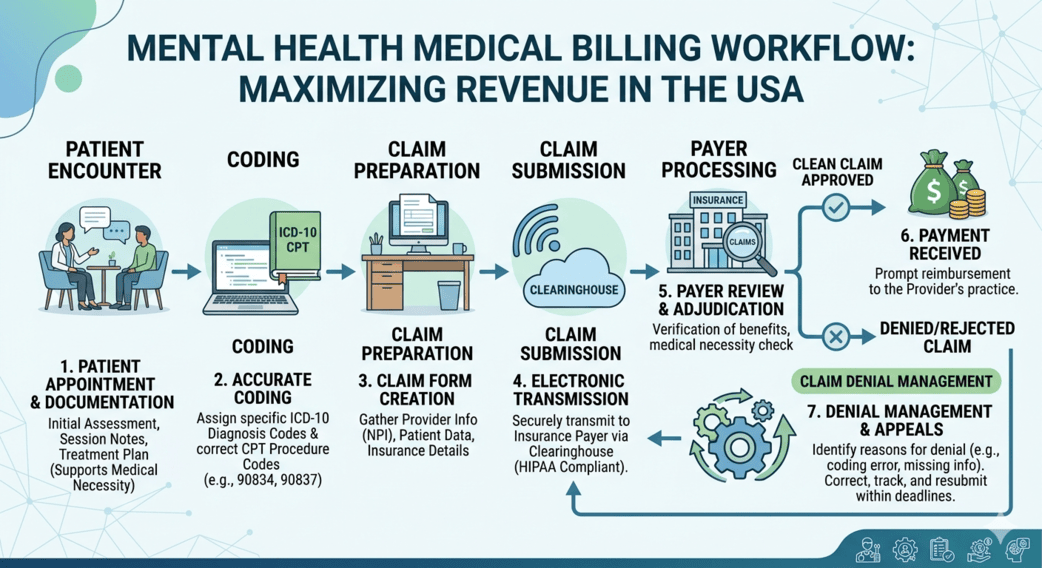
Understanding the Mental Health Billing Process
Successful billing follows a series of organized steps. Missing any one of them can affect payment.
Patient Registration
The process begins with collecting accurate patient information, including:
- Insurance details
- Personal identification
- Referral information (if applicable)
- Consent forms
- Financial responsibility agreements
Incorrect patient information is one of the most common reasons claims are rejected.
Insurance Verification
Before the first appointment, practices should verify:
- Active insurance coverage
- Deductibles
- Copayments
- Coinsurance
- Visit limitations
- Prior authorization requirements
Verifying benefits before treatment helps avoid unexpected billing issues later.
Accurate Documentation
Clinical documentation should clearly describe:
- Diagnosis
- Treatment goals
- Session duration
- Therapeutic interventions
- Progress notes
- Medical necessity
Good documentation supports both compliance and reimbursement.
Choosing the Correct Medical Codes
Accurate coding is the foundation of successful reimbursement.
Mental health providers typically use diagnosis codes along with procedure codes that describe the services performed.
Common therapy services may include:
- Individual psychotherapy
- Family therapy
- Group therapy
- Crisis intervention
- Psychiatric evaluations
- Telehealth counseling
Using incorrect codes, outdated codes, or mismatched documentation can lead to delayed payments or denied claims.
This is one reason many practices rely on experienced medical coding services to improve coding accuracy and reduce administrative burden.
Common Billing Challenges for Mental Health Therapists
Even experienced therapists encounter billing problems. Understanding these challenges makes them easier to prevent.
Frequent Claim Denials
Claims may be denied because of:
- Incorrect coding
- Missing documentation
- Expired insurance coverage
- Authorization issues
- Duplicate submissions
- Incorrect provider information
Regular claim audits help identify recurring issues before they become costly.
Prior Authorization Requirements
Some insurance carriers require approval before therapy services begin.
Failing to obtain authorization may result in unpaid claims even when treatment was medically necessary.
Frequent Insurance Policy Changes
Behavioral health coverage changes regularly.
Practices need to stay updated on:
- Coverage limitations
- Coding revisions
- Telehealth policies
- Documentation requirements
- State-specific payer rules
Documentation Best Practices
Strong documentation supports quality care and successful reimbursement.
Therapists should document:
Session Details
Include:
- Start and end time
- Type of therapy provided
- Patient response
- Treatment goals
- Progress toward objectives
Medical Necessity
Insurance companies generally require evidence that therapy is medically necessary.
Documentation should explain:
- Symptoms
- Functional impairment
- Diagnosis
- Clinical reasoning
- Ongoing treatment plan
Clear documentation also provides protection during audits.
How Telehealth Has Changed Mental Health Billing
Teletherapy has become an important part of behavioral healthcare across the USA.
While virtual appointments offer convenience, they also introduce new billing considerations.
Practices should verify:
- Telehealth eligibility
- Approved billing modifiers
- Place of service requirements
- State licensing rules
- Insurance-specific telehealth policies
Following current payer guidelines helps reduce reimbursement delays.
Strategies to Reduce Billing Errors
Small improvements in billing workflows can significantly improve payment rates.
Consider these best practices:
- Verify insurance before every appointment.
- Submit claims promptly.
- Review documentation before billing.
- Track denied claims and identify patterns.
- Stay current with coding updates.
- Train administrative staff regularly.
- Monitor aging accounts receivable.
Consistency is often more valuable than speed when it comes to billing accuracy.
The Value of Professional Billing Support
Many therapists eventually discover that managing billing internally consumes valuable clinical time.
Professional medical billing services can assist with:
- Insurance verification
- Claim submission
- Payment posting
- Denial management
- Patient billing
- Accounts receivable follow-up
Outsourcing administrative tasks allows therapists to focus more on patient care while improving operational efficiency.
Credentialing Matters More Than Many Therapists Realize
Before submitting insurance claims, providers must complete the credentialing process with insurance companies.
Proper credentialing ensures:
- Participation in insurance networks
- Accurate provider enrollment
- Faster claim processing
- Reduced reimbursement delays
Outdated enrollment information or incomplete credentialing records may lead to rejected claims regardless of how accurate the billing is.
Keeping provider information updated is an important part of maintaining a healthy practice.
Improving Financial Performance Through Better Revenue Management
Billing is only one component of a successful financial strategy.
Many growing practices focus on complete revenue cycle management, which includes every financial step from patient scheduling to final payment collection.
An effective revenue cycle includes:
- Patient registration
- Insurance verification
- Charge capture
- Accurate coding
- Claim submission
- Payment posting
- Denial resolution
- Patient collections
- Financial reporting
Monitoring each stage helps identify inefficiencies and supports long-term financial stability.
How Technology Supports Better Billing
Modern practice management software can automate many repetitive billing tasks.
Helpful features include:
- Electronic claim submission
- Eligibility verification
- Appointment scheduling
- Payment tracking
- Denial alerts
- Reporting dashboards
- Secure documentation storage
Automation reduces manual errors while improving workflow efficiency.
However, technology works best when paired with knowledgeable billing professionals who understand payer requirements.
Building a Sustainable Billing Process
A reliable billing system is built on consistency rather than shortcuts.
Successful therapy practices typically:
- Establish standardized documentation procedures.
- Review payer updates regularly.
- Audit claims periodically.
- Monitor key performance indicators.
- Educate staff on coding changes.
- Resolve denials quickly.
- Maintain accurate provider enrollment.
Organizations like 247 Medical Billing Services understand that every therapy practice has different operational needs. Combining experienced billing professionals with accurate coding, compliance awareness, and efficient administrative processes can help practices maintain smoother financial operations while allowing therapists to prioritize patient care.
Frequently Asked Questions
1. Why is billing for mental health therapists more complicated than general medical billing?
Mental health billing often involves therapy session time requirements, behavioral health benefits, prior authorizations, specialized documentation, and evolving telehealth regulations, making it more complex than many other medical specialties.
2. What is the most common reason mental health claims are denied?
Common reasons include incorrect coding, incomplete documentation, missing authorizations, inaccurate patient information, and insurance eligibility issues.
3. How often should insurance eligibility be verified?
Insurance eligibility should ideally be verified before the initial visit and periodically afterward, especially if treatment extends over several months or a new calendar year begins.
4. Does telehealth require different billing procedures?
Yes. Many insurance plans have specific billing modifiers, place-of-service requirements, and reimbursement rules for virtual therapy sessions.
5. Why is accurate documentation important for reimbursement?
Documentation demonstrates medical necessity, supports the diagnosis and treatment provided, and helps validate claims during payer reviews or audits.
6. What role does credentialing play in mental health billing?
Proper credentialing allows therapists to participate in insurance networks and submit claims successfully. Incomplete or outdated credentialing can delay or prevent reimbursement.
7. How can therapists improve their billing efficiency?
Practices can improve efficiency by verifying insurance early, maintaining accurate documentation, monitoring denied claims, using reliable medical coding services, partnering with experienced medical billing services, and strengthening their overall revenue cycle management process.



 English
 Arabic
 French
 Spanish
 Portuguese
 Deutsch
 Turkish
 Dutch
Dutch
 Italiano
 Romaian
 Portuguese (Brazil)
 Greek
Greek
 Bengali