


Can Coil Precision Improve Performance?
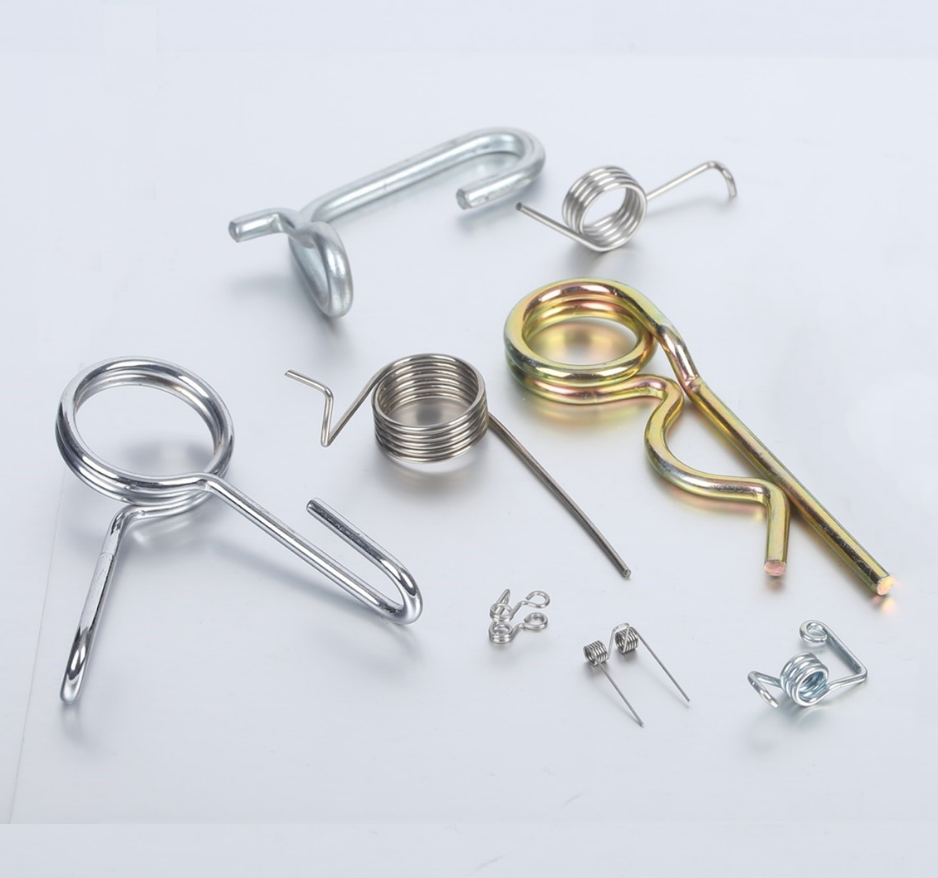
The production of precision torsional components requires strict control over forming, heat treatment, and finishing operations. Manufacturing Double Helix Torsion Springs introduces additional complexity compared to conventional single-wire torsion springs due to dual-coil synchronization requirements.
The process typically begins with raw wire selection. High-carbon spring steel such as SAE 9254 or stainless alloys like SUS304 are commonly used depending on environmental exposure requirements. Wire diameters range from 0.5 mm for miniature mechanisms to over 6 mm for heavy-duty torque systems. Tensile strength values may range from 1200 MPa to 2200 MPa depending on alloy grade and cold drawing level.
The first forming stage is CNC coiling. In double helix production, two synchronized mandrels or a dual-feed coiling system is used to create parallel helical structures. Coil pitch accuracy is critical, with typical tolerances maintained within ±0.05 mm to ±0.2 mm depending on spring size.
During coiling, torsional stress is introduced into the wire. This cold working process increases dislocation density in the metal structure, improving strength but also introducing residual stress. If not properly relieved, this stress can negatively impact fatigue life.
After forming, stress-relief heat treatment is performed. Springs are typically heated to 260°C–450°C and held for 20–60 minutes depending on material thickness. This process stabilizes microstructure and reduces internal stress gradients formed during coiling.
Next, the end legs are shaped and aligned. In double helix systems, leg symmetry is crucial to ensure equal torque distribution between coils. Misalignment greater than 1–2 degrees can lead to uneven load transfer and early fatigue failure in one helix.
Surface finishing follows heat treatment. Common processes include shot peening, polishing, and coating. Shot peening introduces compressive residual stress layers that significantly enhance fatigue resistance. Surface roughness is often controlled below Ra 0.4–1.6 μm for precision applications.
Quality inspection includes torque-angle testing, dimensional verification, and load cycle evaluation. Torque consistency is measured across full angular displacement ranges, typically from 0° to 360° or higher depending on design specification.
In Double Helix Torsion Springs, inspection also includes helix synchronization verification. Both coils must exhibit nearly identical angular response curves under identical loading conditions. Deviation beyond acceptable tolerance may indicate uneven stiffness distribution or forming defects.
Advanced manufacturing systems may use CNC simulation to pre-model coil geometry before production. This reduces material waste and improves repeatability across production batches.
Packaging and handling are also critical, as torsional springs are sensitive to deformation if stored under improper load conditions. Springs are typically stored in a neutral, unloaded state to avoid plastic deformation before installation.
Manufacturing precision directly determines service reliability. Even minor deviations in coil diameter or pitch can significantly alter torque characteristics and fatigue life.

 English
 Arabic
 French
 Spanish
 Portuguese
 Deutsch
 Turkish
 Dutch
Dutch
 Russian
 Romaian
 Portuguese (Brazil)
 Greek
Greek
 Bengali