


Are Ceramic Coatings Better for Cookware?
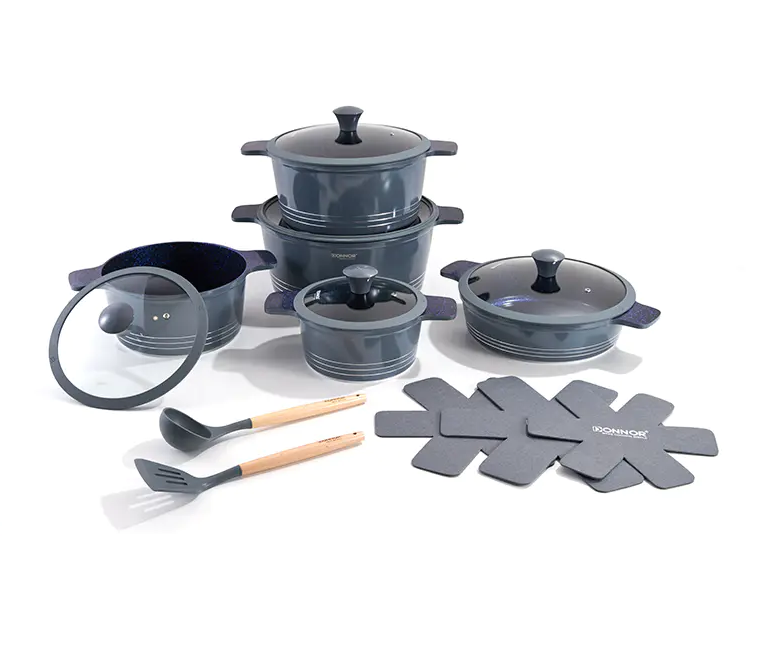
The performance of a die cast aluminum cookware set depends heavily on surface engineering. While aluminum provides the structural and thermal foundation, coatings define food release behavior, durability, and cleaning efficiency.
Most modern cookware uses one of three coating systems: PTFE-based non-stick, ceramic-based sol-gel coatings, or reinforced hybrid coatings. Among these, ceramic coatings have gained significant attention due to their PFAS-free composition and higher heat tolerance.
Ceramic coatings are typically applied through a sol-gel process where silica-based materials are bonded to the aluminum surface. These coatings form a thin inorganic layer that bonds strongly with the base metal. Thickness generally ranges from 20 to 40 microns per layer, and multi-layer systems may include 2–5 layers for added durability.
A key performance factor is heat resistance. Ceramic coatings can generally tolerate temperatures up to around 250–300°C without chemical breakdown. This makes them suitable for sautéing, boiling, and light frying applications. However, long-term exposure to extreme heat can accelerate surface wear.
PTFE-based coatings, commonly used in traditional non-stick cookware, offer strong food release properties. These coatings reduce surface energy significantly, allowing food to slide easily during cooking. However, they require controlled temperature use, typically below 260°C, to maintain stability.
Hybrid coatings combine ceramic particles with reinforced binders or mineral additives. These are designed to improve scratch resistance and extend coating lifespan. Hardness levels in some coatings are measured using pencil hardness tests, often reaching 3H–6H depending on formulation.
Die casting improves coating adhesion due to the uniform aluminum surface. The absence of welding seams or rivets reduces weak points where coatings might separate. Surface preparation processes such as sandblasting or chemical etching further enhance coating bonding strength.
Another important feature is non-stick performance degradation over time. All coatings gradually lose efficiency due to mechanical wear from utensils, cleaning tools, and thermal cycling. Ceramic coatings typically show earlier decline compared to PTFE systems but offer improved heat tolerance.
Cleaning behavior is directly influenced by coating type. Ceramic-coated cookware often allows easy cleaning with mild detergent and soft sponges. Abrasive pads or harsh chemicals can reduce coating lifespan and should be avoided.
Modern cookware designs may also include textured base layers to improve oil distribution. Micro-texturing helps create small air pockets between food and surface, improving release performance even as coatings age.
In summary, coating technology is the defining layer of a die cast aluminum cookware set. It determines not only cooking convenience but also durability, safety, and temperature flexibility. Advances in ceramic and hybrid coatings continue to improve the balance between non-stick performance and thermal resistance.

 English
 Arabic
 French
 Spanish
 Portuguese
 Deutsch
 Turkish
 Italiano
 Russian
 Romaian
 Portuguese (Brazil)
 Greek
Greek
 Bengali