


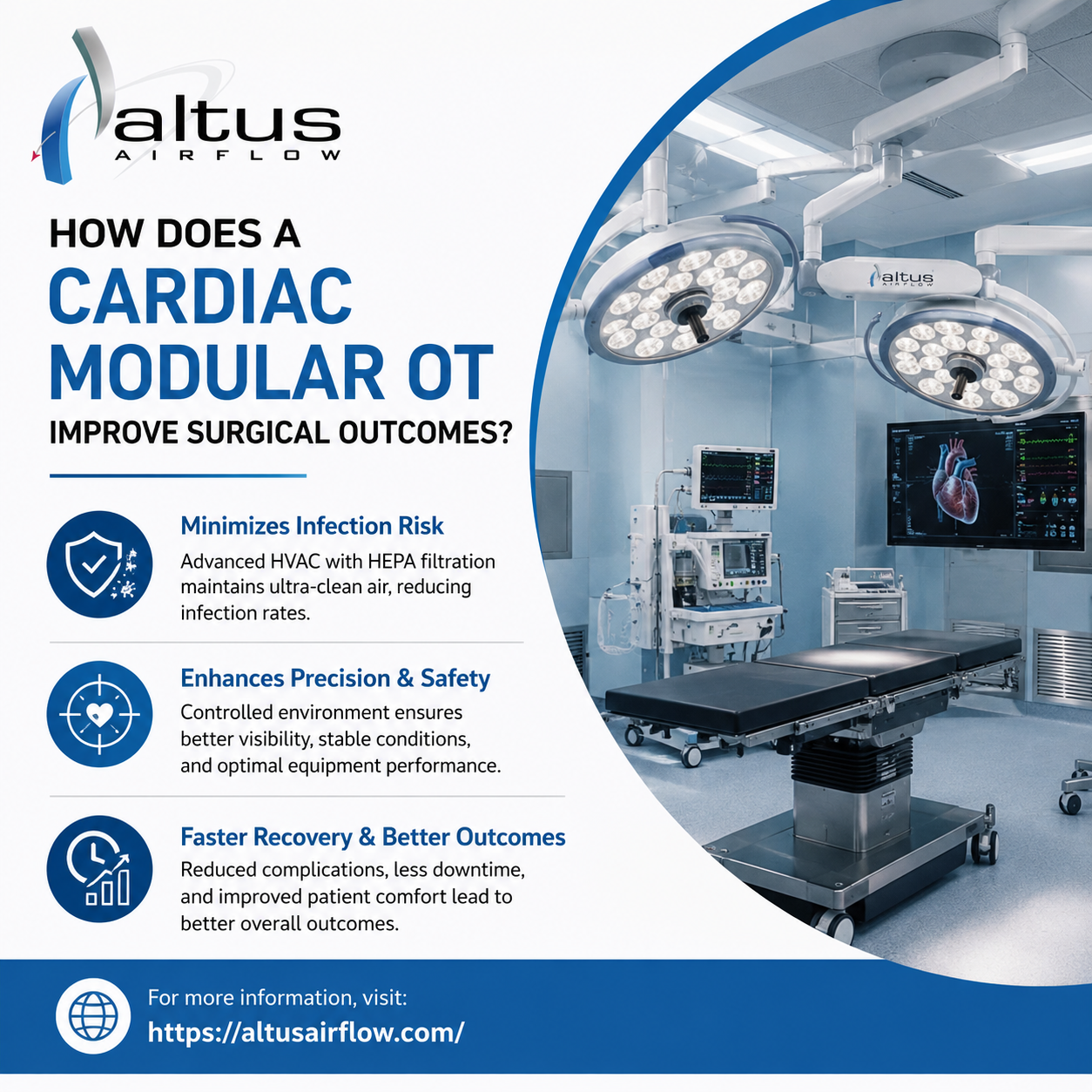
How Does a Cardiac Modular OT Improve Surgical Outcomes?
Introduction
Modern cardiac surgeries require a highly controlled environment where precision, safety, and efficiency work together to ensure successful patient outcomes. As cardiovascular procedures become increasingly complex, hospitals are investing in advanced operation theatre infrastructure that supports both surgical teams and patients. A Cardiac Modular OT With Laminar Airflow is one of the most effective solutions for achieving these goals. Designed with advanced engineering systems, cleanroom technologies, infection-control measures, and integrated medical utilities, modular cardiac OTs create ideal surgical environments that significantly enhance patient safety and operational performance.
Unlike conventional operation theatres, modular cardiac OTs are built using prefabricated panels, advanced HVAC systems, HEPA filtration, laminar airflow technology, and smart environmental controls. These features work together to minimize contamination, improve workflow efficiency, and maintain stable environmental conditions throughout complex procedures. As a result, hospitals can reduce infection risks, improve surgical accuracy, support faster patient recovery, and achieve better overall clinical outcomes.
Understanding Cardiac Modular Operation Theatres
A cardiac modular OT is a specially engineered operation theatre designed to support cardiovascular surgeries.
Its design focuses on:
- Infection control
- Environmental stability
- Advanced technology integration
- Workflow optimization
- Patient safety
These elements contribute directly to improved surgical performance.
Why Surgical Environment Matters
The operating environment can significantly influence surgical outcomes.
Factors such as:
- Air quality
- Temperature
- Humidity
- Equipment accessibility
- Sterility
all affect the success of cardiac procedures.
A controlled environment helps reduce risks and improve procedural consistency.
Enhanced Infection Control
One of the most important benefits of a modular OT is superior infection prevention.
A Cardiac Modular OT With Laminar Airflow incorporates multiple infection-control technologies that help maintain sterile conditions throughout surgery.
Reducing contamination lowers the risk of postoperative complications and surgical site infections.
Role of Laminar Airflow
Laminar airflow systems provide a continuous stream of filtered air across the surgical area.
Benefits include:
- Reduced airborne contaminants
- Consistent airflow patterns
- Improved sterility around the operating table
This technology is especially valuable during lengthy cardiac procedures.
HEPA Filtration for Cleaner Air
HEPA filters are essential components of modern modular OTs.
These filters remove:
- Dust particles
- Bacteria
- Fungal spores
- Airborne contaminants
Cleaner air supports safer surgical conditions and better patient outcomes.
Positive Pressure Environment
Cardiac operation theatres typically operate under positive pressure.
This ensures that:
- Clean air flows outward
- Contaminants remain outside
- Environmental integrity is maintained
Positive pressure helps preserve sterility throughout the procedure.
Reduced Risk of Surgical Site Infections
Surgical site infections can significantly impact patient recovery.
Advanced infection-control systems help:
- Lower infection rates
- Reduce complications
- Improve postoperative outcomes
This is one of the most important advantages of modular OT infrastructure.
Improved Air Quality
Air quality directly affects surgical safety.
Modern HVAC systems maintain:
- Clean air circulation
- Controlled airflow
- Stable environmental conditions
Better air quality supports patient protection and clinical excellence.
Stable Temperature Control
Cardiac surgeries often last several hours.
Maintaining stable temperatures helps:
- Protect patients
- Improve staff comfort
- Support equipment performance
Consistent environmental conditions contribute to procedural success.
Humidity Management
Humidity control plays a vital role in surgical environments.
Proper humidity levels help:
- Minimize microbial growth
- Prevent condensation
- Reduce static electricity
Balanced humidity improves overall OT performance.
Better Support for Complex Procedures
Cardiac surgeries involve intricate techniques and specialized equipment.
Modular OTs provide:
- Organized layouts
- Efficient workflows
- Integrated medical systems
These features help surgical teams perform more effectively.
Advanced Equipment Integration
Modern cardiac OTs accommodate sophisticated medical technologies.
Examples include:
- Cardiac monitoring systems
- Imaging equipment
- Surgical navigation tools
- Anesthesia systems
Proper integration improves operational efficiency.
Improved Workflow Efficiency
A well-designed OT layout reduces unnecessary movement and delays.
Benefits include:
- Faster procedure preparation
- Better staff coordination
- Enhanced productivity
Efficient workflows contribute to improved surgical outcomes.
Enhanced Visibility for Surgeons
Lighting systems in modular OTs are designed to provide optimal illumination.
Features include:
- Shadow-free lighting
- Adjustable intensity
- Accurate color rendering
Better visibility supports surgical precision.
Reduced Procedure Delays
Integrated systems help minimize interruptions during surgery.
This results in:
- Smoother operations
- Faster response times
- Improved procedural consistency
Reduced delays improve patient safety.
Greater Reliability of Medical Systems
Modular operation theatres are designed with dependable infrastructure.
Systems include:
- Medical gas pipelines
- Electrical networks
- Environmental controls
Reliable systems help avoid unexpected disruptions.
Improved Patient Safety
Patient safety is the primary objective of every cardiac OT.
Modular designs support safety through:
- Enhanced sterility
- Environmental control
- Advanced monitoring systems
Safer environments contribute to better clinical outcomes.
Environmental Monitoring Systems
Continuous monitoring ensures that environmental conditions remain within acceptable limits.
Parameters monitored include:
- Air pressure
- Temperature
- Humidity
- Air quality
Real-time monitoring improves quality assurance.
Compliance with Healthcare Standards
Modern modular OTs are designed to comply with strict healthcare regulations.
Compliance supports:
- Infection control
- Patient protection
- Quality management
Following standards helps maintain consistent performance.
Reduced Recovery Time
Patients benefit from cleaner and safer surgical environments.
Advantages may include:
- Fewer complications
- Reduced infection risks
- Faster healing
Improved recovery enhances patient satisfaction.
Better Support for Surgical Teams
A comfortable and efficient working environment helps healthcare professionals perform at their best.
Benefits include:
- Reduced fatigue
- Better concentration
- Improved productivity
Staff performance directly influences surgical outcomes.
Cleanroom Principles in OT Design
Many modular OTs incorporate cleanroom technologies.
These systems focus on:
- Air cleanliness
- Particle control
- Environmental consistency
Cleanroom concepts strengthen infection prevention efforts.
Seamless Hygienic Surfaces
Modular wall and ceiling panels are designed to support cleanliness.
Advantages include:
- Easy cleaning
- Reduced microbial growth
- Improved hygiene
These surfaces help maintain sterile conditions.
Reliable Emergency Systems
Cardiac surgeries require uninterrupted support systems.
Modular OTs include:
- Backup power supplies
- Emergency lighting
- Critical equipment redundancy
These systems enhance patient safety during emergencies.
Long-Term Operational Benefits
Hospitals benefit from modular OT infrastructure through:
- Lower maintenance costs
- Improved efficiency
- Better resource utilization
These advantages contribute to long-term healthcare quality.
Support for Advanced Surgical Techniques
As cardiac surgery continues to evolve, operation theatres must adapt.
Modular OTs provide the flexibility needed to accommodate:
- New technologies
- Advanced procedures
- Future upgrades
This ensures long-term relevance and performance.
Reduced Cross-Contamination Risks
Controlled airflow and environmental management help reduce contamination between different areas.
Benefits include:
- Cleaner surgical environments
- Better infection prevention
- Enhanced patient protection
Cross-contamination control is essential in modern healthcare facilities.
Improved Clinical Outcomes
All elements of modular OT design contribute toward one primary goal: better patient outcomes.
Benefits include:
- Lower infection rates
- Greater surgical precision
- Faster recovery
- Improved safety
These factors collectively enhance healthcare quality.
Future Innovations in Modular Cardiac OTs
Emerging technologies continue to improve surgical environments.
Future developments may include:
- AI-driven environmental controls
- Smart monitoring systems
- Advanced filtration technologies
- Automated maintenance platforms
These innovations will further strengthen patient care.
Why Modular Cardiac OTs Are Transforming Healthcare
A Cardiac Modular OT With Laminar Airflow represents the integration of advanced engineering, environmental control, and healthcare technology.
By combining:
- HEPA filtration
- Laminar airflow
- Smart monitoring
- Cleanroom construction
these facilities create ideal conditions for successful cardiac surgeries.
Conclusion
A well-designed Cardiac Modular OT With Laminar Airflow serves as the foundation for high-quality cardiac care and long-term healthcare excellence. Organizations such as Altus Airflow specialize in developing advanced modular operation theatre solutions that integrate cleanroom engineering, environmental control technologies, and healthcare infrastructure expertise. By partnering with experienced providers like Altus Airflow, hospitals can establish future-ready cardiac OTs that deliver superior surgical outcomes and exceptional patient care.
FAQs
1. How does a Cardiac Modular OT With Laminar Airflow improve surgical outcomes?
A Cardiac Modular OT With Laminar Airflow improves surgical outcomes by reducing airborne contamination, enhancing infection control, maintaining environmental stability, and supporting safer surgical conditions.
2. Why is laminar airflow important in cardiac surgeries?
Laminar airflow provides a continuous flow of filtered air that reduces contamination around the surgical field.
3. How do HEPA filters contribute to patient safety?
HEPA filters remove airborne particles, bacteria, and contaminants, helping maintain clean air quality.
4. What role does HVAC play in a modular cardiac OT?
HVAC systems regulate temperature, humidity, airflow, and air cleanliness to create a controlled surgical environment.
5. Can modular OTs reduce infection risks?
Yes, advanced infection-control systems significantly reduce the risk of surgical site infections.
Read Our Previous Blog --------->What role does HVAC play in andrology room design?

 Arabic
 French
 Spanish
 Portuguese
 Deutsch
 Turkish
 Dutch
Dutch
 Italiano
 Russian
 Romaian
 Portuguese (Brazil)
 Greek
Greek
 Bengali