


Why Businesses Are Switching to Modern HR Software
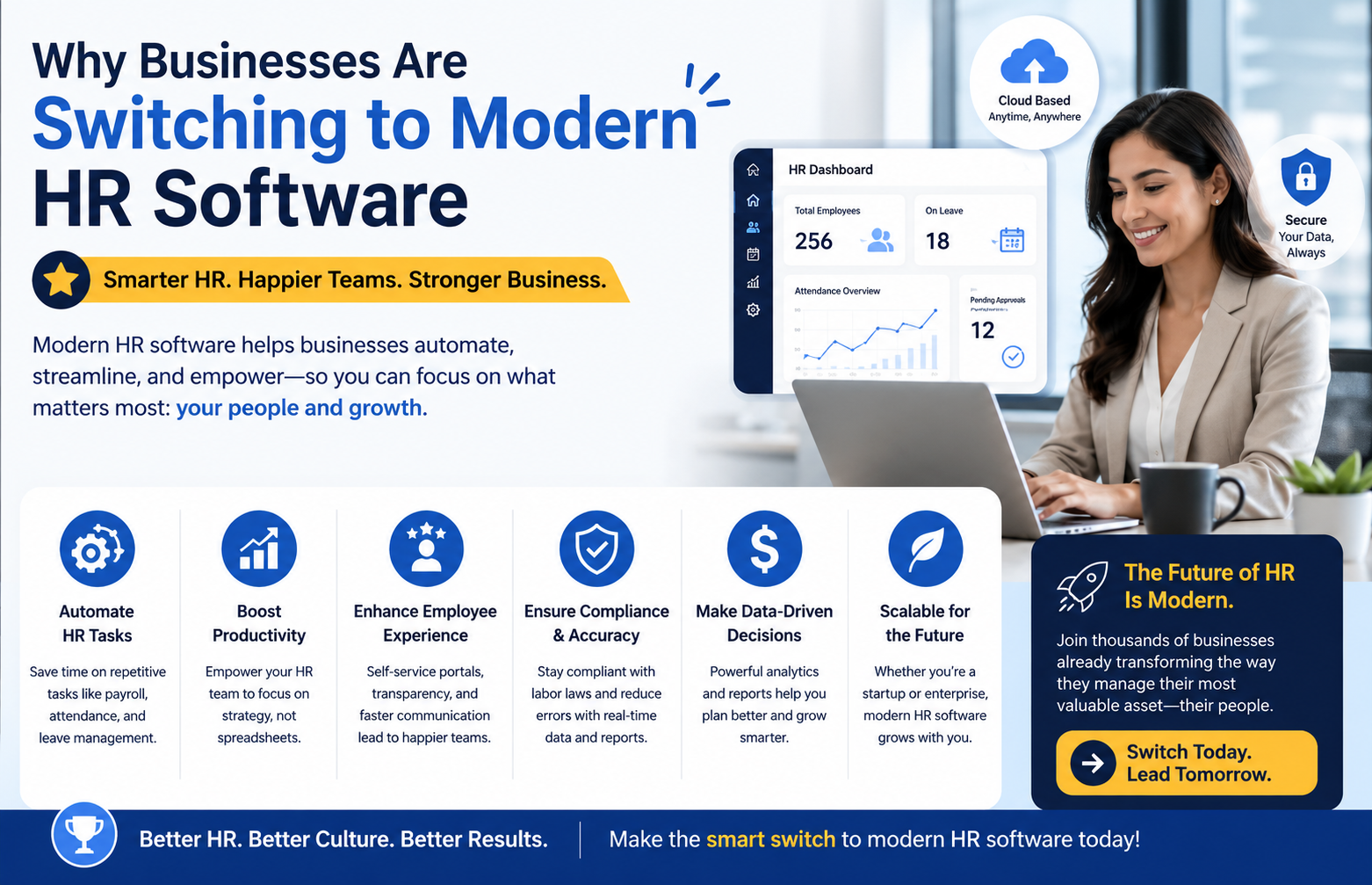
Modern workplaces are changing quickly. As teams become more distributed and business operations grow more complex, traditional HR methods are no longer enough to manage employees efficiently. This is why many organisations are shifting toward modern HR software to simplify processes, improve accuracy, and create better employee experiences.
This article explains the key reasons behind this shift and how modern HR systems are transforming workforce management.
What is Modern HR Software?
Modern HR software is an advanced, cloud-based version of traditional HR systems. It is designed for today’s digital and flexible work environment, where employees may work from office, home, or anywhere in the world.
Unlike older systems, modern HR software focuses on automation, user experience, and real-time access.
Key features of modern HR software include:
- Cloud-based access from any device
- Automated payroll and compliance
- Employee self-service portals
- Real-time analytics and reporting
- Integration with other business tools
- Strong data security and backups
- Support for remote and hybrid teams
Growing Complexity in Workforce Management
Today’s businesses manage more than just attendance and payroll. HR teams handle recruitment, onboarding, performance tracking, compliance, training, and employee engagement—all at once.
Manual systems or spreadsheets often fail to keep up with this complexity. They lead to errors, delays, and miscommunication. Modern HR software centralizes all HR activities into one system, making it easier to manage employees from hire to retirement.
Need for Faster and More Accurate Processes
Speed and accuracy are critical in HR operations. Whether it is processing salaries or tracking leave requests, delays can affect employee satisfaction.
Modern HR software automates repetitive tasks such as:
- Payroll calculations
- Attendance tracking
- Leave approvals
- Tax and compliance reporting
Automation reduces human error and ensures that HR teams can focus on more strategic tasks instead of routine paperwork.
Improved Employee Experience
Employee experience has become a top priority for organizations. Employees now expect quick responses, transparent systems, and easy access to their HR information.
Modern HR software provides self-service portals where employees can:
- Apply for leave instantly
- Download payslips
- Update personal information
- Track attendance and performance
This level of transparency improves trust and reduces dependency on HR departments for small queries.
Remote and Hybrid Work Adaptation
The rise of remote and hybrid work has changed how businesses operate. Traditional HR methods are not designed for distributed teams.
Modern HR software supports remote work by offering cloud-based access. Employees and managers can collaborate from anywhere, ensuring smooth communication and workflow management regardless of location.
This flexibility has become a major reason for businesses upgrading their HR systems.
Better Compliance and Risk Management
Compliance with labor laws, tax regulations, and internal policies is essential for every organization. However, keeping up with changing regulations manually is difficult and risky.
Modern HR software helps businesses stay compliant by:
- Automatically updating regulatory changes
- Generating accurate compliance reports
- Maintaining proper employee records
- Reducing legal and financial risks
This ensures that companies avoid penalties and maintain proper governance.
Data-Driven Decision-Making
One of the biggest advantages of modern HR software is access to real-time data and analytics.
HR teams can track:
- Employee performance trends
- Turnover rates
- Attendance patterns
- Hiring efficiency
- Training effectiveness
These insights help management make informed decisions about workforce planning, employee development, and organizational growth.
Instead of guessing, businesses can rely on data to improve HR strategies.
Scalable Solutions for Growing Businesses
As companies expand, HR processes become more complicated. Adding more employees means more administrative work.
Modern HR software is designed to scale with business growth. Whether a company has 10 employees or 10,000, the system can handle increasing workloads without reducing efficiency.
This scalability makes it a long-term investment for growing organisations.
Cost Efficiency and Resource Optimisation
Although implementing HR software may seem like an investment, it reduces long-term operational costs.
Businesses save money by:
- Reducing paperwork and manual work
- Minimising payroll errors
- Improving workforce productivity
- Lowering administrative overhead
HR teams can also focus on strategic initiatives rather than spending time on repetitive tasks.
Stronger Security of Employee Data
Employee data includes sensitive information such as salaries, personal details, and tax records. Keeping this data secure is critical.
Modern HR software uses:
- Data encryption
- Role-based access control
- Secure cloud storage
- Regular backups
This ensures that employee information is protected from unauthorised access and data loss.
Enhanced Recruitment and Onboarding
Hiring the right talent quickly is essential for business success. Modern HR tools streamline recruitment by:
- Posting job openings across platforms
- Tracking applicants in one system
- Automating interview scheduling
- Managing onboarding workflows
This improves hiring efficiency and ensures new employees have a smooth onboarding experience.
How Modern HR Software is Different
Traditional HR systems are often manual, slow, and limited to basic record-keeping. Modern HR software, on the other hand, is built to handle complex and growing business needs.
Here’s a simple comparison:
- Traditional HR: Paperwork, manual calculations, limited access
- Modern HR: Automated processes, cloud access, real-time data
Modern HR software not only manages HR tasks but also improves decision-making through data insights and enhances employee experience through self-service features.
Conclusion
The shift toward modern HR software is not just a trend—it is a necessary transformation for businesses that want to stay competitive. From automation and compliance to employee experience and data-driven decision-making, these systems offer significant advantages over traditional methods.
As organisations continue to grow and adapt to changing work environments, modern HR software will remain a key tool for building efficient, scalable, and people-focused workplaces.
Frequently Asked Questions (FAQs)
1. What is modern HR software?
Modern HR software is a digital system that helps businesses manage HR tasks like payroll, attendance, recruitment, onboarding, and employee data in one platform.
2. Why are companies switching to HR software?
Companies switch to HR software to reduce manual work, improve accuracy, save time, ensure compliance, and enhance employee experience.
3. Is HR software suitable for small businesses?
Yes, many HR software solutions are designed for small businesses and can scale as the company grows.
4. How does HR software improve employee experience?
It provides self-service features like leave applications, payslip access, and personal data updates, making processes faster and more transparent.
5. Is HR software secure for employee data?
Yes, most modern HR systems use encryption, secure cloud storage, and access controls to protect sensitive employee information.

 English
 Arabic
 French
 Spanish
 Portuguese
 Deutsch
 Turkish
 Dutch
Dutch
 Italiano
 Russian
 Portuguese (Brazil)
 Greek
Greek
 Bengali