


Transforming Business Operations with ServiceNow Workflow Automation
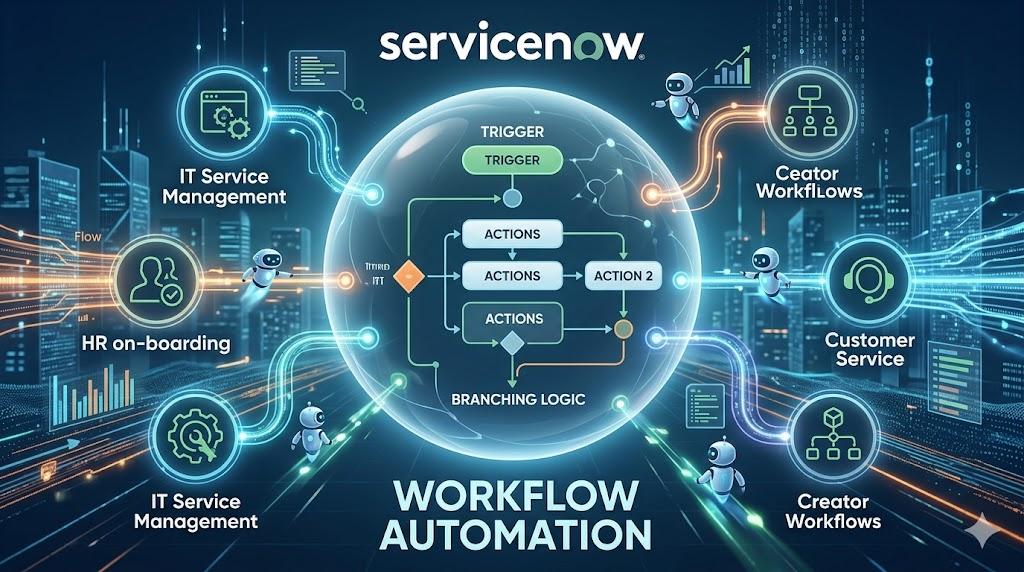
ServiceNow workflow automation is a cornerstone of modern digital transformation, enabling organizations to streamline processes, reduce manual effort, and improve overall efficiency. As businesses increasingly adopt cloud-based solutions, ServiceNow has emerged as a leading platform that connects people, processes, and systems through intelligent workflows.
At its core, ServiceNow workflow automation focuses on digitizing routine tasks and orchestrating complex business processes across departments. Instead of relying on emails, spreadsheets, or manual handoffs, organizations can design automated workflows that ensure tasks move seamlessly from one stage to another. This not only saves time but also minimizes human error and enhances accountability.
One of the key strengths of ServiceNow is its unified platform. It allows businesses to build workflows across various functions such as IT service management (ITSM), human resources (HR), customer service, and security operations. For example, in ITSM, incident management workflows can automatically assign tickets, escalate issues based on priority, and notify stakeholders in real time. This leads to faster resolution times and improved service quality.
Another important aspect of ServiceNow workflow automation is its low-code and no-code capabilities. The platform provides tools like Workflow Editor and Flow Designer, which enable both developers and non-technical users to create workflows with minimal coding. This democratization of automation empowers business teams to innovate and optimize their processes without heavily relying on IT departments.
ServiceNow also integrates advanced technologies such as artificial intelligence (AI) and machine learning. These capabilities enhance workflow automation by enabling predictive analytics, intelligent recommendations, and automated decision-making. For instance, AI can analyze historical data to predict potential issues and trigger preventive actions before they impact operations. This proactive approach significantly improves operational efficiency.
Integration is another critical feature of ServiceNow workflow automation. The platform can connect with third-party applications, legacy systems, and external data sources through APIs and integration hubs. This ensures that workflows are not siloed but instead operate across the entire enterprise ecosystem. As a result, organizations can achieve end-to-end automation and gain better visibility into their processes.
Employee experience is greatly enhanced through ServiceNow workflows. Automated onboarding processes, for example, can handle tasks such as account creation, equipment allocation, and training schedules. This creates a smooth and consistent experience for new hires while reducing administrative overhead. Similarly, HR service delivery workflows can streamline leave requests, benefits management, and employee inquiries.
Customer service is another area where ServiceNow workflow automation delivers significant value. Automated case management workflows ensure that customer queries are routed to the right agents, responses are timely, and issues are resolved efficiently. With the integration of AI-powered chatbots and virtual agents, businesses can provide 24/7 support and improve customer satisfaction.
Security and compliance also benefit from workflow automation. ServiceNow enables organizations to automate security incident response, vulnerability management, and compliance checks. This reduces the risk of breaches and ensures that regulatory requirements are consistently met. Automated workflows can quickly identify threats, assign tasks to security teams, and track remediation efforts.
Moreover, ServiceNow workflow automation supports scalability and adaptability. As businesses grow and evolve, their processes can be easily modified or expanded within the platform. This flexibility allows organizations to respond quickly to changing market conditions and business needs without significant disruptions.
From a strategic perspective, workflow automation with ServiceNow drives cost savings and operational excellence. By eliminating repetitive tasks and improving process efficiency, organizations can allocate resources more effectively and focus on high-value activities. Additionally, real-time analytics and reporting provide insights into workflow performance, helping businesses identify bottlenecks and continuously improve.
In conclusion, ServiceNow workflow automation is a powerful solution that transforms how organizations operate. By combining a unified platform, low-code capabilities, AI-driven intelligence, and seamless integration, it enables businesses to automate processes, enhance productivity, and deliver superior experiences. As digital transformation continues to accelerate, adopting ServiceNow workflow automation is no longer optional but essential for organizations aiming to stay competitive in today’s dynamic environment.

 English
 Arabic
 Spanish
 Portuguese
 Deutsch
 Turkish
 Dutch
Dutch
 Italiano
 Russian
 Romaian
 Portuguese (Brazil)
 Greek
Greek
 Bengali