


KP Automations Pasta Machines: Why Die Temperature Stability Affects Product Quality in Industrial Pasta Production
Sometimes the Shape Looks Right, but the Quality Still Feels Off
A lot of manufacturers focus on extrusion pressure and screw speed.
And yes, both matter.
But honestly, one factor that often gets overlooked is die temperature stability.
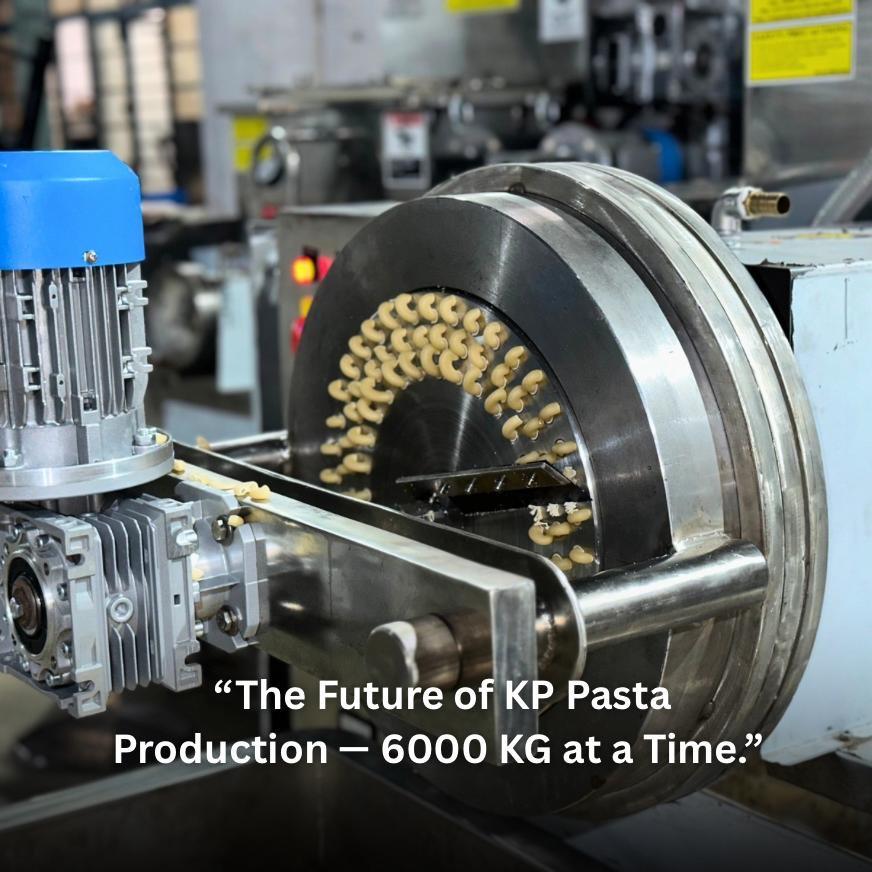
The die is the final shaping point in the pasta extrusion machine.
So even if the dough preparation is perfect, unstable die temperature can still change the final result.
If you ask me, this is one of those hidden variables that directly affects product shape, texture, and consistency.
What Die Temperature Stability Actually Means
Let’s keep it simple.
Die temperature stability means maintaining a steady thermal condition at the die head while the dough is being extruded.
The goal is to keep the product flow smooth and predictable.
In industrial pasta machines, even a small temperature shift at this stage can change how the dough exits.
You’ll notice what stands out is uniformity.
Stable die temperature usually means stable product dimensions.
Why It Matters in the Pasta Extrusion Machine
The pasta extrusion machine pushes dough through the die under controlled pressure.
Now, if the die gets too warm, the dough may soften more than expected right at the exit.
That can slightly change the shape.
If it gets too cool, resistance increases.
This may affect edge sharpness and thickness consistency.
In industrial pasta machines, the die section needs thermal balance to maintain product precision.
Honestly, this is where many subtle defects begin.
Better Shape Retention and Edge Definition
Here’s something practical.
Stable die temperature helps maintain clean product geometry.
Whether it’s spaghetti, macaroni, or penne, the edges stay sharper and the thickness remains more consistent.
For large-volume production, this becomes a major quality factor.
Simple thermal stability, visible product improvement.
Surface Finish Also Improves
This part often gets overlooked.
The way the product exits the die also affects its surface texture.
A stable die temperature helps create a smoother and more uniform finish.
That matters both for visual quality and for how the pasta behaves in later stages.
Honestly, customers may notice this even if they don’t know the reason behind it.
Pressure Stability and Mechanical Load
Die temperature also influences extrusion load.
If the die temperature fluctuates, the internal resistance changes.
That directly affects pressure stability and motor load.
In industrial pasta machines, maintaining stable die temperature helps reduce sudden torque spikes and wear.
So yes, this is also a machine-protection factor.
Drying Stage Benefits Too
Now move one stage ahead.
The pasta drying system performs better when the product dimensions and density remain uniform.
Stable die temperature supports consistent shape and thickness.
That helps industrial pasta dryer systems remove moisture more evenly.
Less cracking.
Better shelf life.
Better texture.
Better Flow Across the Pasta Production Line
In a complete pasta production line, stable die output improves the entire downstream flow.
Conveyor spacing becomes more predictable.
Drying loads remain balanced.
The pasta packing machine receives a more consistent product stream.
One small control point, full-line benefit.
Real Factory Situation: Continuous Run Heat Build-Up
Let’s be real.
In industrial setups around G.B D-372, D Block, Sector 10, Noida, Uttar Pradesh 201301, long continuous production runs naturally increase heat near the die head.
Without monitoring, the temperature may gradually drift.
That’s where operators often start noticing small shape variations.
And if technical support is needed, teams are usually reachable at +91 9310738142 or kpautomations372@gmail.com.
Better Output with Less Rejection
This is where it becomes commercially important.
Stable die temperature reduces rejected batches.
Better dimensional consistency.
Less drying variation.
Lower packaging rejection.
Honestly, it directly improves usable daily output.
Choosing Machines with Better Die Thermal Control
If you’re planning to invest, don’t just compare pasta making machine price.
Check whether the system offers die temperature monitoring and controlled cooling or heating support.
Some industrial pasta making machine setups provide advanced die-zone thermal control.
That makes consistent production much easier.
Where the Industry Is Heading
Modern automatic pasta making machine systems are moving toward sensor-based die temperature monitoring.
Real-time thermal feedback and recipe-based control settings are becoming more common.
Not every plant uses it yet.
But honestly, this is clearly where the industry is moving.
Final Thoughts
Die temperature stability may sound like a small technical detail, but in industrial pasta machines, it directly affects shape accuracy, surface quality, and full-line consistency.
From extrusion precision to drying performance and final packaging, its impact is significant.
If you’re running or planning a production line, this is definitely something worth focusing on.
Because sometimes the smallest temperature change makes the biggest visible difference.

 English
 Arabic
 French
 Portuguese
 Deutsch
 Turkish
 Dutch
Dutch
 Italiano
 Russian
 Romaian
 Portuguese (Brazil)
 Greek
Greek
 Bengali