


Tamper-proof Fasteners Market to Reach USD 4.6 Billion by 2036, with Germany in Front
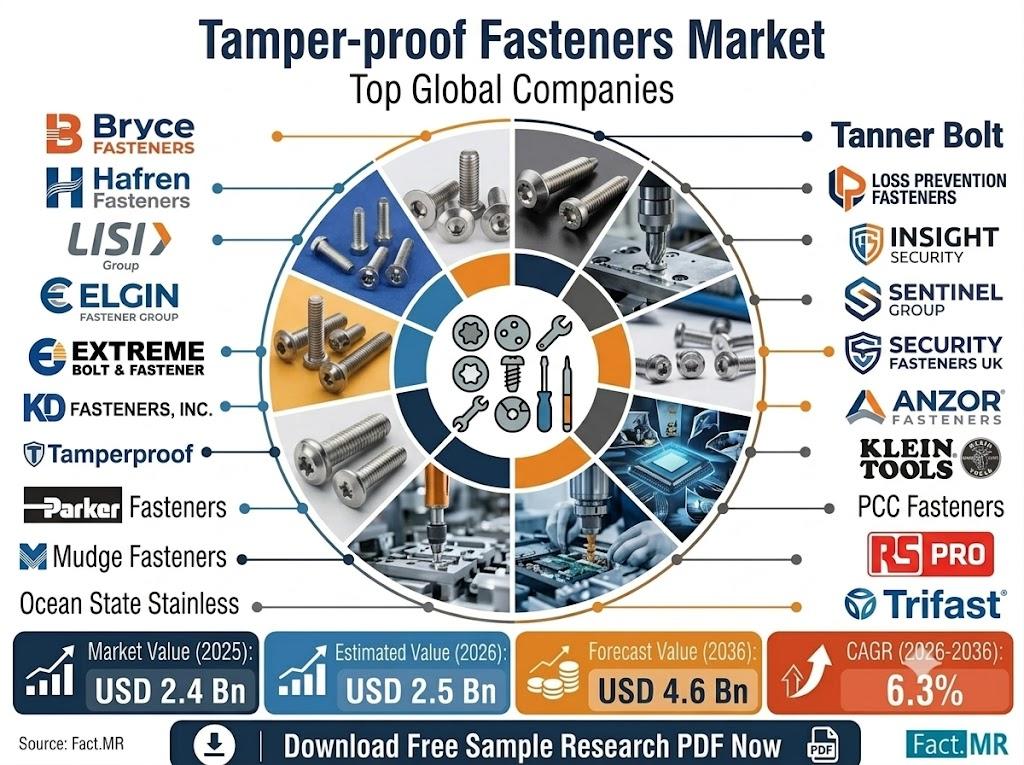
The global tamper-proof fasteners market is projected to grow from USD 2.5 billion in 2026 to USD 4.6 billion by 2036, expanding at a compound annual growth rate (CAGR) of 6.3%, according to Fact.MR. The market was valued at USD 2.4 billion in 2025. The forecast represents an incremental opportunity of USD 2.1 billion between 2026 and 2036.
Demand is being supported by the need to restrict unauthorized access to equipment enclosures, machinery guards, transport assets and exposed infrastructure. Manufacturers and asset operators are increasingly evaluating fastening systems not only for mechanical performance but also for removal control, material durability, maintenance access and long-term component availability.
Get detailed market forecasts, competitive benchmarking, and pricing trends: https://www.factmr.com/connectus/sample?flag=S&rep_id=7531
Regulatory and standards context
Machinery guarding and physical hardware protection provide practical reasons to specify security fasteners. Regulation (EU) 2023/1230 on machinery establishes requirements concerning machinery safety, including the design and securing of guards. Its provisions are relevant when manufacturers select fastening arrangements that permit authorized maintenance while discouraging unintended removal.
In information-system security, the National Institute of Standards and Technology's Security and Privacy Controls for Information Systems and Organizations, SP 800-53 Revision 5 (2020), includes physical-access controls and an enhancement addressing tamper protection for selected hardware components. The applicability of particular controls depends on the system and its security requirements.
Material selection is another consideration. ISO 3506-1 addresses mechanical and physical properties of corrosion-resistant stainless-steel bolts, screws and studs, while ISO 3506-6 provides general rules for selecting stainless steels and nickel alloys for fasteners. These standards help engineers assess material suitability for exposed and maintenance-intensive installations.
Where growth is fastest
Fact.MR's country forecasts indicate that Germany leads the five profiled markets by projected CAGR.
- Germany: The market is forecast to expand at a 7.3% CAGR from 2026 to 2036. Vehicle manufacturing, railway renewal and investment in non-residential structures support demand across transport equipment, industrial machinery and exposed infrastructure.
- Brazil: A 6.6% CAGR is projected. Infrastructure and mobility programs are expanding the installed base of public and transport assets where durable hardware and controlled maintenance access can be important.
- USA: The market is forecast to grow at a 6.0% CAGR. Rail infrastructure investment and formal guidance on physical hardware protection support demand in transportation and secured equipment enclosures.
- UK: A 5.4% CAGR is projected. Infrastructure investment and Network Rail's 2024–2029 Control Period 7 maintenance and renewal program support demand for serviceable, tamper-resistant fastening systems.
- Japan: The market is forecast to grow at a 4.7% CAGR. The country's established manufacturing base supports applications across machinery, electronics, fabricated metals and transportation equipment.
What leads the market
The 2026 segment forecasts identify screws, stainless steel, transportation, industrial manufacturing, direct sales and tamper resistance as leading categories.
- Product — Tamper-proof screws: A projected 29.4% share in 2026. Screws suit panels, equipment housings, brackets and access covers, often allowing security upgrades without redesigning the entire joint.
- Material — Stainless-steel fasteners: A projected 38.7% share. Corrosion resistance supports applications exposed to moisture, cleaning processes, outdoor conditions and extended service intervals.
- Application — Transportation: A projected 33.6% share. Vehicles, rail systems and associated infrastructure require fastening solutions that balance resistance to unauthorized removal with authorized servicing.
- End use — Industrial manufacturing: A projected 27.9% share. Machine guards, electrical cabinets, equipment housings and inspection covers create demand for controlled-access fastening.
- Distribution channel — Direct sales: A projected 54.8% share. OEM relationships support custom dimensions, specified drive patterns, material requirements and consistent replenishment.
- Function — Tamper resistance: A projected 41.2% share. Preventing unauthorized removal is a broad requirement across public assets, industrial equipment and secured enclosures.
The hurdle: Cost and tool management
Higher unit costs than conventional fasteners remain a constraint, particularly where unauthorized access presents little risk. Specialized driver tools also require purchasing controls, inventory management and planning for future maintenance.
Security can weaken if restricted tools become widely available. Buyers therefore need to match the fastening design to the actual threat, considering whether the application requires basic deterrence, controlled access or a more permanent joint.
For maintenance-intensive installations, an overly restrictive design can also complicate authorized repairs. The specification should account for removal procedures, replacement availability and the needs of field-service teams.
Industry investment and competitive positioning
The supplied market material identifies several dated policy, standards and infrastructure references relevant to demand. These establish the operating context rather than proving that any particular development was caused by the market forecast.
- 2020 — NIST SP 800-53 Revision 5: Provides a framework of security and privacy controls, including physical-access controls relevant to protecting selected hardware components.
- 2023 — Regulation (EU) 2023/1230 on machinery: Establishes EU machinery requirements relevant to machinery design and guarding.
- 2024–2029 — Network Rail Control Period 7: Covers the operation, maintenance and renewal of Britain's mainline railway infrastructure, creating a planning framework for railway asset upkeep.
The companies profiled in the supplied material include Anzor Fasteners, Bryce Fasteners, Electronics Fasteners, Elgin Fastener Group, Extreme Bolt & Fastener, GHS Fasteners, Hafren Fasteners, Insight Security, KD FASTENERS, INC., Klein Tools, LISI Group, Loss Prevention Fasteners, MCP Fixings, Mudge Fasteners, Ocean State Stainless, Inc., Parker Fasteners, PCC Fasteners, RS Pro, Security Fasteners UK, Sentinel Group, Tamperproof, Tamper-Pruf Screws, Inc., Tanner Bolt, Trifast and Zoro UK.
Competition spans standard security-drive designs, specialized drive geometries, stainless-steel products, permanent fastening options and engineered components for demanding applications. The supplied material describes Bryce Fasteners' proprietary drive systems, Tamperproof Screw Co.'s range of security fastener styles and PCC Fasteners' engineered fastening systems for aerospace and defense. These examples illustrate different product approaches; they should not be interpreted as endorsements or independently verified assessments of market position.
Analyst opinion
Shambhu Nath Jha, Senior Consultant, Fact.MR, states:
“Tamper-proof fasteners are moving from niche security hardware into routine specification work for exposed equipment, transport assets and controlled-access machinery. Buyers are looking beyond a difficult-to-remove screw head. They need the right material, repeatable drive geometry, matching tools, field serviceability and confidence that the same part will remain available through the maintenance cycle. Suppliers that can combine security design with dependable OEM and distributor support are better aligned with long-term demand.”
What this means for OEMs, procurement teams and asset operators
- Specify the required level of security. Distinguish between deterrent fasteners, controlled-access designs and permanent or one-way options. Match the design to the risk of unauthorized access rather than applying premium hardware to every joint.
- Plan maintenance access before installation. Define who can access the required driver tools, how authorized removal will work and how compatible replacement parts will be obtained. This is particularly important for distributed service teams and long-lived transport or infrastructure assets.
- Balance material performance with supply continuity. Select stainless-steel grades according to the exposure conditions and evaluate custom dimensions, tool compatibility, replenishment arrangements and long-term availability together. Direct OEM supply may be useful when substitution could disrupt assembly or maintenance.
Top Trending Reports:
Thermal Ceramics Market Forecast 2026-2036: Market to Reach USD 17.0 Billion by 2035 with a Steady 7.3% CAGR https://www.openpr.com/news/4402982/thermal-ceramics-market-forecast-2026-2036-market-to-reach-usd
"Quick-Release Aircraft Interior Fasteners Market to Reach USD 321 Million by 2036; Quarter-Turn Segment Leads at 5.4% CAGR
https://www.openpr.com/news/4402939/quick-release-aircraft-interior-fasteners-market-to-reach-usd
"Reusable Aircraft Cabin Panel Fasteners Market Forecast 2026-2036: Market to Reach USD 336 Million at 4.8 % CAGR https://www.openpr.com/news/4402954/reusable-aircraft-cabin-panel-fasteners-market-forecast
About Fact MR
Fact MR is an ESOMAR-certified market research and consulting firm headquartered in Delaware, USA, with offices in the United Kingdom, the United Arab Emirates and India. FMI delivers syndicated and custom research across food and beverage, healthcare, chemicals, technology, packaging, consumer goods and industrial sectors.

 English
 Arabic
 French
 Portuguese
 Deutsch
 Turkish
 Dutch
Dutch
 Italiano
 Russian
 Romaian
 Portuguese (Brazil)
 Greek
Greek
 Bengali