


ODC cargo transport India
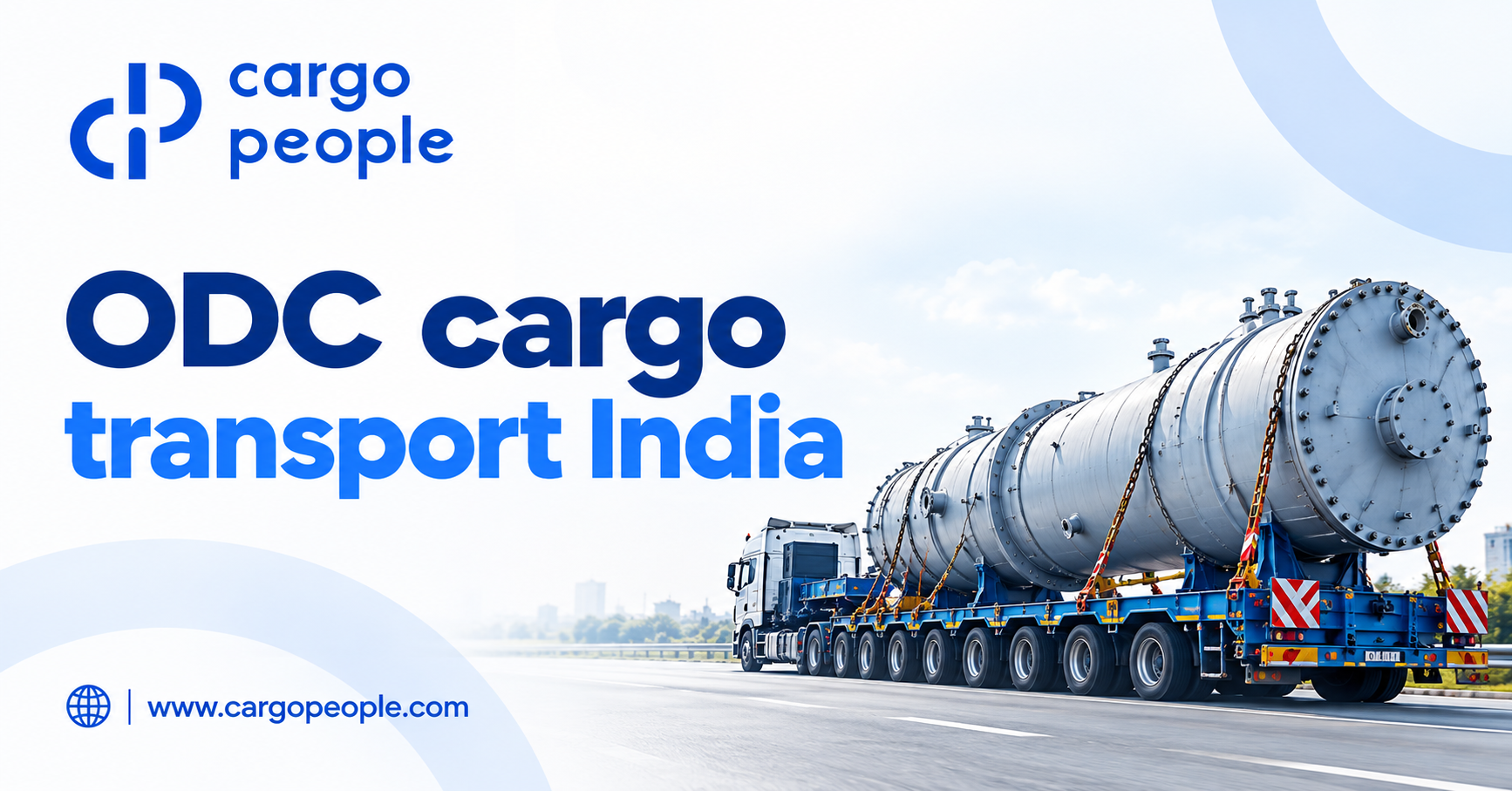
ODC cargo transport in India requires careful planning because over-dimensional cargo cannot be handled like standard freight. Large machinery, transformers, boilers, industrial structures, plant equipment and project cargo may exceed normal road dimensions, axle limits or container sizes.
For manufacturers, EPC companies, project developers, importers and exporters, the real challenge is not simply moving the cargo from one location to another. The movement may require route surveys, specialised trailers, lifting plans, permit coordination, port handling, Customs clearance and final-site preparation.
A well-planned ODC cargo transport India movement usually follows this sequence:
Cargo assessment - route survey - trailer selection - permit planning - port or factory coordination - heavy transport - site delivery
Starting this process early can reduce delays, equipment standby and unexpected cost.
What Is ODC Cargo?
ODC stands for Over Dimensional Cargo.
It refers to cargo that exceeds the standard dimensions or weight limits normally handled by regular transportation equipment.
Typical examples include heavy machinery, transformers, pressure vessels, large generators, steel structures, plant modules and oversized industrial equipment.
The exact transport method depends on the packed dimensions, gross weight, centre of gravity and final delivery location.
Packed dimensions are especially important.
For example, a machine may be 4.0 metres high in its bare form. Once placed on a 0.5 metre skid and loaded on a trailer with an 0.8 metre deck height, the total movement height becomes approximately 5.3 metres.
That height can determine whether the cargo can pass under bridges, flyovers, overhead utility lines and other road structures.
Why ODC Cargo Transport Is Important
ODC cargo is often linked to large industrial projects.
A delay in one heavy machine can hold up the commissioning of an entire plant.
For example, if a ₹30 crore production line cannot start because one imported machine is stuck in transit for 5 days, the commercial impact can be much higher than the transport cost itself.
This is why ODC logistics should be treated as a project rather than a normal trucking assignment.
The route should be checked before the trailer is finalised.
The unloading plan should be confirmed before cargo reaches the site.
If the shipment is imported, the Indian port should also be selected based on inland feasibility and not only ocean freight.
Good ODC planning is therefore about controlling both risk and project schedule.
Who Needs ODC Cargo Transport Services?
ODC transportation is commonly required by industrial and infrastructure businesses.
Manufacturers may need to move large machines from ports to factories.
EPC companies may need transport support for power plants, refineries, cement plants, steel plants or infrastructure projects.
Renewable-energy companies may move wind components, solar equipment or heavy power systems.
Typical users include:
- manufacturing companies
- EPC contractors
- project developers
- heavy engineering companies
Importers and exporters also need ODC support when the cargo cannot fit into normal containers or move on standard trailers.
For these businesses, logistics planning should begin before the cargo is packed.
Cargo Assessment Comes First
The first stage is to collect accurate technical information.
The transport team usually needs the packed length, width, height and gross weight.
Centre of gravity is also important because it affects trailer stability and lifting.
For complex cargo, the team may also require:
- General Arrangement drawings
- lifting points
- support points
- packing drawings
The packed dimensions should always be used.
This sounds simple, but many ODC problems begin when the transporter receives the bare-machine dimensions instead of the final packed dimensions.
Even a 20 cm difference can affect route feasibility.
For heavy or tall cargo, accurate dimensions are not optional. They are the foundation of the entire movement plan.
Route Survey for ODC Cargo Transport India
A route survey is one of the most important parts of ODC movement.
The survey checks whether the cargo can physically travel from the origin point to the final destination.
The team may inspect road width, bridge clearance, sharp turns, gradients, toll plazas, culverts, power lines and overhead structures.
Bridge loading can also become important for very heavy cargo.
For complex routes, a survey may take around 2 to 7 days or more.
The survey may identify temporary work that needs to be completed before movement.
For example, a signboard may need to be removed, traffic may need to be diverted or a utility line may require coordination.
It is much cheaper to identify these issues before the trailer starts moving.
Choosing the Right Trailer for ODC Cargo
The correct trailer depends on the cargo size, weight and road conditions.
Low-bed trailers are commonly used for tall machinery because the lower deck reduces total movement height.
Extendable trailers can be useful for long cargo.
Hydraulic multi-axle trailers are used for heavy loads where weight needs to be distributed across several axles.
For extremely heavy or complex equipment, SPMTs may be required.
The trailer should not be selected only on price.
A cheaper trailer may create route problems or safety risk.
For example, saving ₹40,000 on equipment is not useful if the loaded height becomes too high to pass under a bridge.
The right trailer is the one that matches both the cargo and the route.
Port Planning for Imported ODC Cargo
For imported project cargo, port selection can materially affect the total transport cost.
JNPA, Mundra, Kandla, Chennai and other Indian ports can handle oversized or project cargo depending on vessel service and infrastructure.
The lowest ocean freight rate should not automatically decide the port.
Suppose one port offers freight that is ₹1 lakh cheaper.
If the inland ODC transport from that port costs ₹3 lakh more, the overall option becomes more expensive.
The better comparison should include:
ocean freight + port handling + crane cost + Customs + inland ODC transport + route preparation
For oversized cargo, inland movement can represent a large share of the total logistics budget.
Sea Freight Options for ODC Cargo
Oversized cargo cannot always move inside a standard container.
Depending on size and weight, businesses may use Flat Rack, Open Top, Breakbulk, RoRo or heavy-lift shipping.
Flat Rack containers are useful when cargo exceeds normal container width or height.
Open Top containers are suitable where top loading is required or height exceeds standard limits.
Breakbulk is used when the equipment is too large for containerised movement.
RoRo can work for wheeled machinery and transportable equipment.
Heavy-lift vessels may be required for extremely large or heavy pieces.
The right shipping method should be selected after reviewing the dimensions and Indian port handling capability.
Customs Clearance for ODC Cargo in India
Imported ODC cargo still needs standard Indian Customs clearance.
The usual import documents include the Commercial Invoice, Packing List, Bill of Lading and Bill of Entry.
Technical drawings and product catalogues may also help support HS classification.
For oversized machinery, the Customs broker should understand the equipment before filing.
If the description is too generic, Customs may ask for clarification.
For well-prepared shipments, businesses may plan around 2 to 4 days for straightforward clearance, although examination or regulatory queries can increase the timeline.
The key is to prepare the Customs file before vessel arrival.
If a heavy trailer and crane are already waiting while the broker is still collecting technical documents, standby costs can rise quickly.
Documents Required for ODC Cargo Transport
ODC movements usually need both commercial and technical documents.
A typical file may include:
DocumentPurposeCommercial InvoiceCustoms value and equipment detailsPacking ListWeight, dimensions and packagesBill of LadingMain sea transport documentBill of EntryIndian Customs filingGA DrawingEquipment dimensions and layoutPacking DrawingFinal packed dimensionsRoute Survey ReportRoad feasibilityLifting PlanCrane and lifting methodInsurance DocumentCargo risk protection
For heavy project cargo, centre-of-gravity and lifting-point information can also be important.
The more complete the technical file, the easier it is to plan the movement correctly.
Cost of ODC Cargo Transport India
ODC transport does not have a standard per-kilometre or per-kilogram rate.
The cost depends on cargo size, weight, route, trailer type, crane requirement and project complexity.
A typical cost structure may include:
international freight + OOG surcharge + port handling + route survey + special trailer + crane + permit-related cost + Customs clearance + final delivery
Heavy transport can cost tens of thousands of rupees per day or more depending on the equipment.
Crane mobilisation can also be significant.
Consider an illustrative example:
Heavy trailer: ₹35,000 per day
Crane standby: ₹50,000 per day
Storage: ₹12,000 per day
A one-day delay can therefore create approximately:
₹97,000
in extra cost.
A 4-day delay could increase the exposure to around ₹3.88 lakh.
These are illustrative numbers, but they show why coordination matters.
Common Challenges in ODC Cargo Transportation
Incorrect dimensions are one of the biggest problems.
If the route plan is based on the machine's bare dimensions instead of its packed dimensions, the movement may fail.
Road infrastructure is another challenge.
Narrow roads, sharp bends, weak bridges and low overhead lines can all affect the route.
Permit coordination can also take time depending on the cargo and movement path.
Another common problem is site readiness.
The cargo may reach the factory, but the unloading area may not be prepared or the crane may not have enough working space.
For this reason, ODC planning should cover the complete journey from origin to final foundation position.
Benefits of Proper ODC Planning
The first benefit is cost control.
When the route, trailer and crane are planned early, businesses can reduce emergency changes.
The second benefit is schedule reliability.
A properly surveyed route reduces the risk of the cargo getting stuck during movement.
The third benefit is safety.
Heavy cargo needs correct weight distribution, lifting points and secure lashing.
For industrial projects, even saving 3 to 5 days can make a meaningful difference if installation depends on the equipment.
Good planning also improves coordination between the supplier, port, Customs broker, transporter and project site.
How an ODC Cargo Transport Consultant or Freight Forwarder Can Help
A specialist freight forwarder or project logistics consultant should start with a technical review.
The team examines the dimensions, weight, drawings and route requirements.
The next step is equipment selection and route survey.
For imported cargo, the forwarder can coordinate vessel booking, port handling and Indian Customs clearance.
The inland movement is then planned using the correct trailer, crane and site-access arrangement.
For more complex cargo, the logistics team may also coordinate escorts, lifting plans and temporary route modifications.
The biggest value is coordination between all parties:
supplier - shipping line - port - Customs broker - crane operator - transporter - project site
When these parties work on the same plan, the movement becomes more predictable.
When Should ODC Planning Start?
ODC planning should begin before the cargo reaches the port.
For many project cargo movements, starting 2 to 4 weeks before shipment is a safer approach.
Very heavy or complicated cargo may require even more time.
Ideally, the logistics team should receive technical drawings while the equipment is still being manufactured or packed.
This allows different routes and Indian ports to be compared early.
If one route is too difficult or expensive, the shipment plan can still be changed before vessel booking.
Once the cargo is already on the water, the available options become much more limited.
Conclusion
ODC cargo transport India requires careful coordination between cargo engineering, route planning, specialised trailers, port handling, Customs clearance and final-site delivery.
The process should begin with accurate packed dimensions and weight.
A route survey should then be completed before equipment selection.
For imported cargo, the Indian port should be chosen based on total project cost and inland feasibility, not only ocean freight.
Businesses should also budget for crane mobilisation, specialised trailers, route preparation and possible standby costs.
Cargo People Logistics & Shipping Pvt. Ltd. can support ODC cargo movement, project cargo handling, Customs clearance and door-to-door heavy transportation across India.
👉https://cargopeople.com/blog/odc-cargo-transport-india/
Website: https://cargopeople.com
Phone: +91 97174 65454
Email: wecare@cargopeople.com

 English
 Arabic
 French
 Spanish
 Portuguese
 Deutsch
 Turkish
 Dutch
Dutch
 Italiano
 Russian
 Romaian
 Greek
Greek
 Bengali