


Roofing Material Market Expected to Hit USD 254.4 Billion by 2036 as India Leads Growth
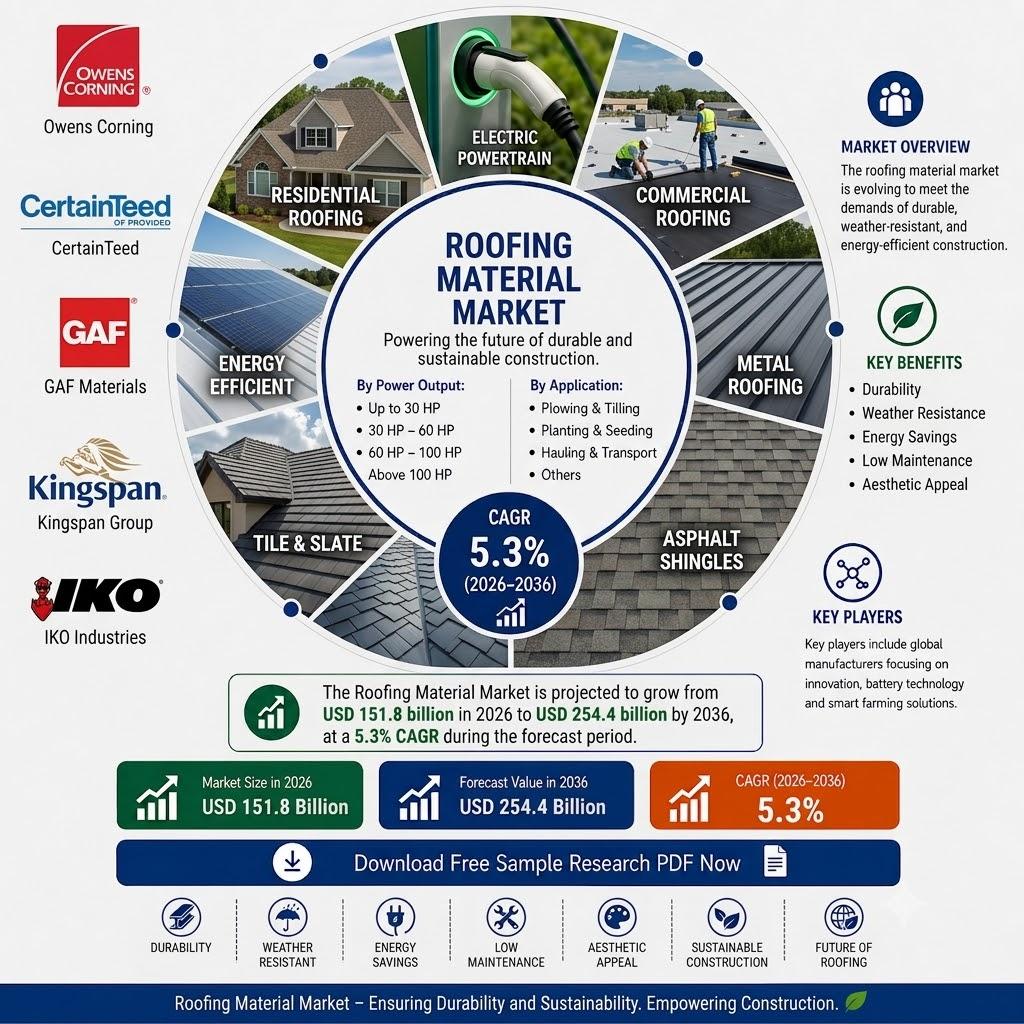
The global roofing material market is projected to grow from USD 151.8 billion in 2026 to USD 254.4 billion by 2036, registering a compound annual growth rate (CAGR) of 5.3%, according to Fact.MR. Valued at USD 144.2 billion in 2025, the market is expected to create an absolute dollar opportunity of USD 102.6 billion over the forecast period.
Demand is being supported by replacement projects across aging housing stock in North America and Europe, alongside new construction in developing economies. Roofing materials such as asphalt shingles, metal panels, clay and concrete tiles, slate, and single-ply membranes remain essential for protecting buildings against rain, wind, ultraviolet exposure, and temperature fluctuations.
The market is also evolving as building owners look beyond basic weather protection. Energy-efficient roofing, impact-resistant products, and reflective materials are gaining attention as property owners assess long-term maintenance costs, climate exposure, and building energy performance.
Get detailed market forecasts, competitive benchmarking, and pricing trends: https://www.factmr.com/connectus/sample?flag=S&rep_id=14436
Residential Replacement and New Construction Drive Demand
Residential applications are projected to account for 59% of the roofing material market in 2026. The segment benefits from recurring replacement cycles as roofs reach the end of their service life. Storm damage and changing building requirements also encourage property owners to replace older materials with products designed for improved durability and energy performance.
Asphalt shingles are expected to hold a 38% share of the market by material type in 2026. Their relatively accessible installation costs, broad contractor familiarity, and availability in different styles support their use, particularly in residential construction. Manufacturers are also developing premium shingle products that offer improved impact resistance and reflective properties.
Metal roofing and single-ply membranes provide additional opportunities across residential, commercial, and industrial applications. Metal systems are valued for durability and weather resistance, while membranes such as TPO, PVC, and EPDM are used extensively in flat and low-slope roofing applications. Selection depends on the building design, local climate, installation requirements, and expected lifecycle costs.
Energy Efficiency and Climate Resilience Reshape Product Selection
Energy performance requirements are influencing purchasing decisions in several established markets. Reflective roofing materials can help reduce heat absorption under suitable conditions, while improved roofing systems can contribute to broader building-efficiency strategies. These requirements are encouraging manufacturers to invest in products that combine weather protection with thermal performance.
Severe weather events are another important factor. Hail, high winds, and storms can accelerate roof replacement, particularly where property owners and insurers prioritize more resilient systems. Impact-resistant shingles and durable metal roofing can offer alternatives for buildings exposed to specific weather risks, although suitability depends on local conditions and installation quality.
These trends are creating opportunities for suppliers that offer differentiated products rather than competing solely on upfront price. Manufacturers must still balance material performance with affordability, availability, and contractor preferences.
India Leads Country-Level Growth
India is projected to record the fastest growth among the countries covered in the report, with an 8.8% CAGR through 2036. Housing development, urbanization, and industrial construction are expected to support demand for roofing materials across new residential and commercial projects.
Brazil follows with a projected CAGR of 7.0%, supported by housing development, infrastructure investment, and demand for weather-resistant roofing. China is expected to grow at 6.8%, reflecting ongoing urban development and interest in modern roofing systems.
The United States market is forecast to expand at a 5.2% CAGR through 2036, with replacement projects and storm-related repairs supporting demand. Germany is projected to grow at 4.5%, while France is expected to register a 4.2% CAGR. In these European markets, renovation activity and energy-efficiency requirements are important influences on material selection.
Manufacturers Focus on Premium Products and Capacity
The roofing material industry is seeing investment in manufacturing capacity, product development, and broader building-envelope solutions. In February 2025, Owens Corning announced plans for a new shingle manufacturing facility in Prattville, Alabama, designed to produce approximately six million squares of laminate shingles annually, with production planned to begin in 2027.
In September 2024, Kingspan completed its acquisition of IB Roof Systems, expanding its presence in the US PVC single-ply roofing market. These developments reflect the importance of production scale, product portfolios, and distribution networks in serving residential replacement and commercial roofing demand.
However, manufacturers continue to face challenges from raw-material price fluctuations, transportation costs, and competition in price-sensitive segments. Labor availability and installation capacity can also affect project timelines. Companies that combine reliable supply with durable products and technical support may be better positioned to compete as buyers place greater emphasis on long-term value.
Analyst Perspective
Shambhu Nath Jha, Principal Consultant at Fact.MR, notes that demand is increasingly shaped by the combination of roof replacement cycles, climate resilience, and energy-performance requirements. Manufacturers that address these needs through impact-resistant products, reflective roofing systems, and application-specific solutions can pursue higher-value opportunities, while suppliers in commodity segments continue to face price competition.
Competitive Landscape
Key companies operating in the roofing material market include Owens Corning, CertainTeed Corporation, GAF Materials Corporation, Kingspan Group, IKO Industries Ltd., Carlisle Companies Incorporated, TAMKO Building Products LLC, and Atlas Roofing Corporation.
Competition spans asphalt shingles, metal roofing, insulation-integrated systems, and commercial roofing membranes. Manufacturers differentiate themselves through product durability, pricing, warranties, contractor relationships, distribution reach, and compliance with applicable building standards. Investment in premium roofing systems and energy-efficient solutions is becoming increasingly relevant as customer requirements evolve.
Market Snapshot
- Market value (2025): USD 144.2 billion
- Market value (2026): USD 151.8 billion
- Forecast value (2036): USD 254.4 billion
- Global CAGR (2026–2036): 5.3%
- Leading country by growth: India, at 8.8% CAGR
- Leading material type: Asphalt shingles, with a projected 38% share in 2026
- Leading end-use segment: Residential, with a projected 59% share in 2026
To View Top Reports
https://afgbfh.blogspot.com/2026/10/medical-case-management-service-market.html
https://sportgalax.com/read-blog/25584
About Fact.MR
Fact.MR is a market research and competitive intelligence provider delivering market intelligence, competitive analysis, and forecasting across global industries. Its research helps businesses assess market demand, evaluate competitive developments, and identify growth opportunities across established and emerging markets.

 English
 Arabic
 French
 Portuguese
 Deutsch
 Turkish
 Dutch
Dutch
 Italiano
 Russian
 Romaian
 Portuguese (Brazil)
 Greek
Greek
 Bengali