


China Leads Alimentary Tract Implant Market Growth at 6.3% CAGR
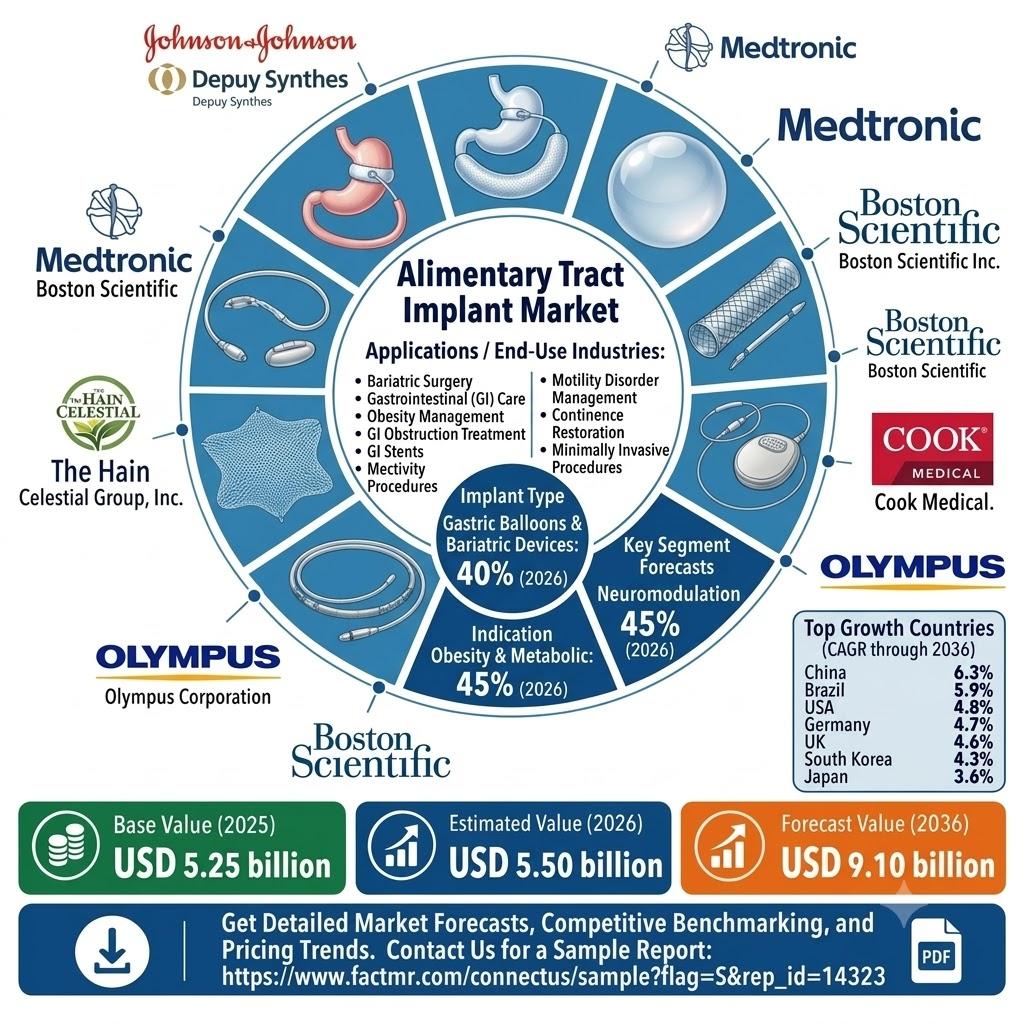
The alimentary tract implant market is projected to grow at a 5.1% CAGR from 2026 to 2036, supported by rising bariatric procedures and expanding gastrointestinal implant use.
February 21, 2026 The global alimentary tract implant market is projected to reach USD 9.10 billion by 2036, increasing from USD 5.50 billion in 2026 at a compound annual growth rate (CAGR) of 5.1%, according to Fact.MR analysis. The market was valued at approximately USD 5.25 billion in 2025. Rising bariatric procedure volumes and broader clinical use of implant-based treatments for gastrointestinal conditions are shaping demand over the forecast period.
The market is expected to add approximately USD 3.9 billion in value between 2026 and 2036. Growth is linked to established clinical needs, including obesity management, gastrointestinal obstruction, motility disorders, and continence restoration. Hospitals and specialized surgical centers remain important care settings as endoscopic and laparoscopic techniques support the use of implantable devices in selected patients.
Get detailed market forecasts, competitive benchmarking, and pricing trends: https://www.factmr.com/connectus/sample?flag=S&rep_id=14323
Alimentary Tract Implant Market Growth Reflects Changing Treatment Needs
The alimentary tract implant market covers medical devices placed surgically or endoscopically to support, repair, or restore function within the gastrointestinal tract. Products include gastric balloons, bariatric restriction devices, gastrointestinal (GI) stents, endoluminal scaffolds, neuromodulation devices, meshes, and continence implants.
Fact.MR estimates that bariatric restriction devices and gastric balloons account for approximately 40% of the global market by implant type. Their minimally invasive placement, reversibility, and suitability for selected outpatient or short-stay procedures support adoption in structured obesity treatment pathways. These devices may also serve patients who are not candidates for permanent surgical interventions.
Obesity and metabolic control represent approximately 45% of the market by indication, based on Fact.MR analysis. This segment reflects demand for interventional treatment options addressing obesity-related health conditions beyond pharmacological therapy alone. Implant-based approaches may form part of supervised treatment programs that also include dietary changes and behavioral management.
Other applications contribute to demand. GI stents and endoluminal scaffolds are used in selected cases involving strictures, obstruction, and leaks, while neuromodulation implants address certain gastrointestinal motility conditions. Continence restoration devices provide another area of clinical application, with repeat and revision procedures contributing to ongoing device requirements.
China Leads Country-Level Growth Through 2036
China is projected to record the fastest growth among the countries assessed, with a 6.3% CAGR from 2026 to 2036. Fact.MR attributes this outlook to expanding bariatric surgery volumes, public hospital capacity, and wider access to advanced endoscopy.
Brazil follows at a projected 5.9% CAGR, supported by increasing uptake of obesity treatment and investment in private hospitals. The United States is forecast to grow at 4.8%, while Germany is expected to record a 4.7% CAGR. The United Kingdom is projected to expand at 4.6%, followed by South Korea at 4.3% and Japan at 3.6%.
These differences reflect variations in procedure volumes, reimbursement arrangements, regulatory requirements, and clinical adoption patterns. Established healthcare markets continue to support demand through existing surgical infrastructure, while faster-growing markets benefit from expanding access to gastrointestinal interventions.
Clinical Evidence and Regulation Shape Product Adoption
Medical device regulation remains central to the development and commercialization of alimentary tract implants. In the United States, the U.S. Food and Drug Administration oversees applicable device authorization and safety requirements, including post-market monitoring. Manufacturers must account for regulatory requirements and clinical evidence when introducing products into different healthcare systems.
Fact.MR identifies advanced implant materials and delivery mechanisms as areas influencing market development. Implantable meshes and stents designed to improve biocompatibility or reduce adhesion risks can carry higher unit prices because of material complexity and regulatory testing requirements. Consequently, market value may increase through product mix changes even when device shipment volumes grow at a measured pace.
In January 2026, Johnson & Johnson announced the submission of its OTTAVA robotic surgical system to the U.S. Food and Drug Administration for De Novo classification. In February 2026, Medtronic announced the first U.S. surgery using its Hugo robotic-assisted surgery system at Cleveland Clinic. These developments concern robotic surgical platforms rather than establishing direct growth in implant sales, but they illustrate broader activity in surgical technology relevant to gastrointestinal procedures.
Fact.MR Analysis Highlights Long-Term Market Priorities
Shambhu Nath Jha, Principal Consultant at Fact.MR, said, “CXOs will find this report useful for understanding how procedure eligibility expansion, minimally invasive access, and reimbursement alignment are shaping long-term demand patterns for alimentary tract implants across bariatric and gastrointestinal care pathways.”
For manufacturers, the findings point to the importance of matching product portfolios with endoscopic and laparoscopic workflows. Clinical evidence covering long-term outcomes, device durability, and revision frequency can also help inform hospital purchasing and reimbursement assessments.
“Procedure volumes tell only part of the story. Device utilization and revision frequency matter, too, because they help explain how clinical demand translates into market value over time,” the analysis indicates through its methodology.
Fact.MR developed its estimates using a hybrid top-down and bottom-up forecasting model. The research incorporates procedure volumes, implant utilization by indication, and replacement or revision frequency. Primary interviews with implant manufacturers, gastrointestinal surgeons, hospital procurement managers, and clinical engineering staff were supplemented by regulatory databases, hospital purchasing records, trade statistics, and public healthcare expenditure data.
The report covers implant types, clinical indications, procedure approaches, care settings, and regional demand across major healthcare markets. It excludes external gastrointestinal devices, disposable endoscopic tools, pharmaceutical therapies, and non-implantable surgical instruments.
View Related Reports :
https://ayushjadhavblogs.blogspot.com/2026/10/video-intercom-device-market-to-reach.html
About Fact.MR
Fact.MR is a market research and consulting firm that provides market intelligence, industry analysis, and forecasts to help businesses understand market developments, assess demand patterns, and support strategic decisions. Its research covers market sizing, competitive landscapes, regional trends, and long-term industry outlooks across multiple sectors.

 English
 Arabic
 French
 Spanish
 Portuguese
 Deutsch
 Turkish
 Dutch
Dutch
 Italiano
 Russian
 Portuguese (Brazil)
 Greek
Greek
 Bengali