


Dubai to India air freight
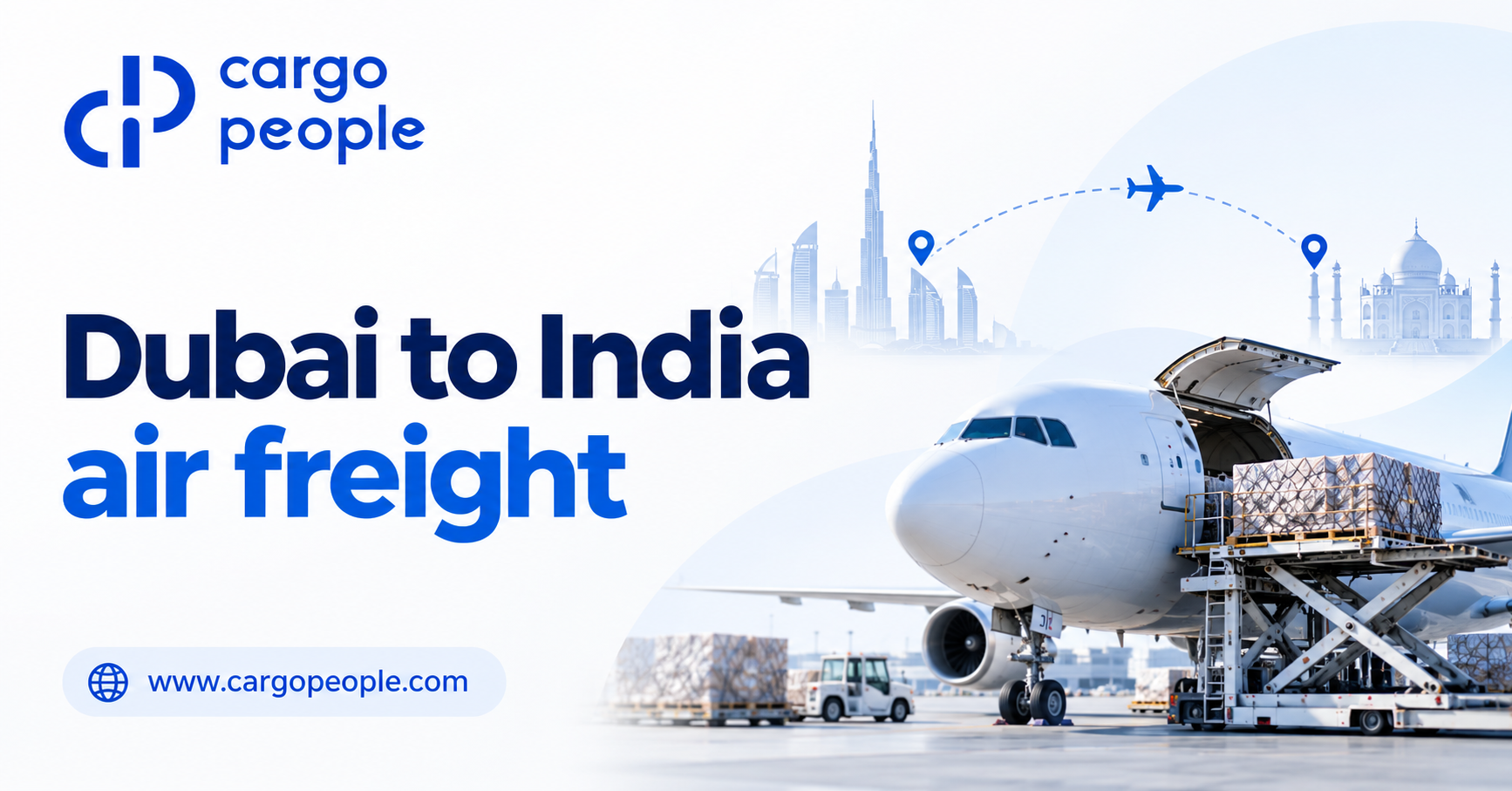
Dubai to India air freight is one of the fastest ways for Indian businesses to move urgent, high-value or time-sensitive cargo from the UAE. Manufacturers, importers, traders and procurement teams regularly use air freight for electronics, machinery spares, automotive components, samples, fashion goods, industrial parts and production-critical materials.
The route is short, but fast movement does not happen automatically. Cargo pickup in Dubai, airline booking, airport handling, export documentation, Indian Customs clearance and final delivery all affect the actual lead time.
For businesses using Dubai to India air freight, the right question is not only, “How fast is the flight?” It is:
How quickly can the cargo move from the Dubai supplier to the final Indian destination without documentation or Customs delays?
A typical shipment follows this sequence:
Cargo review - airline booking - Dubai pickup - export handling - flight - Indian Customs clearance - final delivery
Why Dubai to India Air Freight Is Important
Dubai is one of the Gulf region’s biggest sourcing and distribution centres.
Indian businesses source machinery parts, electronics, industrial components, consumer goods and urgent production material from suppliers based in Dubai, Jebel Ali, Sharjah and surrounding business zones.
For many importers, sea freight works well for regular planned stock. Air freight becomes important when the shipment cannot wait.
A component that is worth only ₹3 lakh may still justify air freight if its absence stops a production line costing ₹5 lakh per day.
This is where the economics of air freight become clearer.
The cost should not be compared only with sea freight. It should also be compared with the commercial cost of delay.
Who Uses Dubai to India Air Freight?
Dubai to India air freight is commonly used by manufacturers, traders, e-commerce businesses, electronics companies, automotive suppliers and industrial importers.
It is particularly suitable for cargo that is relatively small but commercially important.
Typical shipments can include:
- urgent machine spares
- electronics and components
- samples and prototypes
- high-value industrial goods
Air freight is also useful when inventory levels are low and the business cannot wait for a sea shipment.
For regular importers, it can work as an emergency replenishment option while bulk stock continues to move by sea.
How Long Does Dubai to India Air Freight Take?
The actual flying time between the UAE and India is short, but cargo lead time includes much more than the flight itself.
For major Dubai-to-India routes, airport-to-airport movement can often be planned around 1 to 3 days, depending on airline schedules, booking availability and cargo type.
The full door-to-door cycle may look more like this:
Dubai pickup: same day to 1 day
Export handling: 0.5 to 1 day
Air movement: 1 to 3 days
Indian Customs: 1 to 2+ days
Final delivery: same day to 1 day
For properly documented cargo, a practical door-to-door planning range can therefore be around 3 to 7 days.
The important point is that a 1-day flight does not mean a 1-day delivery.
Main Airports Used for Dubai to India Air Freight
Dubai International Airport and Dubai World Central are important cargo gateways for UAE exports.
From Dubai, cargo can move to major Indian air cargo hubs such as Delhi, Mumbai, Chennai, Bengaluru and Hyderabad depending on airline connectivity and final destination.
The Indian airport should be selected based on more than flight availability.
For example, cargo for Delhi NCR may naturally move through Delhi.
Cargo for Pune may sometimes be routed through Mumbai depending on service options.
Cargo for Tamil Nadu may be better routed through Chennai.
A cheaper flight into the wrong airport can create higher road transport cost later.
The correct comparison should therefore include:
air freight + terminal charges + Customs + final delivery
Main Process for Dubai to India Air Freight
The process begins with cargo details.
The freight forwarder usually needs the commodity, gross weight, package dimensions, pickup location and final Indian delivery destination.
The cargo type is important because different commodities can require different airline acceptance procedures.
Once the cargo details are reviewed, the forwarder checks available airline options and space.
The shipment is then picked up from the Dubai supplier and delivered to the airline handling facility.
Export documentation is completed before departure.
At the same time, the Indian Customs broker should begin reviewing the import documents.
This parallel process can save valuable time because the flight itself may take only a few hours.
Chargeable Weight in Air Freight
Air freight is not always charged only on actual weight.
Airlines generally calculate chargeable weight using the higher of actual gross weight and volumetric weight.
This is especially important for large but lightweight cargo.
For example, a shipment may physically weigh 120 kg but have large dimensions.
If the volumetric weight calculates to 210 kg, the airline may charge freight based on 210 kg rather than 120 kg.
For businesses, this means accurate package dimensions are important before requesting the rate.
Reducing unnecessary packaging volume can sometimes reduce the freight bill significantly.
This is particularly useful for regular shipments where packaging optimisation can save money throughout the year.
Documents Required for Dubai to India Air Freight
The standard import file usually includes the Commercial Invoice, Packing List and Air Waybill.
The importer also needs a Bill of Entry for Indian Customs clearance.
Depending on the product, additional regulatory documents may be required.
Typical documents can include:
DocumentPurposeCommercial InvoiceCustoms value and goods descriptionPacking ListQuantity, weight and dimensionsAir WaybillMain air transport documentBill of EntryIndian Customs filingCertificate of OriginOrigin support where applicableTechnical CatalogueProduct classification supportProduct ApprovalBIS, WPC, FSSAI or other compliance where applicable
Document consistency is important.
If the invoice describes one product while the Air Waybill uses a completely different description, Customs may ask for clarification.
For regular imports, the Dubai supplier should receive a standard India document checklist.
Customs Clearance for Dubai to India Air Freight
Customs clearance is often a major part of the total air-freight lead time.
The National Time Release Study reported an average import release time at Indian Air Cargo Complexes of approximately 39 hours and 20 minutes.
This is a useful benchmark, but it should not be treated as a guaranteed clearance time.
A straightforward and properly documented shipment may often be cleared within around 1 to 2 days.
However, HS classification queries, valuation issues, regulatory approvals or examination can increase the timeline.
This is why the Customs broker should review the documentation before the flight lands.
If the cargo reaches India while the importer is still collecting approvals, the speed advantage of air freight can disappear quickly.
Why Pre-Arrival Customs Planning Matters
Dubai to India is a short route.
That means the importer has very little time between shipment departure and arrival.
If documentation is incomplete, the cargo may reach the Indian airport before the Customs team is ready.
Airport storage and terminal charges can then begin adding to the cost.
A better approach is to send the final invoice, Packing List and shipping details to the broker immediately after booking.
The broker can review the HS code, duty and regulatory requirements while the shipment is still in Dubai.
For a route where the international movement may take 1 or 2 days, saving even 24 hours during Customs clearance makes a noticeable difference to total lead time.
Air Freight Cost from Dubai to India
Dubai to India air freight pricing depends on multiple factors.
The main factors include actual weight, volumetric weight, commodity, airline, route and urgency.
The total logistics cost can include:
air freight + fuel surcharge + security surcharge + origin handling + AWB charges + destination terminal handling + Customs clearance + final delivery
Special cargo may attract additional charges.
Dangerous goods, lithium batteries, temperature-sensitive cargo or oversized air cargo can require separate airline approval and handling.
Businesses should therefore compare quotations on a door-to-door basis.
A rate that is ₹10 per kg cheaper may not be the better option if destination charges or delivery costs are much higher.
Direct vs Connecting Air Freight
A direct flight is generally preferable for urgent cargo because it reduces handling and connection risk.
However, a connecting service may sometimes offer a lower rate.
The decision should depend on urgency.
For a shipment required for production tomorrow, paying extra for a direct flight can be commercially sensible.
For non-urgent goods, a connecting service may provide better cost efficiency.
Businesses should ask the freight forwarder to confirm:
flight routing - connection point - cut-off - expected arrival
This gives a much more realistic view than simply checking the quoted transit time.
Dangerous Goods and Lithium Batteries
Not all cargo can move under normal air-freight procedures.
Lithium batteries, chemicals, aerosols and other dangerous goods may require additional classification, packing and documentation.
For lithium-ion batteries, UN classifications such as UN 3480 and UN 3481 may be relevant depending on how the batteries are shipped.
Carrier approval for dangerous goods can take around 1 to 5 working days depending on the cargo and airline.
This is important because the normal Dubai-to-India air route may be fast, but DG approval can add several days before departure.
Businesses should therefore disclose the exact commodity before booking.
Trying to book dangerous goods as general cargo can create serious delays.
Common Challenges in Dubai to India Air Freight
One common challenge is incorrect package dimensions.
If the volumetric weight is much higher than expected, the final freight cost can increase.
Another problem is late documentation.
Because Dubai-to-India transit is short, even a 1-day document delay can affect the complete delivery schedule.
Customs classification is another common issue.
The HS code used by a UAE supplier should not automatically be assumed correct for Indian Customs.
Regulatory approvals can also create delays.
Certain electronics, wireless products, food products or other regulated goods may need specific Indian approvals.
Another challenge is airline space during high-demand periods.
Urgent cargo should therefore be booked as early as possible.
Benefits of Dubai to India Air Freight
The biggest advantage is speed.
A shipment that might require several weeks using a slower supply-chain option can potentially reach India within a few days by air.
This is especially valuable for emergency spares, high-value inventory and production-critical cargo.
Air freight also allows businesses to operate with lower safety stock in some situations.
Instead of holding 60 days of inventory, a company with reliable air replenishment may be able to maintain a leaner stock position for selected products.
Another advantage is flexibility.
Businesses can move small or medium consignments without waiting to accumulate enough cargo for a full container.
For high-value products, the faster transit can also reduce the amount of time goods remain in the international supply chain.
Air Freight vs Sea Freight from Dubai to India
The right mode depends on cost, volume and urgency.
Air freight is generally better for urgent, smaller and high-value cargo.
Sea freight is usually better for heavy, regular and planned shipments.
For example, a 250 kg urgent machine component may be suitable for air freight.
A 12 tonne monthly raw-material shipment will generally be more economical by sea.
Many businesses use both.
Regular inventory moves by sea while urgent replenishment moves by air.
This hybrid model can balance logistics cost with supply-chain reliability.
How a Freight Forwarder Can Help
A professional freight forwarder can coordinate the complete Dubai-to-India air movement.
The process begins with checking cargo weight, dimensions, commodity and delivery urgency.
The forwarder then compares airline options, routing and available capacity.
At origin, the team manages pickup and airline handover.
At the same time, the Indian Customs broker can prepare for clearance.
Once the cargo arrives, the forwarder coordinates terminal release, Customs clearance and final delivery.
For regular shipments, a standard operating process can be created for the same supplier and product.
This can reduce repeated documentation mistakes and improve lead-time predictability.
Conclusion
Dubai to India air freight is a strong option for businesses that need speed, predictable movement and urgent inventory replenishment.
Major routes can often provide approximately 1 to 3 days airport-to-airport transit, while the complete door-to-door movement may take around 3 to 7 days for properly documented cargo.
The biggest risks usually come from poor documentation, incorrect chargeable-weight calculations, Customs issues or late airline booking.
Businesses should therefore plan the complete movement from Dubai supplier pickup to Indian Customs clearance and final delivery.
Cargo People Logistics & Shipping Pvt. Ltd. supports Dubai to India air freight, Customs clearance and door-to-door logistics for commercial cargo, urgent shipments and specialised freight.
👉https://cargopeople.com/blog/dubai-to-india-sea-freight/
Website: https://cargopeople.com
Phone: +91 97174 65454
Email: wecare@cargopeople.com

 English
 Arabic
 French
 Spanish
 Portuguese
 Deutsch
 Turkish
 Dutch
Dutch
 Italiano
 Russian
 Portuguese (Brazil)
 Greek
Greek
 Bengali