


air freight lithium batteries India
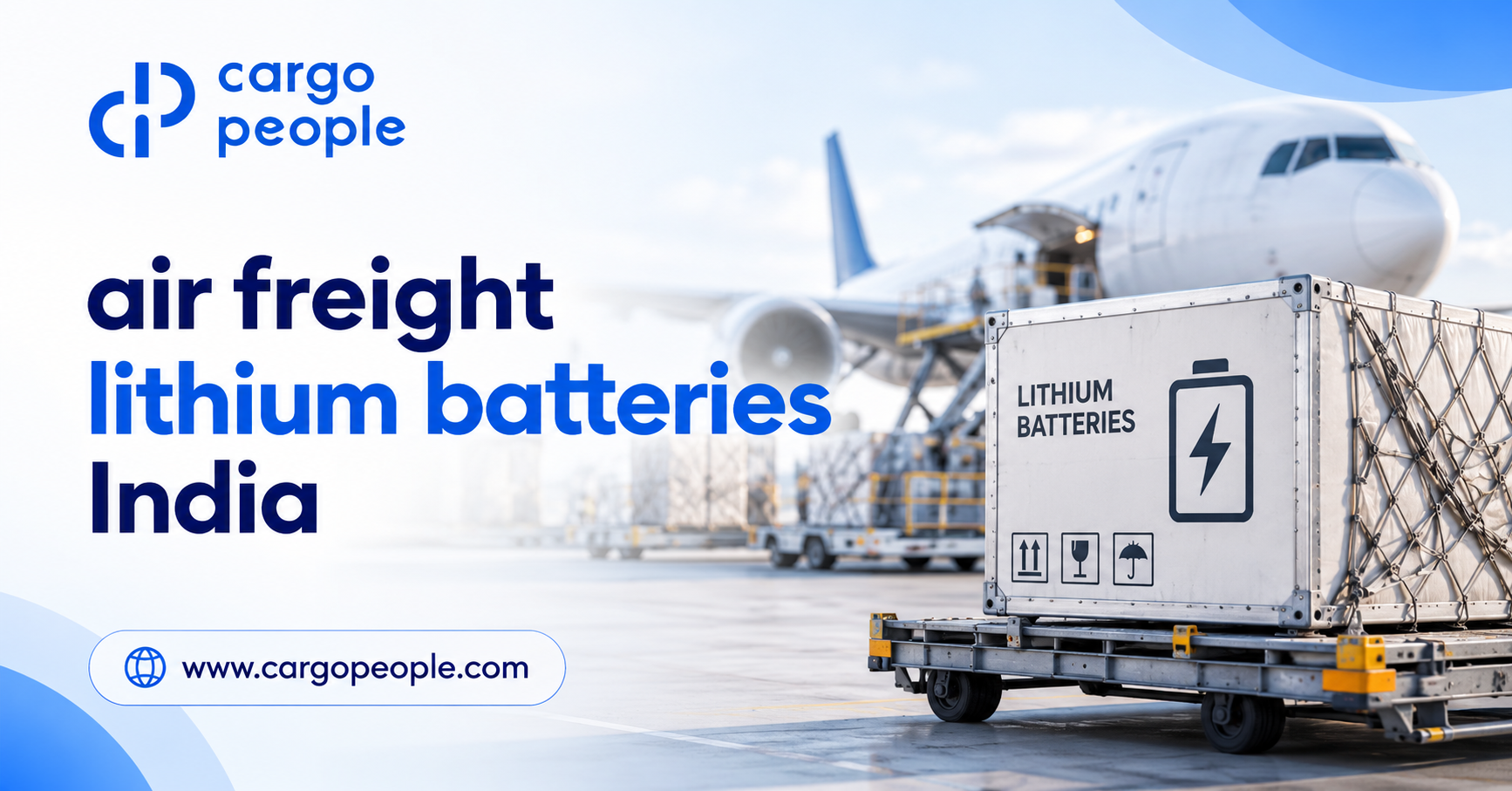
Air freight for lithium batteries in India requires much more planning than normal cargo. Lithium-ion cells, battery packs, batteries packed with equipment and batteries contained in equipment can all fall under dangerous goods requirements.
For Indian importers, electronics companies, EV businesses, battery manufacturers, traders and procurement teams, the main challenge is not only finding an airline rate. The cargo must first be correctly classified, packed, documented and accepted by the airline.
This is why air freight lithium batteries India should be planned as a compliance-led logistics process.
A typical shipment follows this sequence:
Battery identification - UN classification - UN 38.3 verification - packaging review - DG documentation - airline approval - air freight booking - Customs clearance - final delivery
If these steps are completed early, businesses can reduce rejection, repacking and airport storage costs.
Why Lithium Battery Air Freight Needs Special Planning
Lithium batteries are widely used in electric vehicles, electronics, industrial equipment, energy storage systems, power tools and communication devices.
They are commercially important, but they also require special transport controls because damaged, defective or incorrectly packed batteries can create a fire risk during transportation.
Airlines therefore apply stricter acceptance procedures than they do for general cargo.
A shipment weighing only 100 kg may require more technical review than a 1,000 kg general cargo shipment.
This is because acceptance depends on battery chemistry, configuration, Watt-hour rating, package quantity, state of charge and documentation.
For businesses, the important point is simple:
A freight rate is not the same as airline approval.
The airline may still reject the shipment after reviewing the battery details.
Who Needs Lithium Battery Air Freight Services in India?
Lithium battery air freight is commonly used by businesses that need speed.
EV companies may need urgent cells, modules or replacement battery components.
Electronics manufacturers may import batteries for laptops, telecom equipment, industrial devices or consumer products.
Battery manufacturers may use air freight for testing quantities, samples or high-priority production material.
Typical users include:
- EV and battery companies
- electronics manufacturers
- industrial equipment businesses
- traders and importers
Air freight is especially useful where a production delay is more expensive than the additional transportation cost.
If a missing battery component can stop a production line for 3 or 4 days, paying more for air freight may still make commercial sense.
Understanding UN 3480 and UN 3481
Correct classification is one of the first steps.
Lithium-ion batteries shipped by themselves are generally classified as:
UN 3480 - Lithium ion batteries
Lithium-ion batteries packed with equipment or contained in equipment are generally classified under:
UN 3481 - Lithium ion batteries packed with equipment or contained in equipment
This distinction matters because the applicable packing and airline acceptance requirements can differ.
A carton containing only battery packs should not automatically be treated the same way as machinery containing installed batteries.
Lithium metal batteries use separate classifications such as UN 3090 and UN 3091.
This is why businesses should not describe the cargo only as "lithium battery" when asking for a freight quotation.
The freight forwarder needs the exact battery configuration before planning the shipment.
UN 38.3 Test Summary and Why It Matters
UN 38.3 testing is one of the most important technical elements in lithium battery transportation.
Lithium cells and batteries intended for transport generally need to meet the applicable UN testing requirements.
The tests are designed to assess performance under transport conditions such as vibration, pressure difference, temperature change and mechanical stress.
A UN 38.3 Test Summary is commonly used as part of the technical review.
Indian importers should obtain this document from the overseas supplier before booking.
If the supplier cannot provide proper test information, airline acceptance may become difficult.
This is especially important when sourcing from a new manufacturer.
A lower battery purchase price may look attractive, but incomplete transport documentation can create delays that are far more expensive than the initial saving.
2026 IATA Requirements for Lithium Battery Air Freight
Lithium battery air cargo is governed by the IATA Dangerous Goods Regulations.
The 67th Edition of the IATA Dangerous Goods Regulations applies in 2026.
These requirements cover classification, packing, labels, quantity limits, documentation and aircraft restrictions.
Lithium batteries shipped by themselves may face stricter conditions than batteries packed with or contained in equipment.
State of Charge can also be important.
For certain lithium-ion battery configurations, the applicable air transport requirements can include a commonly recognised 30% state-of-charge limit.
The exact requirement depends on the battery type and packing instruction.
That is why businesses should rely on the current transport rules rather than an old shipping method used several years ago.
Airline Acceptance Comes Before Cargo Handover
One of the biggest mistakes businesses make is sending the cargo to the airport before airline DG approval is complete.
The airline may want to review:
UN number - battery chemistry - Watt-hour rating - package quantity - packaging method - UN 38.3 details
Airlines can also apply their own operator-specific restrictions.
This means one carrier may accept a shipment while another refuses it.
Route also matters.
A shipment may be acceptable on a direct cargo-aircraft service but not on a passenger-aircraft route.
Carrier approval can take around 1 to 5 working days depending on the shipment.
For urgent cargo, this time should be included in the planning from the beginning.
Packaging Requirements for Lithium Batteries
Lithium battery packaging needs to prevent short circuits, physical damage and unwanted movement.
Depending on the battery configuration, the shipment may require inner packaging, terminal protection, cushioning and strong outer packaging.
The applicable packing instruction should be checked before the cargo is packed.
A normal commercial carton may not be sufficient.
If incorrect packing is discovered after cargo reaches the freight facility, the shipment may need to be opened and repacked.
This can add 1 to 3 working days or more.
For urgent air cargo, this delay can remove much of the speed advantage.
For regular importers, the supplier's packaging standard should ideally be approved before the first commercial shipment.
Marks and Labels for Lithium Battery Shipments
Lithium battery packages may require specific marks and labels depending on the classification.
The package information must match the transport documentation.
If the package is marked as UN 3480 but the declaration describes UN 3481, the shipment may fail airline acceptance.
The same problem can happen if the quantity or battery configuration does not match.
A proper final check should cover both the package and the documents.
This may take only 20 to 30 minutes but can prevent a 2-day or 3-day delay.
For recurring shipments, businesses should maintain standard label and document templates for each approved battery model.
Documents Required for Air Freight Lithium Batteries India
Lithium battery air freight requires both commercial and technical documentation.
A typical file may include:
DocumentPurposeCommercial InvoiceCustoms value and product descriptionPacking ListQuantity, weight and package detailsAir WaybillMain transport documentSDS / MSDSTechnical and hazard informationUN 38.3 Test SummaryBattery transport testing recordDG DeclarationDangerous goods declaration where applicableBattery SpecificationChemistry, capacity and Watt-hour detailsImport ApprovalProduct-specific Indian compliance where applicable
Consistency is critical.
If the invoice describes one battery model while the technical documents refer to another, the airline or Customs broker may ask for clarification.
Customs Clearance for Lithium Batteries in India
Lithium battery imports also need normal Indian Customs clearance.
The Customs broker should review the HS code, invoice value, product description and applicable regulatory requirements before the cargo arrives.
Depending on the product category, other compliance may apply.
For certain portable rechargeable cells and batteries, BIS-related requirements may be relevant.
Battery Waste Management Rules and EPR obligations may also apply to certain producers or importers.
This does not mean every lithium battery shipment has identical compliance.
The requirement depends on the battery type, use and business role.
For a properly prepared shipment, Customs clearance may often be planned around 1 to 3 days, although examination or regulatory queries can increase the timeline.
How Long Does Lithium Battery Air Freight Take?
The air transit itself may be fast, but the complete logistics cycle can take longer.
A practical planning sequence may look like this:
Technical review: same day to 2 days
Packing and documentation: 1 to 3 days
Airline DG approval: 1 to 5+ days
International air movement: 3 to 7 days
Customs and delivery: 1 to 3+ days
This means a shipment advertised as a 3-day air service can still become a 7 to 12 day or longer door-to-door movement if the DG work starts late.
Businesses should therefore plan according to total lead time rather than flight time.
Cost of Air Freight for Lithium Batteries
Lithium battery air freight usually costs more than normal general cargo.
The total cost may include:
air freight + fuel surcharge + security surcharge + DG surcharge + specialised packing + documentation + terminal handling + Customs clearance + final delivery
The final rate depends on chargeable weight, route, airline and battery classification.
Repacking can also increase cost significantly.
Airport storage may apply if the cargo arrives before the documents are ready.
This is why the cheapest freight rate may not always be the lowest landed cost.
If one carrier costs ₹25,000 more but provides confirmed DG acceptance and a direct route, it may still be the better commercial option.
Common Challenges in Lithium Battery Air Freight
One common problem is incomplete UN 38.3 documentation.
Another is incorrect UN classification.
Some shippers also provide outdated SDS documents or technical sheets that do not clearly show transport information.
Packaging is another frequent issue.
A battery may be compliant as a product but still be packed in a way the airline cannot accept.
Airline restrictions can also change.
A route that worked for the previous shipment may not be available for the next one if aircraft type or operator policy changes.
The safest approach is to review each booking again before cargo handover.
Benefits of Using Air Freight for Lithium Batteries
The biggest advantage is speed.
For urgent production material, samples or high-value batteries, air freight can save days or weeks compared with sea freight.
This can help reduce production stoppage, stock-out risk and customer delay.
Air freight also provides better control for smaller high-value shipments.
The main trade-off is cost.
For regular heavy battery volumes, sea freight may be more economical.
For urgent cargo, however, the additional air cost can be justified if the business impact of delay is high.
Air Freight vs Sea Freight for Lithium Batteries
Air freight is best where speed is critical.
Sea freight works better for planned high-volume shipments.
For example, a company importing 300 kg of urgent battery modules may choose air if production depends on immediate delivery.
A business importing 8 to 10 tonnes of regular battery stock may find sea freight much more economical.
Many businesses use both modes.
Regular inventory moves by sea.
Urgent replenishment moves by air.
This hybrid approach can reduce overall logistics cost while protecting production continuity.
How a Lithium Battery Freight Forwarder Can Help
A specialist forwarder should begin with the battery information before finalising the freight quote.
The forwarder reviews the UN classification, battery configuration, UN 38.3 documentation and packaging.
The next step is carrier selection and DG approval.
Once the airline accepts the cargo, the forwarder coordinates pickup, terminal handling and international movement.
For imports, support continues through Indian Customs clearance and final delivery.
For regular battery shipments, the forwarder can help create a standard product file.
This may include the battery specification, UN number, UN 38.3 Test Summary, packaging format and preferred carrier options.
That makes future shipments easier to repeat.
Conclusion
Air freight lithium batteries India requires more technical planning than normal cargo.
The process should begin with correct battery classification, UN 38.3 verification and packaging review before the airline booking is finalised.
UN 3480 and UN 3481 shipments can have different requirements, while route, aircraft type and airline restrictions can also affect acceptance.
With airline DG approval often taking around 1 to 5 working days, businesses should not wait until cargo is ready before starting the compliance process.
For Indian manufacturers, importers and battery businesses, early planning can reduce repacking, carrier rejection, airport storage and Customs delays.
Cargo People Logistics & Shipping Pvt. Ltd. can support lithium battery air freight, DG coordination, Customs clearance and door-to-door delivery for battery shipments moving into and out of India.
👉https://cargopeople.com/blog/air-freight-lithium-batteries-india/
Website: https://cargopeople.com
Phone: +91 97174 65454
Email: wecare@cargopeople.com

 Arabic
 French
 Spanish
 Portuguese
 Deutsch
 Turkish
 Dutch
Dutch
 Italiano
 Russian
 Romaian
 Portuguese (Brazil)
 Greek
Greek
 Bengali