


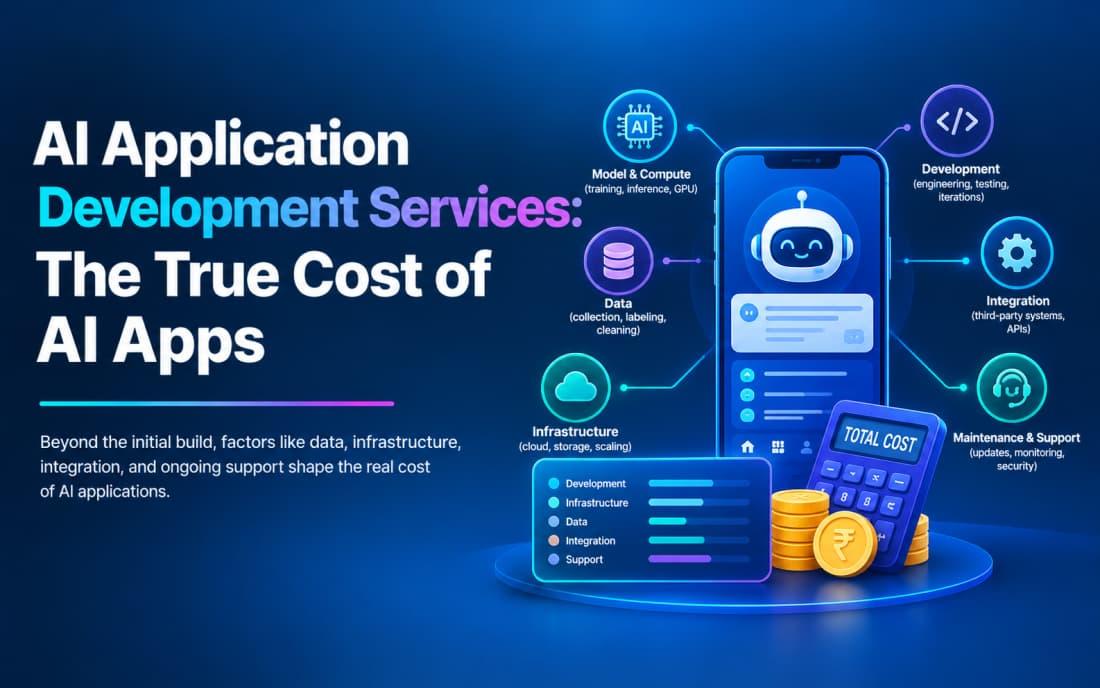
AI Application Development Services: The True Cost of AI Apps
A product team receives two proposals for a customer support assistant. The first has a lower build price and uses the most capable model for every request. The second costs more to build but includes a routing layer that sends simple questions to a smaller model and complex ones to a larger model.
Based on the initial build cost, the first proposal looks better. Eighteen months after launch, however, usage has grown to ten times the pilot volume. The first design now costs several times more to run each month than the second. The initial savings disappeared within the first few months of scaling.
That example highlights the economics of AI application development services. The build quote is only one part of the cost. The larger expense can come from running the application, including inference, context, retrieval, tool calls, monitoring, and human review. Without a per-transaction run-cost model, buyers may approve an architecture without knowing what it will cost to operate at scale.
What Makes AI Apps Different From Traditional Software
Traditional software has a relatively predictable cost structure. Most of the investment goes into building the application. After launch, hosting and maintenance costs generally increase gradually as usage grows. The cost of serving one additional user or transaction is often relatively small.
AI apps work differently. Each time a user asks a question, summarizes a document, or triggers an agent, the application may need to call an AI model. These calls are usually priced according to the number of input and output tokens processed.
As a result, the cost of each transaction can vary significantly. If an AI app gains users quickly, its operating costs can grow along with usage.
This changes how Artificial Intelligence App Development needs to be approached. Decisions such as model selection and prompt length are not just technical choices. When repeated across thousands or millions of transactions, they also become cost decisions.
The Token Price Paradox
Token prices have fallen sharply. The Stanford AI Index report found that the cost of querying a model at the GPT-3.5 level fell more than 280-fold between November 2022 and October 2024.
That trend is expected to continue. Gartner predicts that by 2030, the cost to providers of performing inference on a large model with one trillion parameters will be more than 90% lower than in 2025. Improvements in hardware, smaller distilled models, and competition among providers are helping drive these reductions.
Lower token prices, however, do not automatically mean lower AI bills. Gartner also predicts that AI inference costs per agentic workflow will increase more than fivefold through 2028. Newer AI capabilities can consume more tokens because they use longer context windows, multi-step reasoning, repeated tool calls, and agents that review their own work.
So, while each token may become cheaper, an application may use many more of them for each task.
For buyers, the important point is that token pricing is only part of the equation. The architecture determines how many tokens and model calls each transaction requires.
The Cost Drivers That Matter Most
Model Choice
Larger, more capable models generally cost more per token than smaller models. Yet many tasks do not require the most powerful model available.
A smaller model may be enough to classify an intent, extract a date, or answer a common question. Using the right model for each task can reduce costs without significantly affecting the user experience.
Context Size
Every token sent to a model contributes to the cost. An application that sends a long system prompt, the full conversation history, or large retrieved documents with every request pays for that information each time.
Context size can therefore become one of the biggest hidden cost drivers in an AI application.
Output Length
Output tokens also add to the bill and often cost more than input tokens. Long responses, detailed reasoning, and lengthy generated documents can increase the cost of each transaction.
Controlling unnecessary output can therefore have a direct effect on operating costs.
Retrieval Design
Retrieval-augmented generation, or RAG, applications search a knowledge base and add relevant information to the model prompt.
Sending too many passages or unnecessarily long passages increases the amount of context the model has to process. Poor retrieval can create another problem. If the answer is incomplete or inaccurate, users may repeat or rephrase their questions, creating additional model calls.
Agent Loops and Tool Calls
AI agents can plan a task, call tools, review the results, and decide what to do next. Each of these steps may involve another model call.
An agent that takes eight steps to complete a task can therefore cost roughly eight times as much as a single model call, before accounting for the additional context processed at each step.
Caching
Many AI requests are repeated or share the same information. Caching common responses or reusing prompt prefixes can reduce unnecessary model calls and token usage.
The catch is that caching works best when it is considered during the initial design rather than added after the application is already in production.
Human Review and Monitoring
Some AI applications need human review, especially when they handle sensitive or high-risk outputs. Monitoring, evaluation, and logging also require computing and storage resources.
These costs should be included in the run-cost model rather than treated as separate operational expenses.
Model Routing Among AI App Development Solutions
Model routing sends each request to the least expensive model that can handle it at the required quality level.
The routing logic can be simple. It might classify requests based on their type or length. More advanced systems can use a smaller model to estimate the difficulty of a request before deciding which model should handle it.
Simple requests can go to a smaller model, while more complex requests can be sent to a larger one. Some systems can also move a request to a more capable model if the first response fails a quality check.
Among AI app development solutions, model routing is one of the most useful ways to control operating costs. It does add another component that needs to be tested and maintained, but that work is easier to manage when routing is part of the architecture from the beginning.
Routing can also reduce dependence on one model provider. If prices change, a model is retired, or a better option becomes available, an application designed to work with multiple models can switch more easily.
Building a Per-Transaction Run-Cost Model
A run-cost model estimates how much each transaction costs and how that cost changes as usage increases. It gives product and finance teams a way to evaluate architecture decisions using actual numbers.
A basic model should include:
- Transaction types: Identify the main actions users perform, such as asking questions, summarizing documents, or running agent tasks.
- Volume forecast: Estimate the expected monthly volume for each transaction type at launch and at higher usage levels.
- Tokens per transaction: Estimate average input and output tokens, including system prompts, conversation history, and retrieved content.
- Model mix: Estimate how many requests of each type will be handled by each model based on the routing strategy.
- Price per token: Use current model pricing and account for possible changes over time.
- Additional calls: Include retrieval, embeddings, tool calls, and additional agent steps.
- Cache hit rate: Estimate how many requests can be served through caching instead of generating a new model response.
- Review and monitoring costs: Include human review, evaluation, logging, and related operational costs.
The result should show the cost per transaction and the expected monthly run cost at different usage levels.
That cost should then be compared with the value created by each transaction, such as time saved, revenue generated, or costs avoided. If the cost of a transaction gets too close to the value it creates, the architecture should be reconsidered before launch.
Where AI Application Development Services Should Focus
Strong AI application development services should address cost throughout the development process rather than treating it as a post-launch concern.
- Discovery: Define the main transaction types, expected volumes, and business value before selecting models.
- Architecture: Plan model routing, context management, retrieval, and caching around specific cost targets.
- Prototyping: Measure actual token usage during prototypes and use those results to improve the run-cost model.
- Evaluation: Test whether smaller models can meet the required quality level for specific tasks.
- Launch: Track costs by feature, user segment, and transaction type from the start.
- Operations: Review the cost per transaction regularly and adjust routing, prompts, and caching as usage changes.
This approach keeps operating costs visible throughout the project. It also gives product and finance teams a common way to discuss new features. Instead of looking only at development effort, they can consider how much each feature is expected to cost and what value it will create.
What to Ask an Artificial Intelligence App Development Company?
When comparing an artificial intelligence app development company with other providers, build cost should not be the only topic. Ask about the cost of running the application as well.
Key questions include:
- What is the estimated cost per transaction for each major use case, and what assumptions support the estimate?
- Which models will handle different types of requests?
- How will model routing work?
- How will context size be controlled, including conversation history and retrieved content?
- What caching strategy will be used?
- How will costs be monitored and reported after launch?
- How easily can the application switch models if pricing or availability changes?
- What would the run cost look like at ten times the pilot volume?
An AI application development company that can answer these questions with specific assumptions and design choices has considered the application's lifetime cost. A provider that focuses only on the initial build quote may leave the buyer to discover operating costs later.
Mobile and Edge Considerations
For teams working with an AI mobile app development company, device capabilities provide another way to manage AI costs.
Some tasks can run on smaller models directly on a phone or at the network edge. On-device models can reduce cloud costs while improving privacy and response times. They also come with limitations. Smaller models cannot handle every task, and applications need to be tested across different devices.
A hybrid approach can work well. Simple tasks can run on the device while more demanding requests are sent to the cloud. The run-cost model should account for this split as well as the engineering effort required to maintain models across platforms.
Governance, Security, and Compliance Costs
The cost of running an AI application also includes the controls needed to keep it secure and compliant.
These controls can include content filtering, audit logging, protection of personal information in prompts and outputs, and testing for accuracy and bias. Applications used in regulated industries such as healthcare and finance may also require human review for certain outputs, adding a labor cost to individual transactions.
These requirements should be included in the budget from the beginning. Adding them after launch can increase context size, introduce additional model calls, or require architectural changes. Each of these can increase operating costs.
Common Mistakes That Inflate Run Cost
Several design choices can increase AI operating costs quickly:
- Sending full histories: Passing the entire conversation to the model on every request instead of using a summary or a smaller window of recent messages.
- Using one model for everything: Sending every request to the most capable model regardless of its complexity.
- Over-retrieving: Adding many long passages to a prompt when a smaller amount of relevant information would be enough.
- Uncapped agents: Allowing agents to take too many steps without limits or quality checks.
- No cost telemetry: Launching without tracking costs by feature, making it difficult to identify problems until the bill arrives.
These issues are much easier to address during design than after users depend on the application.
Well-designed AI app development solutions should address these areas before launch. Cost targets should be considered alongside quality and performance requirements when defining acceptance criteria.
Conclusion
AI application development services should be evaluated based on the lifetime cost of an application, not just the initial build quote.
Inference, context size, and model routing decisions made early in development can affect operating costs for years. Falling token prices will not necessarily reduce those costs if the application is designed to use more tokens and model calls than necessary.
A per-transaction run-cost model gives buyers a clearer picture of what an AI application will cost at launch and as usage grows. It also makes it easier to compare architectures and identify expensive design choices before they become difficult to change.
As AI features become part of more products, understanding the cost of each transaction will be essential to scaling them sustainably.

 Arabic
 French
 Spanish
 Portuguese
 Deutsch
 Turkish
 Dutch
Dutch
 Italiano
 Russian
 Romaian
 Portuguese (Brazil)
 Greek
Greek
 Bengali