


Pharmaceutical Contract Manufacturing Market and Commercial Drug Production
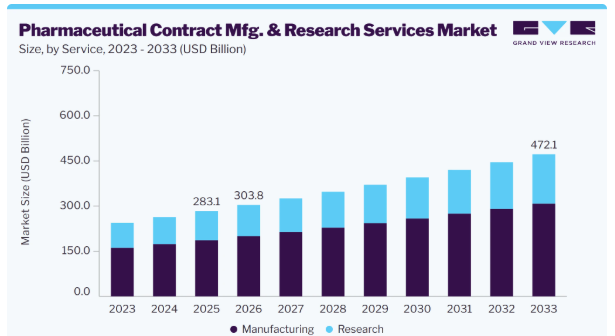
The pharmaceutical industry is changing how medicines move from development to commercial production. Instead of building every manufacturing capability internally, drug developers are increasingly relying on specialized external partners to manage production, improve operational efficiency, and respond to evolving treatment requirements. This shift is strengthening the pharmaceutical contract manufacturing market, where manufacturing expertise and production flexibility are becoming critical business advantages.
Valued at USD 141.7 billion in 2025, the global Pharmaceutical Contract Manufacturing Market is projected to reach USD 310.9 billion by 2033, growing at a CAGR of 10.4% from 2026 to 2033. The market is expected to increase from USD 155.1 billion in 2026. North America held the largest regional share at 38.44% in 2025, while Asia Pacific is anticipated to record the fastest CAGR during the forecast period.
What Is Changing Behind the Growth?
The growing complexity of pharmaceutical production is encouraging companies to reconsider how they allocate resources. Contract manufacturing organizations (CMOs) provide access to specialized facilities, technical expertise, quality systems, and scalable production without requiring pharmaceutical companies to establish every capability themselves.
This model is particularly valuable for small and midsized pharmaceutical businesses that want to prioritize research, clinical development, and commercialization. External manufacturing partners can manage essential production activities, helping developers reduce infrastructure commitments and access capabilities that may be difficult to maintain internally.
Demand is also being supported by the growing requirement for branded medicines, generic drugs, biologics, and specialized treatments. As product pipelines evolve, pharmaceutical companies increasingly need manufacturing partners capable of supporting different formulations and production volumes.
The Market's Three Main Service Areas
API manufacturing remains the foundation. Active pharmaceutical ingredient manufacturing accounted for 70.68% of the market in 2025, making it the leading service segment. APIs are essential to medicine production, and outsourcing supports cost efficiency, specialized expertise, and regulatory compliance.
Finished drug manufacturing supports product commercialization. Contract manufacturers produce formulations such as oral solids, liquids, and topical products. Small-molecule drugs dominated the product segment in 2025 because of their established manufacturing processes and the operational advantages offered by outsourcing.
Packaging is emerging as a faster-growing opportunity. Packaging services are expected to register the fastest CAGR among service segments. Solutions include blister packs, bottles, vials, ampoules, tubes, sachets, pouches, and stick packs. Growing demand for integrated manufacturing and packaging can help pharmaceutical companies maintain product integrity while streamlining supply chains.
Download a free sample report or claim your copy of this full market intelligence report
Biologics Are Raising the Industry's Technical Requirements
The expansion of biologics and biosimilars is changing investment priorities across contract manufacturing. Monoclonal antibodies, complex proteins, vaccines, and other advanced therapies require specialized processes and manufacturing infrastructure.
According to the supplied source, U.S. regulators had approved 80 biosimilars across 19 biologic molecules by September 2025, with 58 launched in the United States. This expanding commercial landscape is encouraging manufacturers to increase their large-molecule capabilities.
In April 2025, Samsung Biologics accelerated its manufacturing expansion by bringing Plant 5 online as part of Bio Campus II. Syngene International also announced the acquisition of its first U.S. biologics facility in March 2025, strengthening its large-molecule process capacity.
Small molecules continued to dominate the product market in 2025, but biologics are expected to experience significant growth. Increasing research investment, outsourcing, and adoption of advanced technologies are supporting demand for specialized biologics manufacturing.
Technology Is Changing How CMOs Operate
Manufacturing innovation is increasingly central to competitiveness. Artificial intelligence and data analytics can help providers evaluate production data, optimize processes, anticipate equipment failures, and support compliance activities.
Quality by design and process analytical technology are also contributing to more systematic process monitoring. Meanwhile, continuous manufacturing offers opportunities to improve efficiency, reduce operating costs, and maintain product consistency.
Batch manufacturing nevertheless dominated the market by scale of operation in 2025. Its established processes and potential cost advantages make it suitable for companies seeking flexible production arrangements. Continuous manufacturing is expected to gain importance as the industry pursues more efficient and technologically advanced production methods.
Which Drug Categories Are Generating Demand?
Generics held the largest market share by drug type in 2025. Patent expirations, the need for affordable medicines, and outsourcing by pharmaceutical companies support demand for external production. Branded medicines also create opportunities as complex formulations, sterile injectables, and novel drug delivery systems require specialized manufacturing capabilities.
Commercial manufacturing dominated the workflow segment in 2025, reflecting demand for large-scale production of approved medicines. Clinical manufacturing is expected to grow as clinical trials expand and developers seek partners with specialized production expertise.
Oncology accounted for the largest application share in 2025. Continued research into cancer therapies and the increasing global cancer burden support demand for pharmaceutical development and manufacturing. Cardiovascular disease is another important application area, with pharmaceutical innovation responding to the substantial worldwide burden of cardiovascular conditions.
Pharmaceutical companies represented the leading end-use segment in 2025. Biotechnology companies are expected to experience significant growth as emerging and midsized businesses increasingly use external manufacturing resources.
Regional Performance and Emerging Opportunities
North America accounted for the largest regional share in 2025, supported by pharmaceutical demand, technological capabilities, and outsourcing activity. The United States led the regional market, with generic drug production and the need for specialized manufacturing services contributing to demand.
Europe is expected to experience significant growth as stringent regulatory requirements and demand for biologics and specialty medicines increase the importance of capable manufacturing partners. Germany held the largest national share in the European market in 2025.
Asia Pacific is projected to record the fastest CAGR during the forecast period. Cost-effective production, established pharmaceutical businesses, technology adoption, and expanding research activities are supporting the region's prospects. China held the largest national share in Asia Pacific in 2025, while India is expected to benefit from demand for generics, biologics, biosimilars, and personalized medicines. Japan also represents an important market amid an aging population and rising pharmaceutical requirements.
Risks That Could Influence the Forecast
Supply-chain disruptions and raw material shortages remain significant challenges for contract manufacturers. These issues can delay production, increase costs, and complicate the delivery of medicines.
Regulatory compliance presents another operational consideration. Requirements relating to good manufacturing practices, data integrity, and quality assurance demand continued investment in facilities, systems, and personnel. Manufacturers must balance these obligations with investment in technology and capacity expansion.
What the Market Could Look Like by 2033
The projected increase to USD 310.9 billion by 2033 reflects the expanding role of outsourced manufacturing in pharmaceutical development and commercialization. Biologics, generic medicines, advanced production technologies, and integrated packaging services are expected to shape future demand.
As pharmaceutical companies seek greater flexibility and access to specialized expertise, contract manufacturing organizations are positioned to become increasingly important partners throughout the drug production lifecycle. Long-term competitiveness will depend on dependable supply, regulatory compliance, technical capabilities, and the ability to accommodate increasingly complex medicines.
Explore Our Research & Intelligence Solutions
Prism AI: Ask. Analyze. Get Cited Market Insights. – Explore Now
U.S. Healthcare Facility Intelligence: Make Better Decisions with Comprehensive Data – Explore the Platform

 English
 Arabic
 French
 Spanish
 Portuguese
 Deutsch
 Turkish
 Dutch
Dutch
 Italiano
 Russian
 Romaian
 Greek
Greek
 Bengali