


Cutting-Edge Facial Recognition Systems for Secure Entry in Saudi Arabia
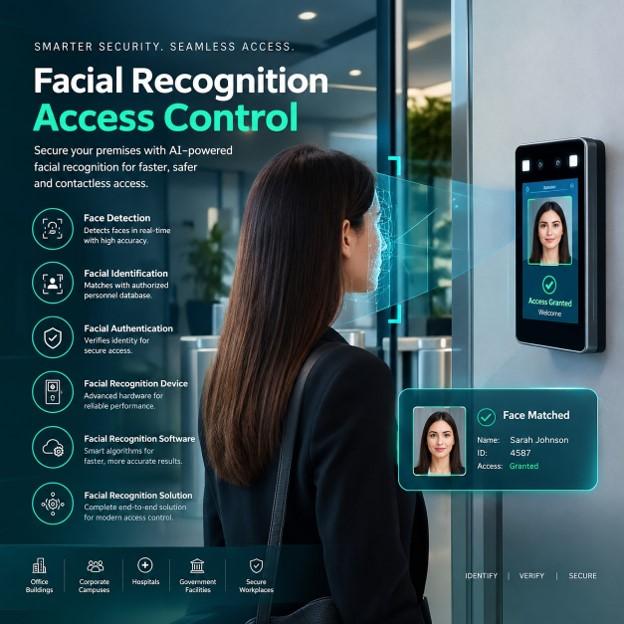
Every access control decision ultimately reduces to one question: is this person really who they claim to be? An advanced Facial Recognition System answers that question with considerably more confidence than a card or PIN ever could, verifying identity directly against an enrolled profile rather than simply confirming that someone is holding a valid credential that could, in principle, belong to anyone.
For Saudi organizations, this distinction between verifying a credential and verifying a person has become increasingly important as identity fraud, credential sharing, and social engineering tactics grow more sophisticated. A card can be lent, lost, or cloned without anyone noticing until it's misused — a verified face cannot be handed to someone else, which is precisely why secure access technology has shifted so decisively toward biometric verification across the Kingdom's corporate, government, and financial sectors.
Why Identity Verification Has Become the Weak Point in Traditional Access Control
Most access control failures don't happen because the door lock itself was defeated — they happen because the credential presented to it wasn't actually being used by the person it was issued to. A shared card between colleagues, a PIN written down and passed along, a badge borrowed "just this once" — these everyday shortcuts quietly undermine the entire security model, regardless of how sophisticated the door hardware behind them is.
This is the core insight driving Saudi enterprises toward biometric verification: the credential itself was never really the security control. Genuine identity assurance depends on confirming the specific person present at the door, not merely confirming that some valid token was presented — a distinction that has driven organizations across the Kingdom to reconsider their entire approach to secure access rather than simply adding another type of card reader.
How Face Detection and Facial Identification Work Together
At a technical level, the verification process begins with Face Detection, where the system's camera locates a human face within its field of view, distinguishing it from the surrounding background before any identity matching takes place. Once a face is detected, the system captures key facial landmarks and geometry to build a mathematical representation used for comparison.
This representation then undergoes Facial Identification, comparing the captured data against a database of enrolled profiles to determine whether a match exists, and if so, which specific individual it corresponds to. The entire process, from detection to identification, typically completes in well under a second on modern hardware, fast enough that people barely need to pause while passing through a secure entrance.
Facial Recognition Access Control: Enforcing Policy in Real Time
Identification alone doesn't secure a building — it needs to be tied to a permissions system that decides what a recognized individual is allowed to do. Facial Recognition Access Control connects the identification result to the building's door and turnstile hardware, automatically unlocking only the specific entry points that individual's role permits, whether that's a general office floor, a restricted server room, or an executive suite.
This integration is what transforms facial recognition from a standalone identification tool into a genuine access control layer — the system isn't simply confirming who someone is, it is actively enforcing the organization's security policy in real time based on that verified identity.
Facial Authentication: Closing the Spoofing Gap That Undermined Earlier Systems
A more rigorous concept than basic identification, Facial Authentication incorporates liveness checks and anti-spoofing measures to confirm that a genuine, present person is being verified — not a photograph, video replay, or mask presented to the camera. This distinction matters considerably for high-security zones where the consequences of a spoofed entry could be serious, such as data centers, executive floors, or vaults.
Robust authentication typically analyzes subtle depth and motion cues that a static image simply cannot replicate, addressing the specific vulnerability that made earlier-generation facial recognition systems easy to dismiss as unreliable rather than genuinely secure. This capability has become a baseline requirement for any facial recognition deployment claiming to offer genuine secure access rather than mere convenience.
Choosing the Right Facial Recognition Device for Secure Zones
Hardware selection should reflect both the entry point's traffic volume and its security sensitivity. A busy main lobby needs a fast Facial Recognition Device capable of processing dozens of people during a morning rush without creating a queue, typically paired with a wide-angle camera and strong infrared sensing to handle variable lighting near glass-heavy Saudi building entrances. A server room or vault, by contrast, benefits from a device prioritizing verification accuracy over raw processing speed.
Environmental factors specific to the Kingdom also matter during device selection — strong desert sunlight through glass facades, dust in industrial zone entrances, and high ambient temperatures in outdoor-adjacent installations all influence which hardware performs reliably over years of continuous, security-critical use.
Facial Recognition Software: The Security Layer Behind the Scenes
Hardware alone cannot deliver secure access without the software managing it. Facial Recognition Software handles enrollment, stores and encrypts biometric templates, applies access policy per individual or role, and generates audit logs of every recognition event across the building — the same audit trail security and compliance teams increasingly rely on to demonstrate exactly who accessed a sensitive area and when.
Well-designed platforms also give security teams visibility they never had with card systems — dashboards flagging unusual access patterns, repeated failed recognition attempts that might indicate a spoofing attempt, and detailed reporting supporting both day-to-day security operations and periodic compliance reviews.
Selecting a Complete Facial Recognition Solution for Genuine Security Assurance
Organizations evaluating vendors should think in terms of a complete Facial Recognition Solution rather than hardware and software purchased separately from unrelated suppliers. A cohesive solution ensures the camera, recognition engine, access control integration, and reporting dashboard were designed to work together from the outset, reducing the integration gaps that can otherwise create genuine security weaknesses at the seams between mismatched components.
This matters particularly for larger Saudi deployments spanning multiple floors or buildings, where consistency in enrollment quality, recognition accuracy, and anti-spoofing rigor across every installed device determines whether the system delivers genuinely secure access or a fragmented patchwork with inconsistent protection from one entrance to the next.
Facial Recognition System technology gives Saudi organizations genuine secure access rather than mere convenience. Face Detection and Facial Identification verify presence and identity, while rigorous Facial Authentication closes the spoofing gap older systems left open. Facial Recognition Access Control enforces policy in real time through the right Facial Recognition Device and Facial Recognition Software, combining into a complete Facial Recognition Solution driving Facial Recognition System KSA and Facial Recognition System Riyadh adoption.

 English
 Arabic
 French
 Portuguese
 Deutsch
 Turkish
 Dutch
Dutch
 Italiano
 Russian
 Romaian
 Portuguese (Brazil)
 Greek
Greek
 Bengali