


Hydraulic Cylinder and Tungsten Carbide Rings: Reliable Solutions for High-Performance Industrial Applications
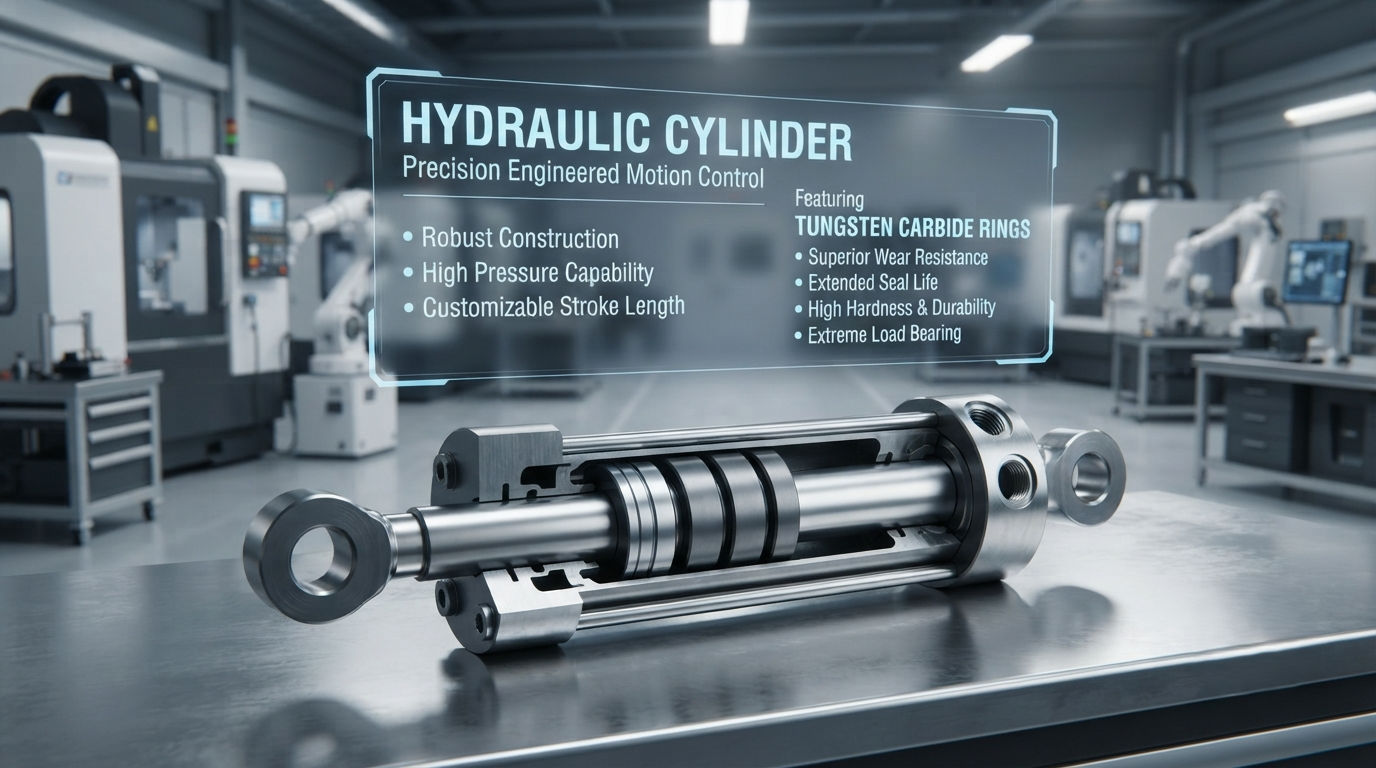
Depend on components that can handle pressure, friction, heavy loads, and continuous operation without compromising performance. Two important engineering products used across demanding industrial environments are the Hydraulic Cylinder and Tungsten Carbide Rings. Although they perform completely different functions, both contribute significantly to equipment reliability, productivity, and operational efficiency.
A Hydraulic Cylinder converts hydraulic energy into controlled linear motion, making it essential for lifting, pushing, pulling, pressing, and positioning operations. Tungsten Carbide Rings, on the other hand, are engineered for exceptional hardness, wear resistance, and dimensional stability in applications exposed to friction and demanding operating conditions.
Understanding their construction, advantages, applications, and selection criteria can help industries make better equipment and maintenance decisions.
What Is a Hydraulic Cylinder?
A Hydraulic Cylinder is a mechanical actuator that generates linear force using pressurized hydraulic fluid. It normally consists of a cylinder barrel, piston, piston rod, seals, cylinder head, and end caps.
When hydraulic fluid enters the cylinder chamber, pressure acts against the piston and creates movement. This simple but powerful operating principle allows hydraulic systems to produce substantial force while maintaining precise control.
Major Components of a Hydraulic Cylinder
The performance of a hydraulic cylinder depends on several carefully manufactured parts:
-
Cylinder barrel for containing hydraulic pressure
-
Piston for converting fluid pressure into movement
-
Piston rod for transferring mechanical force
-
Rod and piston seals for preventing fluid leakage
-
Cylinder head and base for structural support
-
Bearings or guide rings for controlled movement
Every component must work accurately together to achieve smooth operation and dependable service life.
Where Are Hydraulic Cylinders Used?
Industrial Hydraulic Cylinder systems are widely used because they can generate substantial force in relatively compact equipment.
Common applications include:
-
Construction machinery and earthmoving equipment
-
Agricultural machines and tractors
-
Material handling systems
-
Hydraulic presses
-
Mining and drilling machinery
-
Steel and metal processing equipment
-
Manufacturing automation
-
Marine equipment
-
Waste handling machinery
-
Heavy industrial lifting systems
Their ability to deliver controlled force makes hydraulic cylinders suitable for both mobile machinery and stationary industrial equipment.
Key Benefits of Hydraulic Cylinders
High-quality hydraulic cylinders can improve machine efficiency and provide dependable motion under demanding operating conditions.
High Force Output
Hydraulic pressure allows a relatively compact actuator to generate considerable pushing or pulling force. This is particularly valuable in heavy-duty machinery where available installation space may be limited.
Smooth and Controlled Movement
Properly designed cylinders provide consistent linear movement and can support applications requiring controlled positioning, lifting, or pressing.
Strong Industrial Construction
Cylinder barrels, rods, pistons, seals, and mounting components can be designed according to specific operating pressures, environmental conditions, loads, and duty cycles.
Customization for Specialized Machinery
Depending on application requirements, a Hydraulic Cylinder can be customized according to bore diameter, stroke length, mounting style, operating pressure, rod dimensions, sealing system, and material specifications.
This flexibility makes customized hydraulic solutions valuable for specialized industrial equipment.
What Are Tungsten Carbide Rings?
Tungsten Carbide Rings are precision-engineered components made primarily from tungsten carbide combined with a metallic binder. Tungsten carbide is valued in industrial engineering because of its exceptional hardness and resistance to wear.
Unlike conventional components that may wear relatively quickly in abrasive environments, carbide rings can maintain their dimensions and surface characteristics for considerably longer when correctly selected for the operating conditions.
Important Properties of Tungsten Carbide Rings
The primary characteristics associated with quality carbide rings include:
-
Excellent hardness
-
High wear resistance
-
Good dimensional stability
-
Resistance to abrasive conditions
-
Strong compressive strength
-
Extended service potential
-
Precision-machined surfaces
-
Suitability for demanding operating environments
These properties make Tungsten Carbide Rings useful wherever conventional materials experience excessive wear.
Industrial Applications of Tungsten Carbide Rings
Carbide rings can serve different purposes depending on their grade, geometry, surface finish, and machine design.
They are commonly considered for:
-
Mechanical seal assemblies
-
Pumps and rotating equipment
-
Oil and gas machinery
-
Wire and rod processing
-
Industrial rollers
-
Precision engineering systems
-
Wear-resistant machine components
-
Chemical processing machinery
-
Mining equipment
-
Metal manufacturing operations
Correct grade selection is important because different industrial conditions expose carbide components to varying combinations of abrasion, pressure, temperature, impact, and corrosive media.
Hydraulic Cylinder vs Tungsten Carbide Rings
Although both products are important industrial components, their functions are fundamentally different.
| Feature | Hydraulic Cylinder | Tungsten Carbide Rings |
|---|---|---|
| Primary Purpose | Creates linear mechanical motion | Resists wear and supports precision applications |
| Operating Principle | Hydraulic fluid pressure | Material hardness and wear resistance |
| Main Characteristics | High force and controlled movement | Hardness and dimensional stability |
| Typical Applications | Lifting, pushing, pressing and positioning | Sealing, rolling and wear-resistant systems |
| Maintenance Focus | Fluid, seals, rods and leakage | Surface wear and dimensional condition |
| Customization | Bore, stroke, pressure and mounting | Grade, size, geometry and finish |
Both products contribute to equipment reliability, but each addresses a different engineering requirement.
How to Choose a Hydraulic Cylinder
Choosing the right Hydraulic Cylinder should involve more than matching basic dimensions.
Consider the following factors:
-
Required pushing or pulling force
-
Operating pressure
-
Bore size
-
Stroke length
-
Piston rod diameter
-
Mounting configuration
-
Operating speed
-
Hydraulic fluid compatibility
-
Temperature range
-
Working environment
-
Expected duty cycle
-
Seal material
Incorrect specifications may result in leakage, inefficient movement, premature seal damage, rod problems, or reduced equipment performance.
How to Select Tungsten Carbide Rings
Selecting Tungsten Carbide Rings requires careful evaluation of the actual application.
Important considerations include carbide grade, binder composition, ring dimensions, dimensional tolerances, required surface finish, operating speed, pressure, abrasive exposure, chemical environment, and expected mechanical loading.
Why Precision Manufacturing Matters
Small dimensional variations can create major performance differences in precision industrial systems.
Quality manufacturing helps provide:
-
Accurate dimensions
-
Consistent geometry
-
Controlled tolerances
-
Smooth surface finishing
-
Reliable fitting
-
Reduced premature wear
Material Grade Is Equally Important
Not every tungsten carbide grade performs identically. The correct balance between hardness and toughness should be selected according to operating conditions rather than choosing a material solely because it has the highest hardness value.
Maintenance Tips for Better Service Life
Proper maintenance can help both products deliver more dependable long-term performance.
For hydraulic cylinders, regularly inspect the piston rod, hydraulic seals, fluid condition, mounting points, leakage, alignment, and operating pressure.
For Tungsten Carbide Rings, monitor contact surfaces, alignment, dimensional wear, lubrication conditions where applicable, and signs of abnormal loading.
Preventive inspection can identify developing issues before they become expensive equipment failures.
Frequently Asked Questions
1. What is the main function of a Hydraulic Cylinder?
A Hydraulic Cylinder converts hydraulic fluid pressure into linear mechanical force for pushing, pulling, lifting, pressing, or positioning equipment.
2. What industries commonly use hydraulic cylinders?
They are widely used in construction, agriculture, manufacturing, mining, material handling, marine machinery, and heavy engineering.
3. Can hydraulic cylinders be customized?
Yes. Bore size, stroke, rod diameter, mounting style, seals, pressure ratings, and other specifications can be customized.
4. What causes hydraulic cylinder failure?
Common causes include seal damage, contaminated hydraulic fluid, incorrect alignment, excessive pressure, damaged piston rods, and inadequate maintenance.
5. Why are Tungsten Carbide Rings highly wear resistant?
Their extremely hard carbide structure provides excellent resistance against abrasion and surface wear in demanding industrial conditions.
6. Where are Tungsten Carbide Rings commonly used?
They can be used in mechanical seals, pumps, rollers, metal-processing systems, oil and gas equipment, and other wear-intensive machinery.
7. Are tungsten carbide rings stronger than steel rings?
They generally provide substantially greater hardness and wear resistance, although suitability depends on impact conditions, component design, and the specific carbide grade.
8. How do I select the correct carbide grade?
Selection should consider abrasion, impact, pressure, temperature, corrosion exposure, operating speed, and required toughness.
9. Why is surface finish important for carbide rings?
A precise surface finish can improve contact performance, dimensional accuracy, sealing behavior, and wear characteristics in suitable applications.
10. How can industrial component service life be improved?
Correct product selection, professional installation, proper alignment, scheduled inspection, suitable lubrication or hydraulic fluid, and preventive maintenance can significantly improve reliability.

 English
 Arabic
 French
 Spanish
 Portuguese
 Deutsch
 Turkish
 Dutch
Dutch
 Russian
 Romaian
 Portuguese (Brazil)
 Greek
Greek
 Bengali