


Compressor Oil Market to Reach USD 12.2 Billion by 2036 at 5.4% CAGR; India Leads at 6.9%, UK Trails at 4.1%
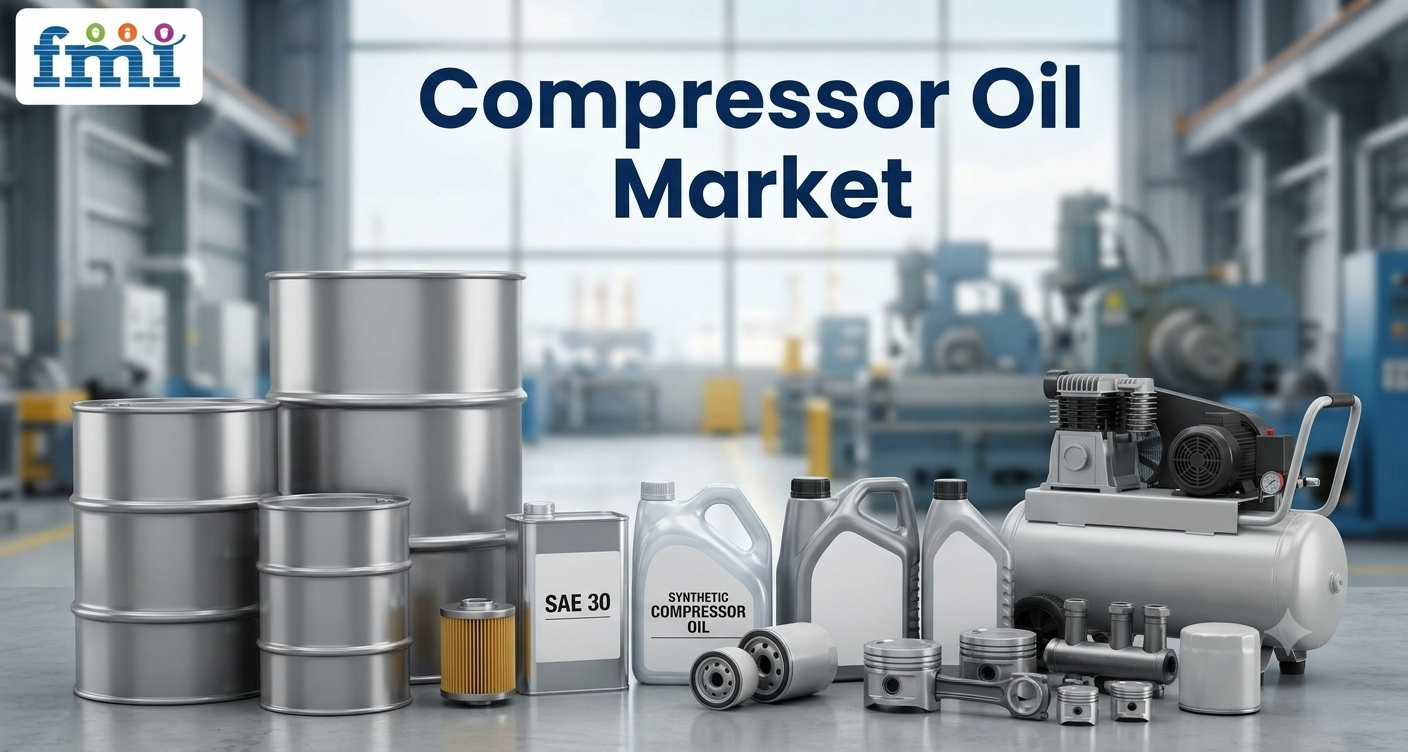
According to Future Market Insights, the global compressor oil market is projected to grow from USD 7.2 billion in 2026 to USD 12.2 billion by 2036, registering a 5.4% CAGR from 2026 to 2036. Synthetic oil is expected to account for 45.0% of oil type demand, while manufacturing and others are projected to represent 40.0% of end-use demand in 2026.
Market development is supported by industrial modernization, energy efficiency initiatives, and preventive maintenance programs. Manufacturing facilities, refrigeration systems, and industrial operations depend on compressor oils to reduce wear, maintain equipment performance, and manage maintenance requirements. The growing preference for high-performance synthetic formulations is also supporting demand for lubricants that offer oxidation stability and extended service intervals.
Get detailed market forecasts, competitive benchmarking, and pricing trends: https://www.futuremarketinsights.com/reports/sample/rep-gb-4871
Key Takeaways of the Compressor Oil Market
- The market is projected to reach USD 12.2 billion by 2036, growing at a 5.4% CAGR from 2026 to 2036.
- Market value is estimated at USD 7.2 billion in 2026.
- Synthetic oil is projected to account for 45.0% of oil type demand in 2026.
- Manufacturing and others are expected to represent 40.0% of end-use demand in 2026.
- India is projected to record the highest country-level growth at a 6.9% CAGR through 2036.
- China is expected to grow at 6.5%, followed by the United States at 6.2%.
- Key companies include ExxonMobil, Shell, Chevron, TotalEnergies, BP, FUCHS Petrolub SE, Quaker Houghton, Valvoline, Phillips 66, and Sinopec.
How Is the Compressor Oil Market Segmented?
The market is segmented by oil type, end use, compressor type, and region.
Oil types include synthetic, mineral, semi-synthetic, and bio-based oils. End-use applications cover manufacturing and others, HVAC-R, oil and gas, automotive, and power generation.
Compressor types include air compressors, such as rotary screw, reciprocating, centrifugal, and vane and axial compressors, alongside refrigeration compressors, including screw, scroll, and reciprocating types. Regional coverage includes Asia Pacific, Europe, North America, Latin America, and the Middle East and Africa.
Why Does Synthetic Oil Lead the Oil Type Segment?
- Synthetic oils offer oxidation stability and viscosity performance for demanding operating conditions.
- Extended drain intervals can reduce the frequency of lubricant replacement and maintenance interventions.
- Wear protection and thermal resistance support equipment reliability across continuous-duty industrial applications.
Synthetic oil is projected to account for 45.0% of oil type demand in 2026. Its suitability for demanding operating environments and potential to support longer service intervals strengthen its position among industrial users seeking improved equipment performance.
Why Does Manufacturing and Others Lead End-Use Demand?
- Manufacturing facilities rely on compressed-air systems to support production equipment and factory operations.
- Preventive maintenance programs encourage the use of lubricants that help reduce wear and unplanned downtime.
- Industrial modernization increases demand for oils compatible with updated compressor systems and operating requirements.
What Are the Key Dynamics in the Compressor Oil Market?
Industrial modernization, energy efficiency, maintenance optimization, and advances in lubricant formulations shape market development.
- Driver: Industrial operators are prioritizing equipment reliability, reduced downtime, and improved energy performance, supporting demand for high-performance compressor oils.
- Restraint: Raw material price volatility, formulation complexity, and the upfront cost of premium synthetic oils can influence purchasing decisions.
- Opportunity: Synthetic formulations, extended drain intervals, OEM partnerships, and condition-monitoring solutions create opportunities for lubricant suppliers.
Compressor oils help protect moving components, manage friction, and maintain lubrication under different operating temperatures and workloads. As manufacturing facilities modernize equipment, lubricant selection increasingly considers operating conditions, compressor design, compatibility, and total maintenance costs.
Which Country CAGRs Are Profiled in the Market?
- India: 6.9% CAGR
- China: 6.5% CAGR
- United States: 6.2% CAGR
- Japan: 4.6% CAGR
- Germany: 4.4% CAGR
- Brazil: 4.2% CAGR
- United Kingdom: 4.1% CAGR
These growth rates represent the country-level forecasts through 2036.
How Do Country-Level CAGRs Shape the Market?
- India: The market is projected to grow at a 6.9% CAGR, supported by manufacturing expansion, industrial modernization, and increasing requirements for reliable compressed-air systems.
- China: Growth is forecast at a 6.5% CAGR, reflecting industrial upgrades and demand for energy-efficient lubrication across manufacturing operations.
- United States: The market is projected to register a 6.2% CAGR, supported by advanced manufacturing, preventive maintenance, and adoption of synthetic lubricants.
- Japan: Growth is forecast at a 4.6% CAGR, reflecting precision manufacturing, industrial automation, and equipment reliability requirements.
- Germany: The market is expected to grow at a 4.4% CAGR, supported by its industrial base and demand for high-performance lubrication.
- Brazil: Growth is projected at a 4.2% CAGR, supported by industrial modernization and lubricant adoption across manufacturing and process industries.
- United Kingdom: The market is forecast to expand at a 4.1% CAGR, reflecting continued investment in industrial efficiency and maintenance practices.
Which Companies Are Notable in the Compressor Oil Market?
ExxonMobil, Shell, Chevron, TotalEnergies, BP, FUCHS Petrolub SE, Quaker Houghton, Valvoline, Phillips 66, and Sinopec are among the companies profiled in the market.
Competition focuses on lubricant performance, product compatibility, OEM approvals, technical support, and service life. Suppliers seek to meet the requirements of manufacturing plants, HVAC-R operators, automotive facilities, and oil and gas businesses.
Product development increasingly emphasizes synthetic formulations, oxidation stability, wear protection, and longer drain intervals.
Explore More Related Studies Published by FMI Research:
FMI Custom Research: Strategic Intelligence for Confident Decision-Making
In today's rapidly evolving construction environment, leadership teams need more than market data—they need actionable intelligence tailored to their strategic priorities. FMI's Custom Research solutions help organizations evaluate growth opportunities, validate investments, assess competitive dynamics, understand technology adoption, and reduce uncertainty before making critical business decisions.
Key Executive Benefits
- Decision-Ready Insights: Research tailored to specific business challenges, expansion plans, technology priorities, and investment requirements.
- Reduced Strategic Risk: Validate market opportunities, customer demand, competitive positioning, and technology adoption before committing resources.
- Market Entry Confidence: Assess opportunity size, regulatory barriers, distribution dynamics, project specifications, and competitive landscapes before entering new markets.
- Competitive Advantage: Gain proprietary intelligence unavailable through syndicated reports or internal datasets.
- Faster Growth Decisions: Accelerate market expansion, product development, portfolio optimization, partnerships, and investment planning.
Business Impact
FMI helps organizations transform market complexity into strategic clarity, enabling leadership teams to identify growth opportunities faster, optimize resource allocation, strengthen competitive positioning, and make high-stakes business decisions with confidence.
To explore how FMI Custom Research can support your strategic priorities, connect with the team at sales@futuremarketinsights.com.

 English
 Arabic
 French
 Spanish
 Portuguese
 Deutsch
 Turkish
 Dutch
Dutch
 Russian
 Romaian
 Portuguese (Brazil)
 Greek
Greek
 Bengali