


3D Metrology Market Demand for Faster Inspection Technologies
Manufacturers are under increasing pressure to produce components that meet exact specifications while minimizing defects, waste, and production delays. The 3D Metrology Market is gaining momentum as industries adopt advanced measurement technologies to verify dimensions, inspect surfaces, and assess product quality with greater precision.
3D Metrology Market Valued at USD 10.4 billion in 2023, the global market is projected to grow from USD 14.2 billion in 2026 to USD 19.6 billion by 2030, registering a CAGR of 9.5% from 2024 to 2030. Demand is supported by the growing importance of quality assurance across automotive, aerospace, heavy machinery, electronics, energy, construction, and medical device manufacturing.
Unlike conventional measurement approaches, 3D metrology creates detailed representations of physical objects, helping engineers compare manufactured components against design specifications and identify deviations before they affect product performance.
When Micron-Level Accuracy Becomes a Competitive Advantage
- Market value: USD 10.4 billion in 2023
- Projected value: USD 19.6 billion by 2030
- Growth rate: 9.5% CAGR from 2024 to 2030
- Leading component: Hardware, with 66.7% revenue share in 2023
- Leading application: Quality control and inspection
- Largest regional market: North America, with 34.5% revenue share in 2023
From Inspection Rooms to Real-Time Production Lines
One of the most important developments in the 3D metrology industry is the movement of measurement activities closer to the manufacturing process itself.
Traditional inspection workflows can require parts to be removed from production, transported to measurement areas, and checked separately. Integrating metrology into production lines enables manufacturers to obtain measurements more quickly and respond to quality issues earlier.
This shift is closely connected to Industry 4.0, where connected equipment, robotics, automated inspection, and real-time data exchange support more responsive manufacturing operations.
AI-assisted measurement systems can analyze collected data, detect anomalies, and support automated adjustments. Robotic inspection also improves repeatability and reduces the need for manual intervention in repetitive measurement tasks.
These capabilities are particularly valuable when manufacturers need to inspect complex geometries, maintain consistent tolerances, or assess large numbers of components within limited production cycles.
Download a free sample report or claim your copy of this full market intelligence report
The Technology Stack: Where Market Demand Is Concentrated
The market is developing across hardware, services, specialized measurement equipment, and increasingly automated inspection applications.
Hardware Provides the Measurement Foundation
Hardware accounted for 66.7% of market revenue in 2023. Coordinate measuring machines (CMMs) represented the largest hardware category, supported by demand for accurate dimensional inspection in automotive, aerospace, heavy machinery, and electronics manufacturing.
CMMs help verify component dimensions against engineering specifications, making them important in industries where small measurement deviations can affect assembly, reliability, or safety.
However, hardware adoption also creates demand for calibration, system integration, maintenance, and operator training. Consequently, the services segment is projected to grow at a CAGR of 10.0% over the forecast period as companies seek to maximize equipment performance and integrate measurement systems into existing workflows.
Automated Optical Inspection Expands Quality Monitoring
Three-dimensional automated optical inspection systems are gaining importance, particularly in electronics manufacturing. These systems help inspect components on printed circuit boards and identify defects that may be difficult to detect using conventional inspection methods.
As production processes become more complex, manufacturers require inspection systems capable of delivering consistent results at higher speeds.
3D Scanning Makes Complex Measurements More Accessible
The 3D scanning application segment is anticipated to record the fastest CAGR from 2024 to 2030. Scanners capture large numbers of data points to generate detailed digital representations of physical objects.
These capabilities support reverse engineering, rapid prototyping, dimensional verification, and product development. In healthcare, scanning can also support face and body measurement applications.
In September 2023, 3DMakerpro introduced the SEAL and SEAL Lite scanners, reflecting ongoing efforts to expand access to 3D scanning technology. Earlier, in March 2022, Shining 3D introduced the FreeScan UE Pro, combining photogrammetry and laser technology for large-scale inspection and reverse engineering.
Why Quality Control Remains the Core Application
Quality control and inspection accounted for the largest application revenue share in 2023. The segment benefits from manufacturers' need to maintain consistent product quality, comply with recognized standards, and reduce costly production errors.
Three industry requirements are especially important:
- Dimensional consistency: Components must match specified dimensions and tolerances.
- Defect identification: Surface imperfections and geometric deviations need to be detected before products reach customers.
- Repeatable inspection: Automated measurement can improve consistency across production batches and manufacturing facilities.
Aerospace and defense represented the largest end-use segment in 2023. Aircraft components operate under demanding conditions, making accurate measurement essential during manufacturing, maintenance, and quality verification.
The medical segment is expected to grow at the fastest rate from 2024 to 2030. Medical implants, prosthetics, dental products, and diagnostic equipment require precise measurements to support safety, fit, and performance. Regulatory requirements and quality standards further strengthen the need for reliable metrology systems.
Regional Competition: Manufacturing Strength Drives Adoption
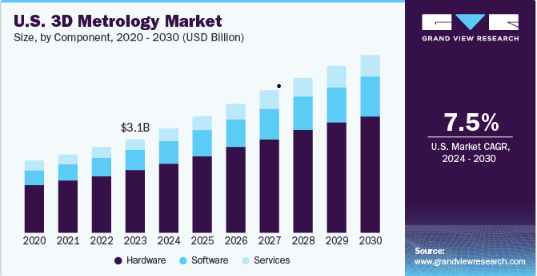
North America held 34.5% of global market revenue in 2023. The region benefits from established manufacturing capabilities, aerospace and pharmaceutical production, semiconductor activity, and investment in automation. The U.S. 3D metrology market is anticipated to grow at a CAGR exceeding 7% from 2024 to 2030.
Asia Pacific is projected to be the fastest-growing regional market, with a CAGR of 10.9% during the same period. Its extensive manufacturing base across automotive, electronics, aerospace, and industrial equipment supports demand for high-precision measurement technologies.
India's 3D metrology market is expected to grow at a CAGR of 13.8% from 2024 to 2030, supported by increasing automation, non-contact measurement adoption, and demand for improved product quality. China is also expected to record growth exceeding 10.0% as precision engineering and industrial manufacturing expand.
Europe remains an important market, with projected growth exceeding 8.4% from 2024 to 2030. Its emphasis on quality assurance, advanced engineering, additive manufacturing, and automated production processes supports continued investment in metrology solutions.
Key Companies
The competitive landscape includes established measurement technology providers and specialized optical inspection developers.
- FARO Technologies: Offers 3D measurement, imaging, laser scanning, measurement arms, and software for processing scan data and supporting CAD-related workflows.
- Hexagon AB: Provides metrology-assisted manufacturing technologies designed to improve measurement accuracy, automation, and production efficiency.
- 3D Systems Inc.: Identified among the leading companies profiled in the market.
- Carl Zeiss AG: Identified among the leading companies profiled in the market.
- Carl Zeiss GOM Metrology: Identified among the leading companies profiled in the market.
- Heliotis AG: Develops optical 3D measurement technologies for industrial quality control, including laboratory and automated measurement systems.
- Metrologic Group: Specializes in 3D measurement software and quality-control solutions, including its Metrolog XG platform.
Research investment, product development, and strategic collaborations remain important competitive approaches. For example, Ricoh partnered with North Carolina State University to advance additive manufacturing applications in medical device production and surgical planning.
What Will Determine the Next Growth Phase?
The future of the 3D metrology market will depend on how effectively manufacturers integrate accurate measurement into increasingly automated production environments. Hardware innovation will remain important, but software, services, scanning technologies, and automated inspection will increasingly influence purchasing decisions.
As production requirements become more demanding, companies will seek solutions that combine precision, speed, repeatability, and compatibility with existing manufacturing systems. Providers that address these needs can benefit from growing demand for reliable quality control across industrial and medical applications.
With the global market projected to reach USD 19.6 billion by 2030, 3D metrology is positioned to remain an important technology for manufacturers seeking better product consistency and more efficient production processes.
Explore Our Research & Intelligence Solutions
Prism AI: Ask. Analyze. Get Cited Market Insights. – Explore Now
Grand View Signal: Understand the Factors Shaping Commodity Prices – Explore the Platform

 English
 Arabic
 French
 Spanish
 Portuguese
 Deutsch
 Dutch
Dutch
 Italiano
 Russian
 Romaian
 Portuguese (Brazil)
 Greek
Greek
 Bengali