


Why Ceramic Fiber Blankets Are Ideal for Energy-Efficient Furnaces
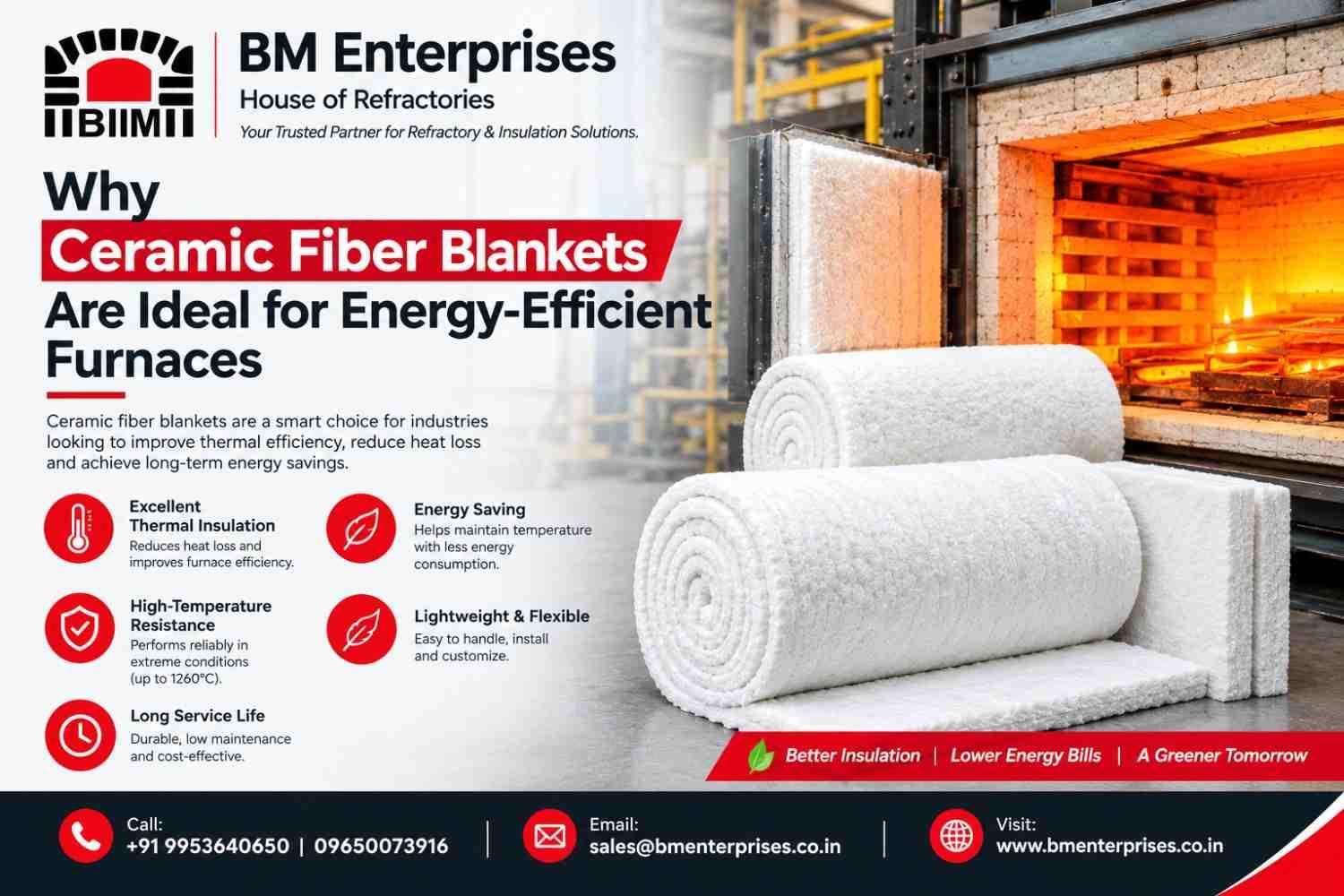
Efficiency in energy use has increasingly gained importance among industries working with furnaces, boilers, kilns, heat treatment facilities, etc. Excess heat loss from the walls and roofs of furnaces increases fuel consumption, operational costs, and makes temperature control harder. It is, thus, important to use the appropriate insulation material.
The use of ceramic fiber blankets has been common as an insulating material due to their low thermal conductivity, lightweight nature, flexible construction, and thermal shock resistance. This makes them ideal for installation in new furnaces, replacement of refractory lining, and insulation of industrial materials.
BM Enterprises was founded in 1988 and manufactures refractory and insulating materials for various industries. The company manufactures ceramic fiber insulation materials, Shree Cera ceramic blankets in particular, which can be used by customers who are looking for suitable Heat Insulation Materials.
What Are Ceramic Fiber Blankets?
The Ceramic Fiber Blanket is an insulating material in the form of a flexible blanket, composed of alumina-silica ceramic fiber material. The ceramic fibers are formed in a lightweight, needle-punched blanket form to provide insulation properties along with flexibility to cut and shape the blanket to fit around the equipment geometry.
As compared to standard dense refractory brick lining, the refractory insulation blankets have relatively lower thermal mass. This helps to reduce heat transfer through insulated surfaces and consumes less energy for heating of the insulating layer itself at start-up. Hence, they are very useful for industrial applications requiring rapid heating, controlled cooling, and thermal management.
There are different grades of Ceramic Fiber Blankets, which differ in densities, thickness, width, and temperature range of use. For example, standard densities of Ceramic Fiber Blankets are: 64 kg/m³, 96 kg/m³, 128 kg/m³, and 160 kg/m³.
Why Ceramic Fiber Blankets Improve Furnace Energy Efficiency
1. Decreased Heat Loss through Furnace Walls
Ceramic fiber blankets help decrease the heat flow through furnace walls and roofs, enabling efficient heat retention and decreased energy usage.
2. Low Thermal Capacity for Fast Heating
Because of their light structure, ceramic fiber blankets require little energy to heat up, which makes them well-suited for furnaces that have often recurring periods of heating and cooling.
3. Better Temperature Control
Ceramic fiber blankets enable improved temperature control within the furnace.
4. Lightweight Structure
Being easy to cut and install around furnace walls, doors, ducts, and irregular surfaces, ceramic fiber blankets offer good insulation while being lightweight.
5. Ability to Withstand Thermal Shock
Being designed for high-temperature applications, proper ceramic fiber blankets can withstand temperature changes throughout their operational range.
6. Possible Decrease in Operating Costs
Because of heat loss reduction and increased energy efficiency, ceramic fiber blankets may help save on energy expenses of a furnace. Savings vary depending on insulation type, operational mode, and installation quality.
Types of Ceramic Fiber Blankets Available from BM Enterprises
BM Enterprises provides industrial clients with ceramic fiber insulation materials. The choice of the density and thickness of the material depends on the needs of the project and technical information from the manufacturer.
Ceramic Fiber Blankets 64 kg/m³
The ceramic fiber blankets 64 kg/m³ are lightweight insulation materials that may be used where it is important to have lightness and thermal resistance.
It will depend on the thickness needed for the insulation, its strength during handling, installation configuration, and operating environment. If there are stresses applied to the structure or the need for maintenance is high, a heavier material should be used.
Ceramic Fiber Blanket Density 128 kg/m³
A company supplying ceramic fiber blanket density 128 kg/m³ is another common request by industrial consumers looking for furnace insulation products.
For example, BM Enterprises provides ceramic blankets having an average density of 128 kg/m³. Among those that are specified in the company’s list is a Shree Ceramic blanket specification with a roll size of about 7.30 m × 0.61 m × 25 mm and a temperature rating of 1260°C. The thermal conductivity of the material is about 0.15 W/m·K at 600°C.
The above-mentioned data can be used only for reference purposes, as it is specific to each particular product. It is necessary to verify all the parameters of the material.
Ceramic Blankets in Different Thicknesses
There are different thicknesses of ceramic blankets ranging from 6 mm, 12 mm, 20 mm, 25 mm, and 50 mm.
While thicker insulation can lower the heat transfer, the ultimate effectiveness of the insulation depends on the thermal conductivity at the mean temperature, quality of insulation, emissivity of surfaces, and other system parameters. Thermal design calculations must be done to find out the necessary thickness.
Technical Specifications of Ceramic Fiber Blankets
The following table provides an overview of commonly specified ceramic blanket options. Availability and exact values should be verified for the selected product grade.
| Specification | Typical options or reference details |
| Material composition | Alumina-silica ceramic fiber |
| Colour | White |
| Density | 64, 96, 128 and 160 kg/m³, depending on grade |
| Thickness | 6, 12, 20, 25 and 50 mm, depending on product |
| Reference temperature classification | Up to 1260°C for the listed standard configuration |
| Listed roll size | Approximately 7.30 m × 0.61 m × 25 mm |
| Thermal conductivity | Approximately 0.15 W/m·K at 600°C for the listed 128 kg/m³ configuration |
| Form | Flexible blanket rolls |
| Packaging | HDPE wrapping or box, depending on the product |
| Typical applications | Furnaces, boilers, kilns, ducts and industrial heating equipment |
Important technical note: Classification temperature is not necessarily the recommended continuous operating temperature. The maximum permissible service temperature depends on the specific grade and service conditions. Always use the manufacturer's current technical documentation for engineering decisions.
Industrial Applications of Ceramic Fiber Insulation Materials
Industrial Furnaces
Fiber ceramic blankets are used as lining material for walls and roofs, backup insulation, doors, and hot faces as well. The lightweight nature of such material may prove to be an advantage in case equipment is subject to constant heating and cooling.
Boilers and Combustion Systems
In boilers that have proper design for it, ceramic fiber insulation can be used as insulation for heat-exposed parts, cases, ducts, and other equipment. It is necessary to consider the temperature of operation, vibrations, gases, and mechanical protection.
Kilns and Ceramic Manufacturing
Repeated heating and temperature profiles usually characterize ceramic manufacturing. Ceramic blankets can be used as insulation material in suitable kiln designs.
Steel and Metal Processing
Heat-treating furnaces, annealing machines, and other processes that use metals may require ceramic fiber insulation for creating the right thermal environment. The appropriate grade of blankets should be determined based on process temperature, atmospheres, and susceptibility to mechanical abuse.
Petrochemical and Process Industries
Ceramic fiber insulation products can also be utilized in selected heating units, conduits, expansion joints, and process equipment. Every application needs to take into consideration the chemical compatibility, temperature limitations, and safety guidelines.
Ceramic Blankets vs. Conventional Refractory Insulation
It cannot be stated that one material – either ceramic fiber blanket or dense refractory materials – is always better than another.
Ceramic fibers are flexible materials, have comparatively low thermal mass, and are easy to install on complicated geometrical forms. Dense refractory materials can be stronger, resistant to erosion, and suitable for places of severe abrasion and impact load.
In some cases, a combined solution consisting of refractory material facing the fire and ceramic fiber insulation can be efficient. The choice of the lining material depends on several factors, including operating temperature, heat flux, and many other aspects.
How to Select the Right Ceramic Fiber Blanket
Prior to buying ceramic fiber blankets, certain technical criteria need to be assessed.
Operational temperatures: The process operating temperatures need to be determined. A blanket that has a suitable continuous operation rating and adequate heat resistance needs to be chosen.
Thickness of the insulation layer: It needs to be calculated what heat loss is required, what the allowable surface temperature is, and how much room there is for the installation. This is done by a professional engineer.
Density and strength of the blanket: Lighter density ceramic fiber blankets can be used for some light insulation, whereas the denser blankets can have better installation strength. Density does not always determine the efficiency of the insulation.
Thermal conductivity: The conductivity of the product should be compared at various mean temperatures, based on the tests done by the manufacturer. Generally, the conductivity increases with increasing temperature.
Chemical and atmospheric conditions: These need to be taken into account as to whether there is any presence of alkali and process gases.
Why Choose BM Enterprises as Your Ceramic Fiber Blankets Supplier in India?
Since 1988, BM Enterprises has been offering refractory and insulating materials to its customers working in fields like industrial heating, furnace repair, and thermal insulation works.
Ceramic fiber insulation is one of the products offered by BM Enterprises along with refractory bricks, castables, mortars, calcium silicate boards, and many other industrial materials. The ceramic fiber blanket products line consists of products designed for applications in which heat resistance, flexibility, and thermal insulation are crucial.
If you are seeking a ceramic fiber blankets supplier in India, please contact BM Enterprises in order to consult about the desired density, thickness, roll size, operating temperature, quantity, and delivery address.
If you need a ceramic fiber blankets manufacturer in India, it is necessary to keep in mind the difference between the real manufacturer and a distributor or supplier. BM Enterprises offers insulation products and may help you choose product specifications. Please make sure that you receive information about the manufacturing location and product brand.
Whether you require ceramic fiber blankets 64 kg/m³ or a ceramic fiber blanket density of 128 kg/m³ you require, please give detailed information about your application.
Safe Handling, Storage and Installation
Fibrous ceramic blanket insulation should be stored in a safe, dry place in the same original packaging until needed. Do not contaminate, compress, or damage the materials in any way that would impact the quality of the installation process.
When cutting or installing these insulation materials, always observe the information contained on the manufacturer's Safety Data Sheet, as well as the relevant workplace policies. Appropriate protection should be worn to protect skin, eyes, and respiratory organs from hazards.
If there is a need for protective facings or coatings to prevent erosion of fibers, install them. Follow the manufacturer's guidelines for anchorages, joints, expansion, and hot face protection.
For high-temperature furnaces, insulation installation should be carried out by qualified professionals only. Proper installation and material choice are crucial to achieve the desired results.
Frequently Asked Questions
1. How do ceramic fiber blankets make energy-efficient furnaces?
Low thermal conductivity and low thermal mass properties of ceramic fiber blankets allow you to decrease energy losses and achieve the necessary temperature faster.
2. What is the difference between 64 kg/m³ and 128 kg/m³ ceramic fiber blankets?
These numbers refer to the density of the materials. A 64 kg/m³ blanket will be lightweight, whereas a 128 kg/m³ blanket has more fiber mass in each volume unit. Which one to choose depends on specific conditions.
3. What temperature can ceramic fiber blankets endure?
This value varies by type. According to BM Enterprises, a typical configuration of a ceramic blanket can withstand up to 1260°C. However, this number cannot be taken as a universal limit because it should be determined based on technical data sheets from the producer.
4. In what applications are refractory blankets found?
Refractory blankets are found in compatible furnace lining applications, boilers, kilns, industrial heaters, ductwork, expansion joints, and certain high-temperature processes. The specific blanket will be determined by the conditions of use and lining design.
5. Is it possible to lower industrial energy costs through the use of ceramic blankets?
Yes. By lowering heat losses and lowering the amount of insulation mass that has to be heated, ceramic blankets can potentially lower the energy requirement. Energy savings will depend on the existing lining material, furnace design, frequency of use, thickness of insulation, and installation method.
6. How do I order ceramic fiber blankets from BM Enterprises?
Contact BM Enterprises with your required density, thickness, temperature resistance, roll dimensions, quantity, and delivery address. They will assist you in determining availability and appropriate product configuration.
Conclusion
The use of Ceramic Fiber Blankets is one of the effective options for insulation in industrial furnaces because of their low thermal conductivity, light weight, flexibility, and resistance to thermal shock.
BM Enterprises provides the Ceramic Fiber Insulation materials required by industrial clients looking for Heat Insulation Materials for furnaces, boilers, kilns, and other similar equipment. Whether it is 64 kg/m³ Ceramic Fiber Blankets or 128 kg/m³ Ceramic Fiber Blankets, the proper choice must always be made according to proven technical specifications.
Contact BM Enterprises for Ceramic Fiber Blankets
Website: www.bmenterprises.co.in
Email: sales@bmenterprises.co.in
Phone: +91 9953640650 | +91 9650073916
Location: Faridabad, Haryana, India – 121015

 English
 Arabic
 French
 Spanish
 Portuguese
 Turkish
 Dutch
Dutch
 Italiano
 Russian
 Romaian
 Portuguese (Brazil)
 Greek
Greek
 Bengali