


India Pre Engineered Buildings Market to Reach USD 34.25 Billion by 2035
Market Overview
According to Market Research Future® (MRFR), the India Pre Engineered Buildings Market is expected to expand significantly between 2026 and 2035, supported by demand for efficient construction methods, logistics infrastructure, affordable housing, and specialized industrial facilities. Pre-engineered buildings (PEBs) use components designed and manufactured in advance before being transported and assembled at the project site. This approach can help streamline construction schedules and provide flexibility for facilities that require adaptable layouts or faster project delivery.
PEBs can serve a range of applications, from commercial buildings and industrial facilities to modular structures and other prefabricated building formats. Material options include concrete, metal, glass, timber, and other materials, while product categories include modular buildings, panelized and componentized systems, and other prefab types. This broad structure allows the market to address different project requirements, including cost, functionality, durability, and construction timelines.
India’s ongoing urban and industrial development creates opportunities for construction companies, component manufacturers, project developers, and building-system providers. As customers seek greater predictability in project execution, pre-engineered solutions may gain attention where standardized components and coordinated installation offer practical advantages.
Market Size Reached in 2025
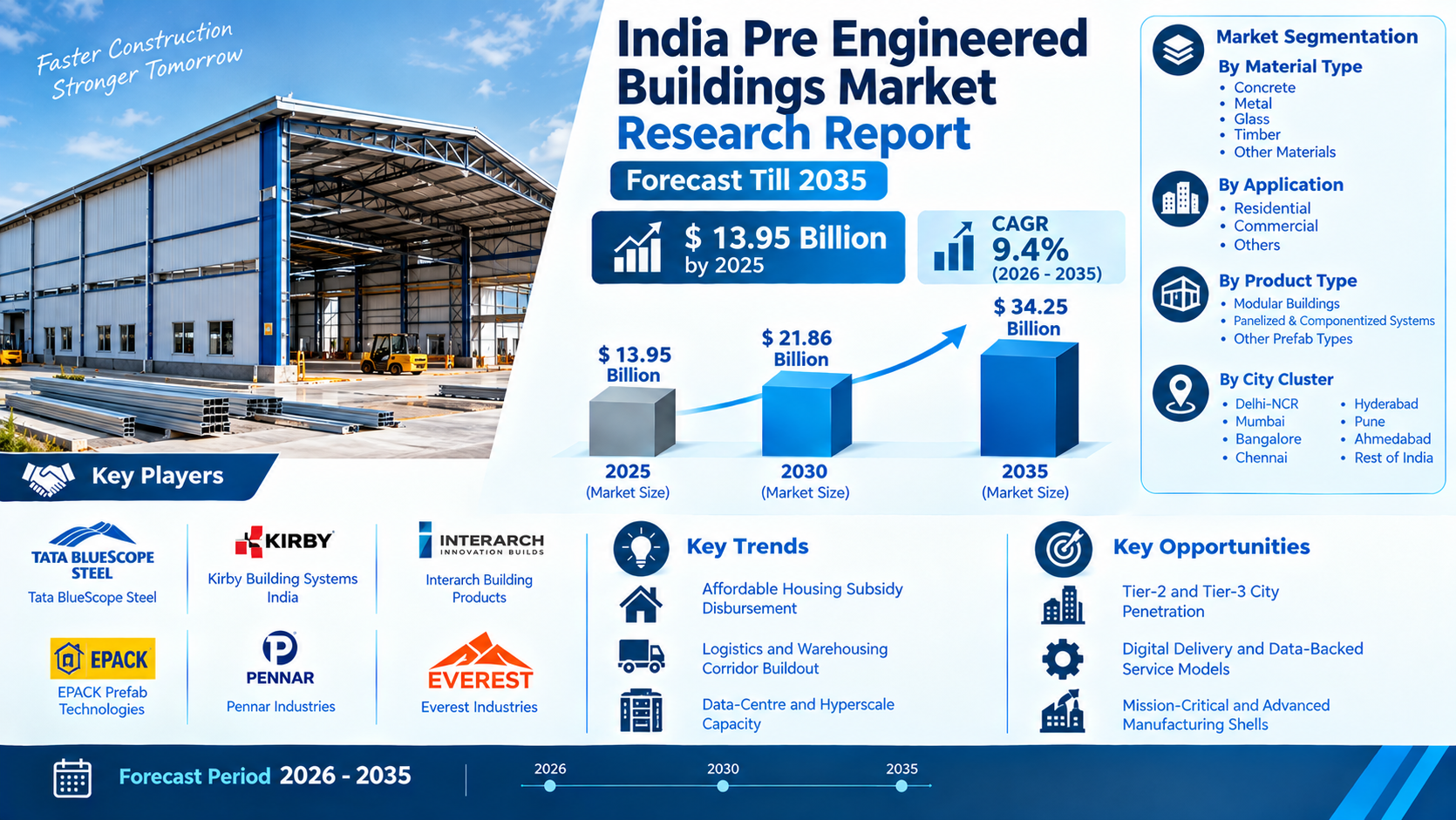
The India Pre Engineered Buildings Market reached USD 13.95 billion in 2025, establishing the baseline for the forecast period. This market size reflects demand across residential, commercial, and other applications, supported by a range of building materials and prefabricated construction formats. The diversity of applications means that market development depends on several types of investment rather than one construction segment alone.
Residential demand can be influenced by housing availability, affordability, and the need for efficient project delivery. Commercial and industrial demand may come from warehouses, logistics facilities, data centers, and buildings designed for manufacturing or other business operations. These projects can have different structural and technical requirements, making it important for suppliers to match building systems with intended use.
Product selection also influences project design. Modular buildings can support repeatable layouts, while panelized and componentized systems allow building elements to be manufactured before installation. The suitability of each option depends on project specifications, site conditions, design requirements, and local construction practices.
Expected Market Size by 2035
The market is forecast to reach USD 34.25 billion by 2035, reflecting a substantial increase over the 2025 level. The intermediate forecast places market size at USD 21.86 billion in 2030, illustrating the expected expansion across the decade. This outlook creates opportunities for manufacturers, developers, engineering firms, contractors, and suppliers of prefabricated components.
As demand grows, companies may focus on production capacity, design capabilities, installation coordination, and the ability to support projects across multiple locations. Standardized components can help improve repeatability, but successful delivery still requires accurate engineering, quality control, transportation planning, and site coordination. Providers that integrate these activities may be better equipped to serve clients seeking dependable project schedules and building performance.
Demand may also evolve as new types of facilities become more prominent. Logistics networks require warehouses and distribution facilities, while data centers and advanced manufacturing sites can need buildings designed around specialized operational requirements. These uses create opportunities for PEB providers with suitable technical expertise.
Market CAGR
The India Pre Engineered Buildings Market is expected to grow at a CAGR of 9.4% from 2026 to 2035. This projected expansion reflects opportunities associated with urban development, logistics infrastructure, commercial construction, and the growing need for specialized facilities. The forecast indicates a positive outlook for prefabricated construction solutions, although individual application categories may develop at different rates.
Growth will depend on project financing, construction demand, material costs, design standards, and the ability of suppliers to meet customer specifications. Pre-engineered systems may offer advantages in planning and assembly, but their suitability varies by building type and project conditions. Developers must consider lifecycle performance, site requirements, safety standards, and operational needs when selecting a construction approach.
Key Growth Drivers
Affordable housing subsidy disbursement is one of the trends shaping the market outlook. Housing initiatives can support construction activity and encourage stakeholders to explore building approaches that balance affordability with practical performance. Pre-engineered and prefabricated systems may offer advantages where designs can be standardized and construction activities coordinated efficiently. Adoption, however, depends on the suitability of these systems for local housing needs, regulatory requirements, and buyer expectations.
Logistics and warehousing corridor development is another important demand driver. Distribution networks need storage facilities that can accommodate inventory, transport operations, and changing business requirements. Pre-engineered buildings can be attractive for warehouse projects because their layouts can be designed around operational needs and their components prepared ahead of on-site assembly. Project scale, location, clear-span requirements, and delivery timelines can influence the choice of building system.
Data-center and hyperscale capacity represents a further opportunity. These facilities require carefully planned structures and coordination with electrical, cooling, and other technical infrastructure. PEB providers may participate by supplying suitable building shells and supporting construction schedules. The opportunity depends on the specifications of each project and the capability of suppliers to work with specialized engineering and construction teams.
Emerging Market Trends
Digital delivery and data-backed service models are becoming relevant to construction planning. Digital design coordination, project tracking, and data-supported workflows can help stakeholders manage design changes, material requirements, and installation schedules. Better coordination can reduce avoidable delays and support more predictable delivery, although the results depend on the quality of implementation and collaboration between project participants.
Another trend is the potential expansion of PEB adoption beyond established industrial and commercial applications. Tier-2 and Tier-3 cities may offer opportunities as businesses, logistics providers, and property developers explore new locations. Suppliers that can provide standardized products, local project support, and flexible delivery arrangements may be able to reach customers in a wider range of markets.
Competitive Landscape
Key companies identified in the India Pre Engineered Buildings Market include Tata BlueScope Steel, Kirby Building Systems India, Interarch Building Products, EPACK Prefab Technologies, Pennar Industries, and Everest Industries. Competition can be influenced by design expertise, manufacturing capabilities, product quality, installation coordination, and the ability to meet varied project requirements.
As demand develops, companies may seek to differentiate themselves through digital project services, modular solutions, and the capacity to serve specialized buildings such as warehouses and data-center facilities. Long-term opportunities will depend on balancing competitive pricing with engineering quality, reliable delivery, and suitable building performance.

 English
 Arabic
 French
 Spanish
 Portuguese
 Deutsch
 Turkish
 Italiano
 Russian
 Romaian
 Portuguese (Brazil)
 Greek
Greek
 Bengali