


Canada 3PL Market Size, Growth Trends and Report 2026-2034
IMARC Group has recently released a new research study titled "Canada 3PL Market Report by Mode (Roadways, Railways, Waterways, Airways), Services (Dedicated Contract Carriage (DCC)/Freight Forwarding, Domestic Transportation Management (DTM), International Transportation Management (ITM), Warehousing and Distribution, Value Added Logistics Services (VALs)), End Use (Automotive, Manufacturing, Chemical, Retail, Healthcare and Pharmaceuticals, Construction, and Others), and Region 2026-2034", offering a detailed analysis of the market drivers, segmentation, growth opportunities, trends, and competitive landscape to understand the current and future market scenarios.
Canada 3PL Market Size & Share 2026-2034
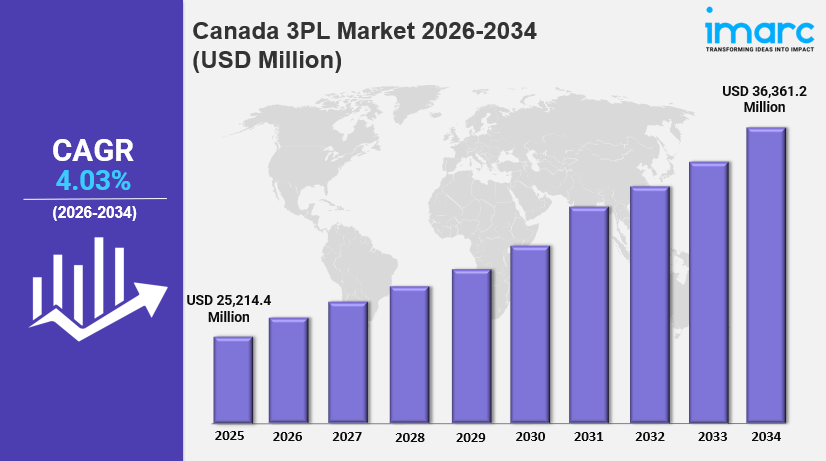
The Canada 3PL market size reached USD 25,214.4 Million in 2025 and is projected to reach USD 36,361.2 Million by 2034, expanding at a CAGR of 4.03% during 2026-2034. In 2026, the market continues to gain momentum, shaped by e-commerce growth, rising demand for efficient supply chain management, advancements in technology, and the growing need for cost-effective logistics solutions.
Growth in 2026 is further reinforced by rapid globalization, the expansion of trade agreements, and greater outsourcing by manufacturers and retailers across distribution, transportation, and warehousing. These dynamics are expected to strengthen the Canada 3PL market share throughout the forecast period.
Key Market Statistics at a Glance
- Base Year: 2025
- Historical Years: 2020-2025
- Forecast Period: 2026-2034
- Market Size (2025): USD 25,214.4 Million
- Projected Market Size (2034): USD 36,361.2 Million
- Growth Rate: CAGR of 4.03% (2026-2034)
Explore Opportunities in the Canada 3PL Market: Download the IMARC Sample Report: https://www.imarcgroup.com/canada-3pl-market/requestsample
Key Growth Drivers and Trends in the Canada 3PL Market
Growth in the Canada 3PL market is being driven primarily by the rapid expansion of e-commerce, which increases demand for efficient logistics and fulfillment and prompts businesses to rely on 3PL providers to manage supply chains and meet expectations for fast, reliable delivery. According to the International Trade Administration, Canada had over 27 million e-commerce users in 2022, equal to 75% of the population, and this share is expected to reach 77.6% in 2025. Retail e-commerce sales are estimated to total US$ 40.3 billion by 2025, and digital wallets are estimated to account for 27% of online payments by 2025. Retailers are investing in digital platforms to reach consumers spread across a vast landmass and to compete with sites such as Amazon Canada.
One of the leading Canada 3PL market trends is the adoption of advanced technologies such as IoT, AI, and automation, which improve tracking, inventory management, and route optimization. 3PL providers using these technologies can offer enhanced services. In April 2024, Oracle launched updated AI capabilities in its Oracle Fusion Cloud Supply Chain & Manufacturing platform to help companies improve operational efficiency, including risk prediction and inventory visibility. Digital transformation is becoming central to improving supply chain resilience, optimizing asset use, and increasing transparency across complex logistics networks.
Another key factor supporting Canada 3PL market growth is rising focus on sustainability, cold-chain shipping, and omnichannel fulfillment, which align with changing consumer expectations and regulatory pressures and influence technology investment and service design. Heightened cross-border trade with the United States and the need for scalable, cost-effective last-mile delivery further support demand for third-party logistics services.
Speak to an Analyst: https://www.imarcgroup.com/request?type=report&id=23996&flag=C
Canada 3PL Industry Segmentation Insights
Breakup by Mode:
- Roadways: Trucking and road-based freight services that move goods across Canada's cities, provinces, and border crossings.
- Railways: Rail freight services suited to moving bulk and long-distance cargo across the country.
- Waterways: Marine and inland shipping services linked to ports and international trade.
- Airways: Air freight services for time-sensitive and high-value shipments.
Breakup by Services:
- Dedicated Contract Carriage (DCC)/Freight Forwarding: Dedicated transport capacity and freight forwarding arrangements provided to specific customers.
- Domestic Transportation Management (DTM): Management of the movement of goods within Canada, including carrier selection and routing.
- International Transportation Management (ITM): Management of cross-border and overseas shipments, including customs and trade documentation.
- Warehousing and Distribution: Storage, order processing, and distribution services supporting e-commerce and retail fulfillment.
- Value Added Logistics Services (VALs): Additional services such as packaging, labeling, kitting, and other customized supply chain support.
Breakup by End Use:
- Automotive: Logistics support for vehicle manufacturing, parts supply, and distribution.
- Manufacturing: Outsourced transportation, warehousing, and supply chain management for manufacturers.
- Chemical: Specialized handling, storage, and transport of chemical products.
- Retail: Fulfillment, warehousing, and last-mile delivery for retailers and e-commerce businesses.
- Healthcare and Pharmaceuticals: Temperature-sensitive and regulated logistics for medical and pharmaceutical products.
- Construction: Logistics for construction materials and equipment.
- Others: Includes other industries not captured in the categories above.
Breakup by Region:
- Ontario: Canada's major commercial and industrial province, including the Toronto area, with extensive logistics and distribution activity.
- Quebec: A large provincial market with strong manufacturing and distribution networks.
- Alberta: A province whose economy supports demand for transportation and warehousing services.
- British Columbia: A province with major port and trade gateways on the Pacific coast.
- Others: Includes the remaining provinces and territories.
Key Challenges and Growth Opportunities in the Canada 3PL Market
The Canada 3PL market faces challenges including growing operating expenses, manpower shortages, and infrastructure deficiencies that confront providers.
Despite these challenges, the market offers considerable growth opportunities in rural expansion, logistics for small and medium-sized enterprises (SMEs), and last-mile development. There is also strong potential for digital expansion and value-added services that match changing customer and industry requirements.
Competitive Landscape
The Canada 3PL market features international and domestic participants competing on service integration, geographic scope, and digital capability. Providers with sophisticated fulfillment, last-mile capabilities, and data-driven insights are gaining an advantage, particularly in metropolitan centers and in industries such as retail, manufacturing, and pharmaceuticals. The IMARC report examines the competitive landscape, including market structure, key player positioning, top winning strategies, a competitive dashboard, and a company evaluation quadrant, along with profiles of the major companies.
Author IMARC Group
IMARC Group is a leading global market research company providing data-driven insights and expert consulting services to businesses seeking to achieve their strategic objectives. With a multidisciplinary team of industry experts, IMARC delivers reliable market intelligence across sectors including Chemicals and Materials, Healthcare, Technology, Agriculture, and Retail.
Contact Us:
IMARC Group
Email: sales@imarcgroup.com
United States: +1-201-971-6302

 English
 Arabic
 French
 Spanish
 Portuguese
 Deutsch
 Turkish
 Dutch
Dutch
 Italiano
 Russian
 Romaian
 Portuguese (Brazil)
 Bengali