


Disc Cap and Flip Top Cap: Smart Packaging Closures for Convenient, Secure and Modern Products
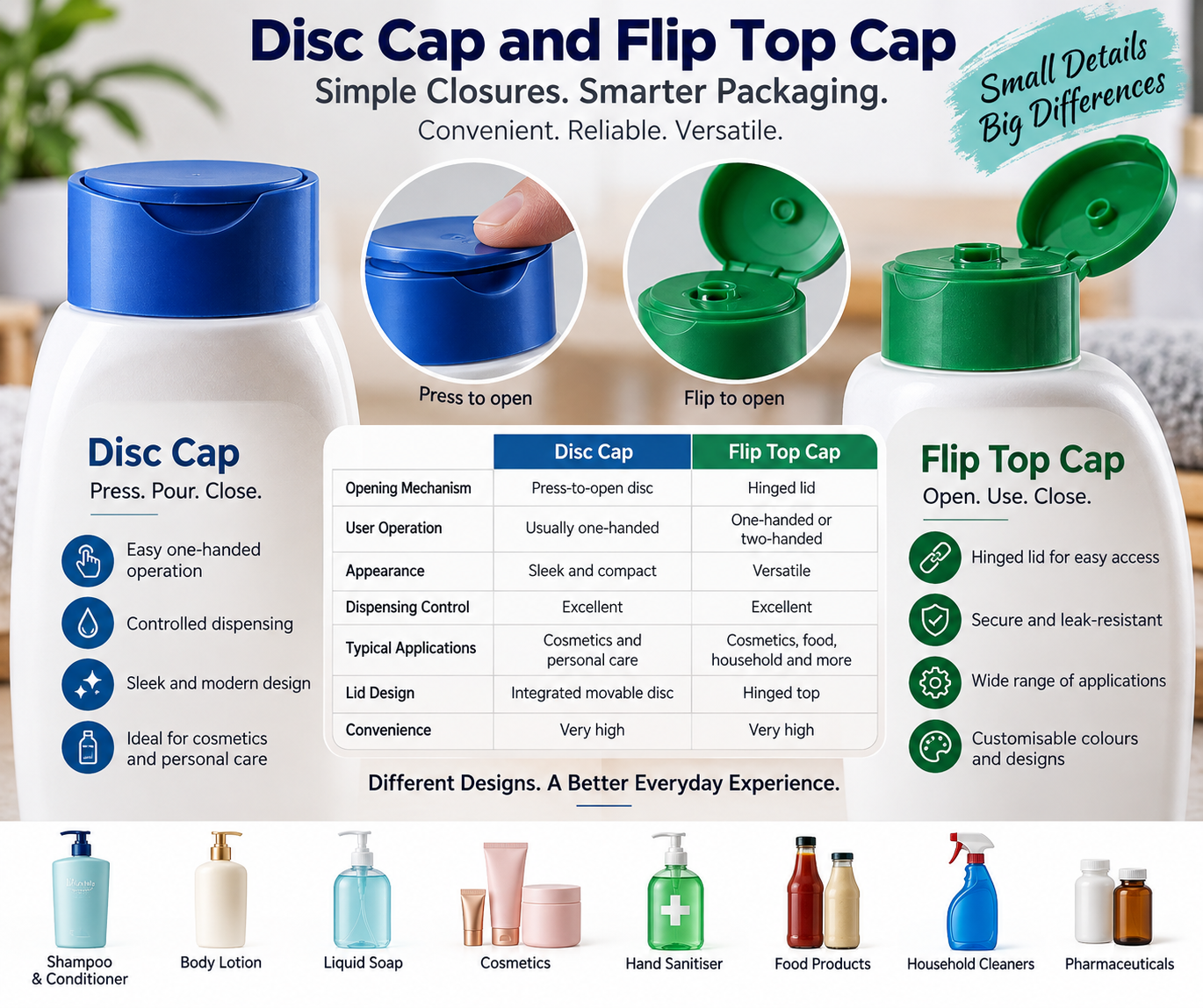
Packaging is no longer limited to protecting a product. Modern packaging must also improve convenience, control dispensing, reduce leakage, support branding, and create a better user experience. Two widely preferred closure solutions that meet these requirements are the disc cap and flip top cap.
These closures are commonly used with bottles and containers for cosmetics, personal care, household products, healthcare formulations, and many other liquid or semi-liquid products. Choosing the correct closure can improve product functionality while giving packaging a professional and attractive appearance.
What Is a Disc Cap?
A disc cap, often known as a disc-top closure, is a dispensing cap designed with a press-operated top surface. When one side of the disc is pressed, the opposite side rises and exposes the dispensing opening.
The consumer can dispense the required quantity without completely removing the closure from the bottle.
This design makes disc caps particularly suitable for products that require controlled and frequent dispensing. Their smooth structure also gives bottles a clean, modern appearance.
Common Applications of Disc Caps
A disc cap can be used for various packaging applications, including:
-
Shampoo and conditioner
-
Body lotion
-
Hand wash
-
Hair oil
-
Shower gel
-
Cosmetic formulations
-
Liquid soap
-
Cleaning products
-
Skin care products
-
Personal care liquids
The simple opening mechanism can improve convenience while helping protect the contents between uses.
What Is a Flip Top Cap?
A flip top cap is a bottle closure featuring a hinged lid that can be opened and closed without removing the entire cap from the container. The lid generally covers a dispensing hole, nozzle, or opening through which the product can be released.
Because the cap stays attached to the bottle, users do not need to keep track of a separate closure.
Why Flip Top Closures Are Popular
The flip top cap has become popular because it combines convenient operation with reliable product protection. Depending on bottle design and product viscosity, it can support controlled dispensing for liquids, gels, creams, and similar formulations.
Typical applications include:
-
Shampoo bottles
-
Cosmetic packaging
-
Lotion containers
-
Hand sanitizers
-
Sauces and condiments
-
Pharmaceutical packaging
-
Household cleaners
-
Toiletry bottles
Disc Cap vs Flip Top Cap
Selecting between a disc cap and a flip top cap depends on product characteristics, bottle construction, dispensing requirements, and target consumer expectations.
| Feature | Disc Cap | Flip Top Cap |
|---|---|---|
| Opening Style | Press-operated disc | Hinged lid |
| User Convenience | High | High |
| Controlled Dispensing | Excellent | Excellent |
| Suitable for Frequent Use | Yes | Yes |
| Modern Appearance | Very strong | Strong |
| Common Uses | Cosmetics, lotions, shampoos | Personal care, food, household products |
| Attached Closure | Yes | Yes |
| One-Hand Operation | Often possible | Often possible |
Both closure options provide practical advantages, although compatibility testing should always be completed before final packaging production.
Key Benefits of Using Modern Dispensing Caps
The performance of packaging depends greatly on how easily and safely consumers can access the product. A well-designed closure offers several advantages.
-
Convenient dispensing: Consumers can access products quickly without completely removing the cap.
-
Reduced product waste: Controlled openings can help users dispense more appropriate quantities.
-
Improved cleanliness: Closable dispensing openings reduce unnecessary exposure between applications.
-
Better packaging appearance: Attractive closures contribute to shelf presentation and brand perception.
-
Reusable functionality: The closure can normally be opened and closed repeatedly throughout the product's usable life.
Materials Used for Disc and Flip Top Caps
Plastic materials are commonly selected for dispensing closures because they can provide durability, flexibility, lightweight construction, and efficient manufacturing.
Polypropylene Packaging Closures
Polypropylene, commonly called PP, is frequently used for closure manufacturing because its properties can support flexible hinges and repeated opening and closing.
Material selection should nevertheless depend on the intended formulation.
Why Compatibility Testing Matters
The cap material should be evaluated against factors including:
-
Product ingredients
-
Chemical compatibility
-
Storage temperature
-
Bottle-neck dimensions
-
Transportation conditions
-
Expected shelf life
-
Required sealing performance
Testing the complete bottle-and-closure system is more reliable than evaluating either component independently.
How to Select the Right Packaging Cap
A closure should not be selected only because it looks attractive. Manufacturers and packaging buyers should consider actual product performance requirements.
Check the bottle-neck size and thread configuration first. The closure must fit the container precisely.
Next, consider product viscosity. Thin liquids may require a different dispensing opening from thick lotions, gels, or creams.
Evaluate leakage resistance and dispensing control under realistic transportation and storage conditions.
Finally, consider consumer usability, brand appearance, production requirements, and cost.
Customization and Branding Opportunities
Both disc cap and flip top cap designs can contribute to stronger packaging identity. Depending on manufacturing capabilities, closures may be produced in different sizes, shapes, surface finishes, and colours.
Matching the closure colour with bottle graphics or brand identity can create more consistent shelf presentation.
For businesses launching multiple product variants, different closure colours may also help consumers distinguish between formulations quickly.
Quality Factors to Check Before Purchasing Caps
Packaging buyers should evaluate closure quality carefully before placing large-volume orders.
Important considerations include:
-
Accurate dimensions
-
Smooth opening and closing
-
Secure bottle fitting
-
Consistent colour
-
Clean moulding
-
Reliable hinge performance
-
Controlled dispensing
-
Leakage resistance
-
Compatibility with filling lines
Sample testing before bulk production can help identify compatibility problems early.
Frequently Asked Questions
1. What is a disc cap used for?
A disc cap is primarily used for controlled dispensing of shampoos, lotions, cosmetics, liquid soaps, and personal care products.
2. How does a disc cap open?
Users press one side of the upper disc, causing the opposite side to rise and reveal the dispensing opening.
3. What is a flip top cap?
A flip top cap is a closure containing a hinged lid that opens to expose the product's dispensing outlet.
4. Which cap is better for shampoo bottles?
Both designs can work effectively. The right choice depends on bottle style, shampoo viscosity, opening size, branding, and intended user experience.
5. Are disc caps reusable?
Yes. They are generally designed for repeated opening and closing throughout normal product use.
6. Can flip top caps prevent leakage?
A correctly designed and compatible closure can provide effective sealing, but actual leakage performance should be verified through packaging tests.
7. Can these closures be customized?
Yes. Manufacturers may offer customized colours, dimensions, finishes, and closure configurations depending on production requirements.
8. Which materials are commonly used?
Polypropylene is widely used, although suitable material selection depends on the product formulation and packaging requirements.
9. Are these caps suitable for cosmetic packaging?
Yes. Both closure styles are frequently selected for skincare, haircare, body care, and other cosmetic packaging.
10. How do I choose the correct cap size?
Match the closure dimensions and thread or neck configuration precisely with the bottle and conduct fit, dispensing, and leakage tests.

 English
 Arabic
 French
 Spanish
 Portuguese
 Deutsch
 Turkish
 Dutch
Dutch
 Italiano
 Russian
 Romaian
 Greek
Greek
 Bengali