


Commercial Turf Installation in Sandy Springs: What to Know
Picture an office park on a July afternoon. The lawn out front looked great in April, but now it has brown patches, muddy spots near the walkways, and a sprinkler system running almost daily. For many property managers, this cycle repeats every year. That's one reason commercial turf installation has become a common topic among businesses, schools, and community spaces across Sandy Springs, GA.
Synthetic turf isn't new. What has changed is how it's used. It has moved well beyond sports stadiums and now shows up at apartment courtyards, rooftop patios, dog parks, and playgrounds.
Understanding Commercial Turf Installation
At its core, commercial turf installation means replacing natural grass with a synthetic surface built for heavy use. Commercial projects differ from residential ones in scale, foot traffic, and performance needs.
A backyard might see a few people and a dog. A corporate courtyard, school field, or public play area might see hundreds of people a day. That difference shapes almost every decision, from the type of fiber to how the base is built.
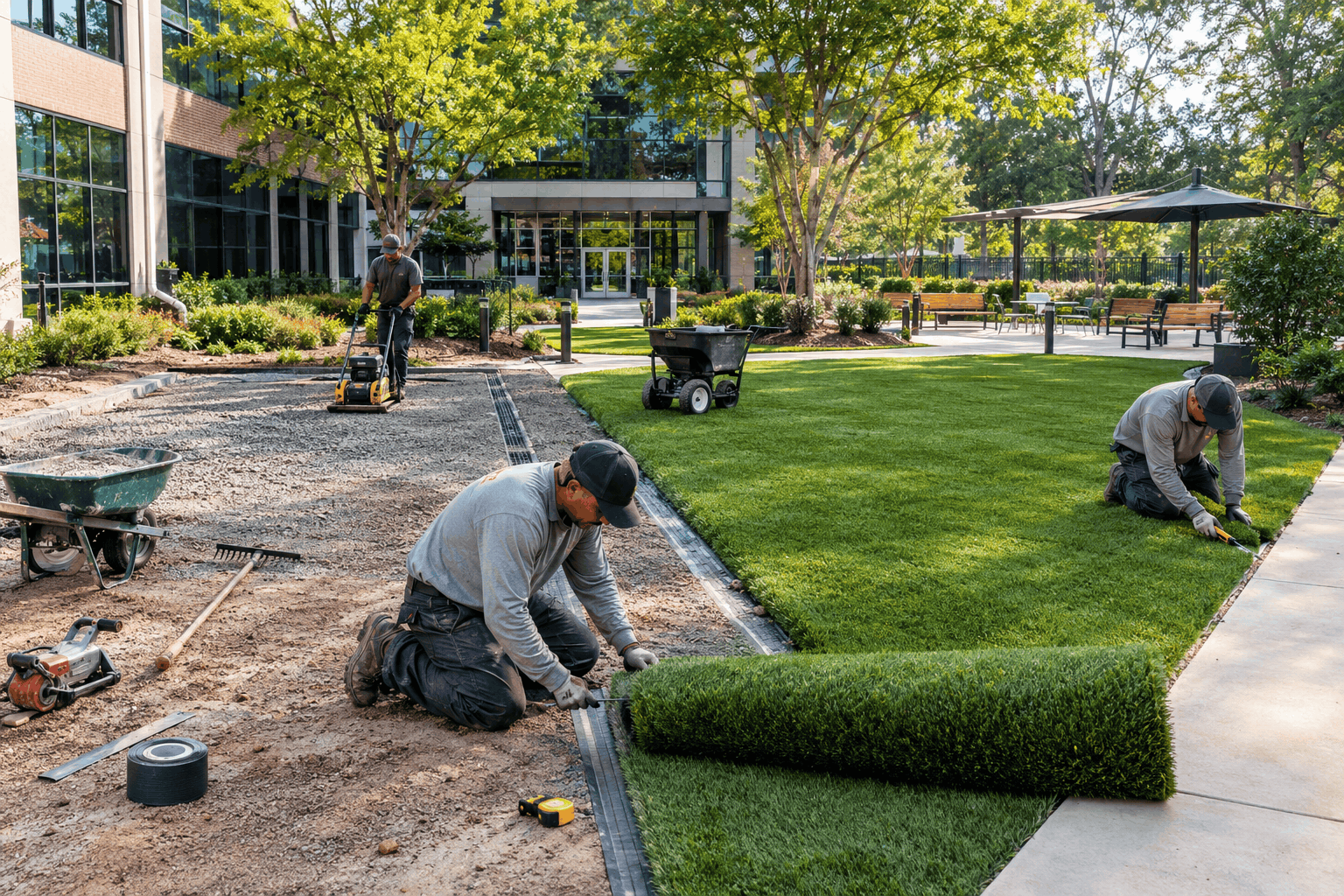
Most installers agree that the base matters more than the turf itself. The ground is excavated, graded, and filled with compacted crushed stone. This layer supports the surface and controls drainage. Skip it or rush it, and even premium turf can ripple, sink, or hold water.
Drainage is a big deal in the Atlanta area. Georgia's red clay soil doesn't absorb water well, and summer storms can drop a lot of rain in a short time. A well-designed base helps water move through the surface instead of pooling on top.
After the base, crews lay the turf, seam the rolls together, and secure the edges. Infill, often sand, rubber, or organic materials, is then brushed into the fibers. It helps the blades stand upright, adds weight, and provides cushioning.
Why Property Owners Are Making the Switch
The most obvious draw is lower maintenance. Synthetic turf doesn't need mowing, fertilizing, or weekly watering. Over time, that can mean real savings in labor and utility costs, especially for large properties.
Water use is another factor. Metro Atlanta has faced drought restrictions in the past, and many organizations now look for ways to cut outdoor water use. Artificial turf may still need an occasional rinse, but its demand is far lower than a natural lawn's.
Durability also plays a role. Natural grass struggles in shaded areas, high-traffic zones, and spots where people gather. Turf holds up in places where grass simply won't grow, like under large trees or along busy paths.
There's also the matter of appearance. A green, even surface year-round helps a property look cared for. For retail centers, hotels, and office buildings, that first impression matters to visitors and tenants alike.
Still, turf isn't a perfect fit everywhere. It can get hot in direct summer sun, and it requires an upfront investment that's higher than sod. Most experts suggest weighing long-term costs against the initial price before deciding.
Schools Turf Installation and Campus Spaces
Educational campuses are one of the fastest-growing areas for synthetic surfaces. Schools turf installation projects often focus on athletic fields, but many now include playgrounds, outdoor classrooms, and common areas.
For schools, the biggest benefit is usable time. A natural grass field may close for days after heavy rain to prevent damage. A synthetic field with good drainage can often be used soon after the storm passes. That means fewer canceled practices and more time outdoors for students.
Safety is a key concern for school leaders. Playground turf can be paired with shock-absorbing pads beneath the surface to meet fall-height guidelines. Athletic fields are often tested for impact absorption to help reduce injury risk.
Because schools turf installation usually involves public funds, decision-makers tend to look closely at lifespan and warranty terms. Most quality commercial systems last roughly 8 to 15 years, depending on use and care.
Real-World Examples Around the Community
Think about a multifamily complex near the Perimeter Center area. Its central lawn is the spot where residents walk dogs, host gatherings, and let kids play. Natural grass in that space wears down fast. A pet-friendly turf system with antimicrobial infill and strong drainage can keep it clean and usable.
Or consider a small private school in Sandy Springs that shares one field for recess, gym class, and after-school sports. Before converting, the field turned to mud each spring. After installation, the same space handles daily use without closing for repairs.
Rooftop terraces offer another example. Many newer buildings now include outdoor lounges on upper floors. Lightweight turf adds a soft, green look without the soil weight or irrigation needs of real grass.
Even local parks and event venues have found uses for it. Putting greens, bocce courts, and lawn-game areas all benefit from a consistent, level surface.
Choosing the Right Approach
Every site is different, so experienced installers usually start with an evaluation. They look at soil conditions, slope, sun exposure, and how the space will be used. A sports field needs different fibers and infill than a dog run or a decorative courtyard.
Local knowledge helps too. Contractors familiar with Sandy Springs, GA tend to understand the region's clay soil, heavy storms, and summer heat. Companies such as Turf Restoration And Design LLC are among the regional firms that handle both new installs and renovations of aging turf systems.
It's also smart to ask about maintenance plans. Turf still needs routine brushing, debris removal, and infill top-ups to look and perform its best. Property owners who plan for this upkeep usually get longer life from their investment.
Final Thoughts
Commercial turf installation has grown from a niche option into a practical choice for many types of properties. It saves water, cuts maintenance, and keeps high-traffic spaces looking sharp all year.
That said, the results depend on careful planning, a solid base, and the right materials for the job. When those pieces come together, a synthetic surface can serve a business, school, or community space well for many years.
Frequently Asked Questions
How much does commercial turf installation cost?
Costs vary based on project size, base work, and turf quality. Many commercial projects fall somewhere between $6 and $15 per square foot, with sports fields often costing more.
How long does commercial artificial turf last?
Most commercial-grade turf lasts about 8 to 15 years. Heavy use, sun exposure, and maintenance habits all affect lifespan.
Does artificial turf get hot in the summer?
Yes, synthetic turf can get warmer than natural grass in direct sun. Lighter-colored fibers, cooling infill, and shade structures can help reduce surface heat.
Is artificial turf safe for schools and playgrounds?
When installed with proper padding and tested for impact absorption, turf can meet safety guidelines for play areas. Schools often review fall-height ratings before choosing a system.
How long does a commercial turf project take?
Smaller areas may take a few days, while large fields can take several weeks. Weather, site prep, and drainage work are the main factors that affect timing.

 English
 Arabic
 French
 Spanish
 Portuguese
 Deutsch
 Turkish
 Dutch
Dutch
 Italiano
 Russian
 Portuguese (Brazil)
 Greek
Greek
 Bengali