


When Should a Business Choose a Gable Box Instead of a Conventional Carton?
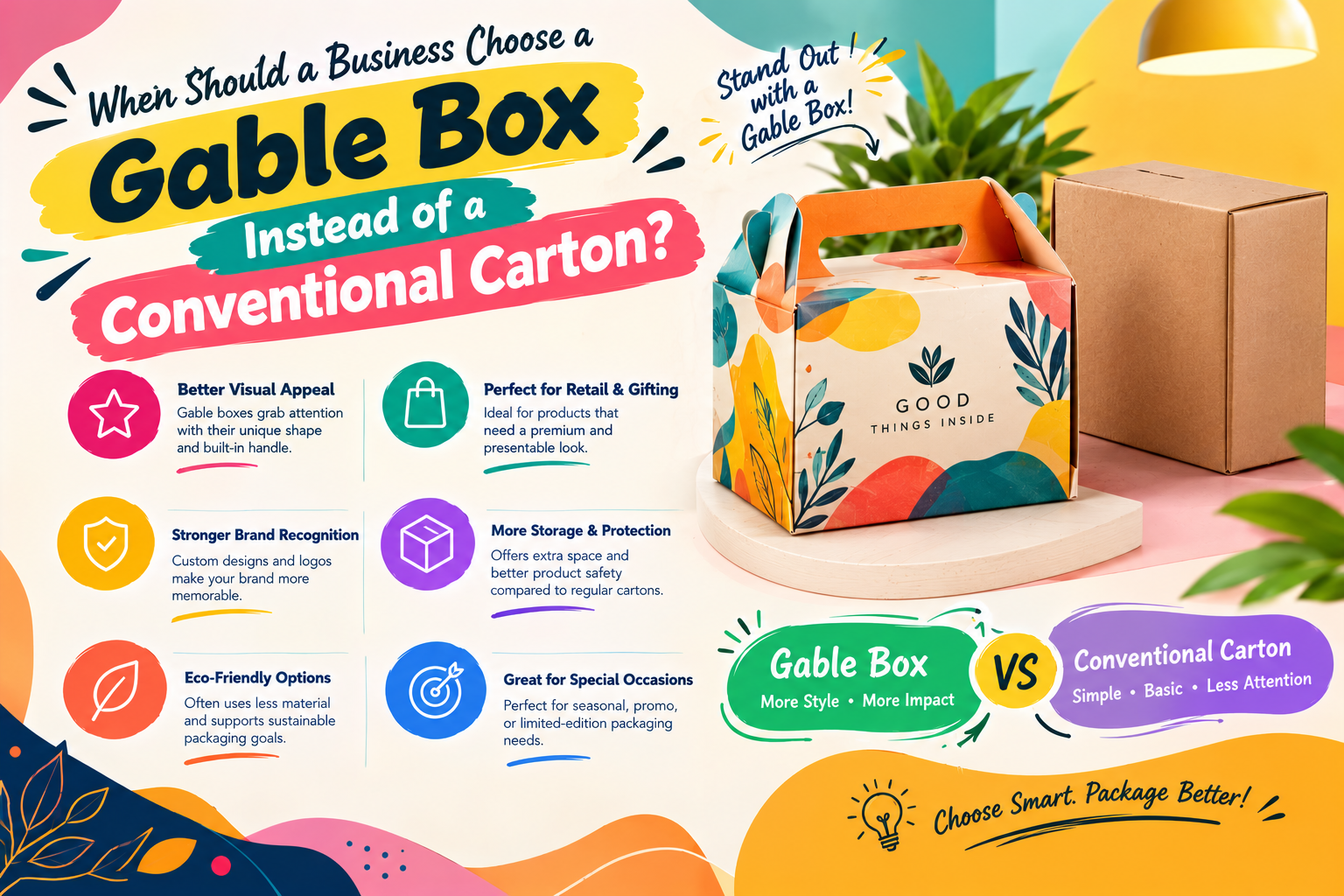
Choosing the right packaging is not always as simple as selecting a box that fits the product. Businesses must also consider how customers will carry their purchases, how the packaging will look on display, what level of protection the contents require, and how much the packaging will cost. Among the available options, gable boxes and conventional cartons serve different purposes, even though both can be used to package a wide range of products.
A gable box features a distinctive top with an integrated handle, giving it a convenient, gift-like appearance. A conventional carton, on the other hand, typically offers a straightforward structure that can be adapted for storage, shipping, and everyday product packaging.
Neither option is automatically better for every business. The right choice depends on the product, the sales environment, customer expectations, and the practical demands of distribution. Understanding these differences can help businesses invest in packaging that supports their goals instead of adding unnecessary costs.
Choose a Gable Box When Carrying Convenience Matters
One of the clearest reasons to choose a gable box is the convenience of its built-in handle. Customers can pick up and carry the package without needing a separate shopping bag, provided the box is appropriately designed for the product's weight.
This feature is especially useful for bakeries, takeaway businesses, event organizers, gift shops, and retailers selling small ready-to-carry items.
Imagine a bakery selling a box of cupcakes for a birthday celebration. A conventional carton may contain the cupcakes effectively, but a suitably designed gable box offers an additional advantage: customers can carry it conveniently from the store to the celebration.
The integrated handle also gives the packaging a distinctive silhouette that can make the product easier to recognize.
For businesses where customers frequently carry purchases by hand, gable boxes can offer a more convenient experience than conventional cartons that require separate handling arrangements.
Select Conventional Cartons When Distribution Takes Priority
Packaging requirements change significantly when products must travel through warehouses, delivery networks, or long-distance shipping routes.
Conventional cartons are often a practical choice for these situations because they can be designed for stacking, efficient storage, and compatibility with protective outer packaging. Their relatively straightforward construction can also suit businesses that need standardized packaging across multiple product lines.
For example, an online retailer shipping clothing, books, or household accessories may prefer conventional cartons because they can be selected according to product dimensions and shipping requirements.
Gable boxes can also be transported and shipped, but their handles and shaped tops may affect how efficiently they fit together in storage or shipping arrangements.
Businesses should therefore evaluate the complete distribution process rather than focusing only on the appearance of the individual package. If efficient stacking, palletization, and protection during transit are the main priorities, a conventional carton may be the more suitable option.
Give Gable Boxes the Advantage When Presentation Is Part of the Product
Packaging does more than contain an item. It can influence how customers perceive its value before they even see what is inside.
Gable boxes naturally create a presentation-focused appearance because of their distinctive shape and integrated handle. This makes them particularly attractive for products associated with celebrations, gifting, hospitality, and special occasions.
Consider a business preparing welcome kits for conference attendees. A customized gable box featuring the event logo, coordinated colors, and carefully arranged contents can make the kit feel more organized and intentional.
A conventional carton can also be printed and decorated, but it generally provides a more familiar rectangular appearance.
When the packaging itself contributes to the customer's first impression, a gable box may provide a useful visual advantage. However, the design should still reflect the product's positioning rather than relying on shape alone to communicate quality.
Match the Box Style to the Way Customers Purchase Your Product
The point of sale can be just as important as the product itself when deciding between these packaging styles.
Products purchased for immediate use, personal gifting, or event distribution often benefit from packaging that is ready to carry and present. Products purchased in bulk, stored for later use, or delivered through e-commerce channels may benefit more from conventional cartons.
For example, a boutique selling handmade soaps might use gable boxes for gift bundles displayed during the holiday season. The same business could use conventional cartons for larger wholesale orders supplied to other retailers.
This distinction allows businesses to choose packaging according to the customer's purchasing journey instead of applying one solution to every transaction.
Before making a decision, consider whether customers will carry the package directly from the store, place it inside another bag, store it at home, or receive it through a delivery service. The answers can reveal which design offers the greatest practical benefit.
Use Gable Boxes for Small Gifts, Favors, and Curated Collections
Certain products are purchased as complete experiences rather than as individual items. Gift sets, promotional bundles, wedding favors, and curated product collections are good examples.
Gable boxes can bring these items together in a single package while providing a convenient handle and a finished presentation. Their shape can also make them suitable for decorative ribbons, branded labels, seasonal artwork, or small personalized messages.
For instance, a skincare business creating a limited-edition collection might package several complementary products inside a custom gable box. The coordinated exterior can help the collection feel like a unified offering rather than a group of separate products.
However, internal organization remains important. If the items are fragile or vary considerably in size, inserts or dividers may be necessary to keep them in place.
Conventional cartons remain a reasonable alternative when the products require more space-efficient packaging, additional cushioning, or a format optimized for shipment.
Evaluate Product Weight Before Choosing an Integrated Handle
A gable box may look convenient, but its handle should never be treated as a guarantee of carrying strength.
The material, construction, handle design, locking mechanism, and weight distribution all influence how well the package performs. A lightweight box holding cookies has different requirements from one containing glass containers or several heavy promotional items.
Businesses should assess the total packaged weight and test whether the handle remains secure during normal handling. The bottom panel and closure also need to withstand the expected load.
Conventional cartons can offer greater flexibility for products requiring reinforced structures, specialized cushioning, or additional external protection. Their suitability still depends on the chosen board, dimensions, and construction.
If a product is heavy, fragile, or unusually shaped, businesses should prioritize structural performance before deciding which style looks better. A practical sample test can help identify weaknesses before full production begins.
Compare Total Packaging Costs, Not Just the Price of One Box
Budget is another important factor, but comparing packaging options solely by their unit price can produce misleading results.
The overall cost may include material usage, printing, finishing, assembly, storage, shipping, protective inserts, and any additional bags or packaging components needed during retail sales.
A gable box may eliminate the need for a separate carry bag in some situations. On the other hand, its integrated handle and shaped top may affect material consumption, production methods, or storage efficiency.
Conventional cartons may be economical for standardized packaging and large-volume operations, particularly when their dimensions work well with existing fulfillment processes.
To make a fair comparison, calculate the total packaging cost for the same product and quantity. Include any additional components each option requires.
The better choice is the one that meets the packaging requirements at an acceptable total cost, not necessarily the one with the lowest initial purchase price.
Consider Shelf Space, Storage, and Transportation Efficiency
Packaging decisions influence operations long before a customer receives the product. Businesses must store empty boxes, transport packaging supplies, assemble packages, and manage finished inventory.
Conventional cartons often have an advantage when standardized shapes and efficient stacking are essential. Depending on their design, they can be supplied flat and stored compactly before assembly.
Gable boxes may also be supplied flat, but their final shape and handle construction can influence assembly time and how efficiently finished packages can be arranged.
Retailers should also consider how the boxes will appear on shelves. A gable box may help a gift set stand out, while a conventional carton may make better use of limited storage or display space.
For businesses with high order volumes, even small differences in storage requirements and packing time can become significant over time.
Choose Customization According to the Purpose of the Packaging
Both gable boxes and conventional cartons can support branding, but the best customization strategy depends on how the package will be used.
Gable boxes work well when a business wants the packaging to feel distinctive at the point of purchase. A logo, brand colors, a short message, or seasonal artwork may be sufficient to create a recognizable appearance.
Conventional cartons offer considerable flexibility too. They can feature product information, handling instructions, shipping details, or branded graphics, depending on whether they are used for retail presentation or transportation.
The important consideration is the role the package needs to perform.
If the primary objective is to create an attractive, easy-to-carry gift presentation, a customized gable box may be appropriate. If the objective is to protect a product through storage and distribution, the design should focus on dimensions, material strength, closure performance, and compatibility with the shipping process.
Adding decorative features without considering these objectives can increase costs without improving packaging performance.
Look Beyond Appearance When Sustainability Matters
Businesses increasingly need to consider how packaging materials are sourced, used, and disposed of. However, choosing between a gable box and a conventional carton does not automatically determine which option has the lower environmental impact.
Both formats can be made using paper-based materials, but their overall performance depends on the material composition, amount of material used, manufacturing process, transportation requirements, and available recycling facilities.
A gable box that replaces an unnecessary carry bag may reduce the number of packaging components used in a transaction. A well-sized conventional carton may offer better space efficiency during shipping and help reduce wasted transport capacity.
Neither advantage applies in every situation.
Businesses should compare actual material requirements and avoid oversized packaging or unnecessary decorative components. They should also verify environmental claims against the specific materials and disposal systems involved.
A thoughtful design can support both functional packaging requirements and more responsible material use.
Identify When a Hybrid Packaging Strategy Makes More Sense
Businesses do not always need to choose a single box style for every product or sales channel.
A hybrid strategy can be more effective when the same product is sold through retail stores, corporate gifting programs, and online orders.
For example, a confectionery brand might use gable boxes for gift collections purchased in-store while using conventional cartons for bulk deliveries to retailers. If individual gift boxes need extra protection during shipping, they can be placed inside appropriately sized outer cartons.
This approach separates the roles of presentation packaging and transportation packaging.
The gable box creates the desired customer experience, while the outer carton provides protection and supports efficient handling during distribution.
By assigning each package a specific purpose, businesses can avoid forcing one design to meet requirements that may conflict with one another.
Test Both Packaging Styles Under Real Working Conditions
Product specifications and design mockups provide useful starting points, but practical testing is often the most reliable way to identify the right packaging.
Prepare samples of both formats and evaluate them using the same product, approximate load, and handling conditions.
Check how easily each package can be assembled, whether the contents remain secure, how comfortable it is to carry, and how efficiently it can be stored or transported. Review the printed design and observe whether the package remains presentable after normal handling.
For products sold online, test the complete shipping arrangement rather than assessing the inner box alone. For retail products, consider how the package looks when displayed alongside competing items.
A short trial can reveal whether the convenience and presentation benefits of a gable box justify its cost or whether a conventional carton better supports daily operations.
The decision should be based on demonstrated performance rather than appearance alone.
Final Thoughts: Which Packaging Style Should Your Business Choose?
A business should choose a gable box instead of a conventional carton when convenient carrying, attractive presentation, and a ready-to-gift appearance are important parts of the customer experience.
Gable boxes are particularly useful for suitable bakery products, gift sets, event favors, promotional kits, and retail purchases that customers carry directly from the point of sale.
Conventional cartons are often more practical when storage efficiency, standardized shipping, stacking, or straightforward product protection takes priority.
Ultimately, the right packaging choice depends on the product's weight and dimensions, the way it is sold, the distance it travels, and the experience the business wants to create.
Rather than selecting a box based on appearance alone, evaluate its complete role throughout the product's journey. When packaging design aligns with both operational requirements and customer expectations, businesses can improve presentation, manage costs, and deliver a more consistent experience.
Order Now: https://ibexpackaging.com/gable-boxes/

 English
 Arabic
 French
 Spanish
 Portuguese
 Deutsch
 Turkish
 Dutch
Dutch
 Italiano
 Romaian
 Portuguese (Brazil)
 Greek
Greek
 Bengali