


Cream Jar and Cosmetic Jar: Smart Packaging Solutions for Modern Beauty and Skincare Products
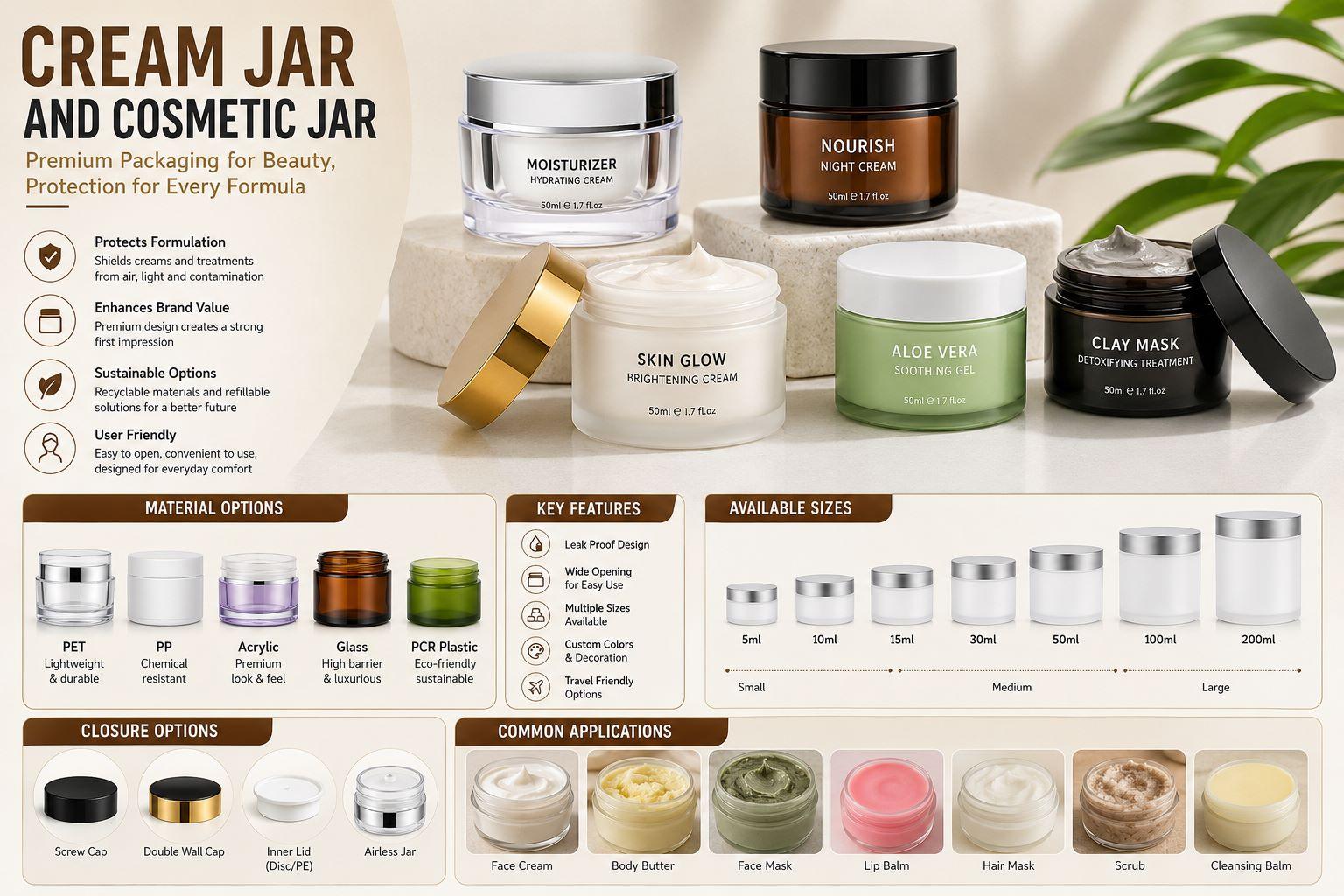
Packaging is one of the first things customers notice when choosing skincare and beauty products. An attractive, functional, and reliable cream jar can communicate product quality before a customer even opens the container. Similarly, a well-designed cosmetic jar helps protect the formulation while strengthening the overall visual identity of a beauty brand.
From moisturizers and face creams to body butter, masks, balms, scrubs, and premium skincare formulations, jars remain one of the most versatile packaging choices available. Selecting the right material, capacity, closure, shape, and decoration can significantly influence product safety, customer experience, shelf appeal, and brand recognition.
What Is a Cream Jar?
A cream jar is a packaging container specifically designed for semi-solid cosmetic and personal care formulations. These containers usually feature a wide opening that allows consumers to access the product conveniently using their fingers, spatulas, or applicators.
They are commonly used for:
-
Face creams
-
Moisturizers
-
Eye creams
-
Body creams
-
Night creams
-
Hair masks
-
Body butter
-
Facial masks
-
Healing balms
-
Scrubs and exfoliating products
A quality jar should not only look attractive but also provide adequate protection against contamination, leakage, moisture, and unnecessary exposure to external conditions.
Why Cosmetic Jar Packaging Matters
A cosmetic jar performs several functions beyond simply holding a product. Packaging creates a physical connection between the customer and the brand.
Effective cosmetic packaging can help businesses:
-
Protect formulations during storage and transportation.
-
Improve the appearance of products on retail shelves.
-
Create a distinctive brand identity.
-
Provide convenient product access.
-
Reduce leakage and product wastage.
-
Communicate premium quality.
-
Display essential labeling and product information.
Consumers increasingly evaluate products visually, particularly when shopping online. High-quality skincare packaging can therefore influence purchasing decisions and customer perception.
Popular Materials Used for Cream Jar Packaging
Selecting the correct material depends on the formulation, target audience, positioning, budget, and distribution requirements.
| Material | Key Advantages | Common Applications |
|---|---|---|
| Plastic | Lightweight, practical, versatile | Moisturizers, scrubs, body creams |
| Glass | Premium appearance and strong presentation | Luxury skincare and facial creams |
| Acrylic | Elegant appearance with flexible designs | Premium cosmetic products |
| PP | Durable and widely used | Creams, masks and personal care products |
| PET | Clear visibility and lightweight structure | Gels, creams and beauty formulations |
Plastic remains widely preferred because it offers design flexibility and lower transportation weight. Glass can be an excellent choice when brands want a luxurious appearance and substantial feel.
Important Features of a Quality Cosmetic Jar
Businesses should evaluate more than appearance when choosing packaging.
Secure Closure System
A properly engineered closure helps minimize leakage while protecting the formulation during transportation and everyday use.
Suitable Product Compatibility
Packaging material should be compatible with the formulation. Oils, fragrances, active ingredients, and other components can interact differently with packaging materials.
Convenient Wide-Mouth Design
Wide-mouth containers make thicker formulations easier to access, which is particularly useful for facial creams, masks, scrubs, and body butter.
Strong Branding Surface
A good cosmetic jar should provide enough surface area for labels, printing, logos, decorative finishes, and important product details.
Premium Finishing Options
Depending on the brand positioning, manufacturers may use screen printing, labeling, embossing, metallic effects, frosting, color coating, or other decorative techniques to enhance packaging presentation.
How to Choose the Right Cream Jar
Choosing a cream jar requires balancing aesthetics, functionality, formulation compatibility, and cost.
Before finalizing packaging, consider these factors:
-
Product consistency and viscosity
-
Required jar capacity
-
Target customer segment
-
Brand positioning
-
Packaging material
-
Closure performance
-
Transportation requirements
-
Decoration possibilities
-
Labeling space
-
Sustainability goals
A luxury anti-aging product, for example, may require completely different packaging from an everyday body cream.
Brands should ideally test their formulations with the selected packaging before large-scale manufacturing. Compatibility testing can help identify potential problems involving leakage, discoloration, deformation, or formulation interaction.
Cream Jar Sizes and Capacities
Beauty brands often require multiple capacities to create different product variants.
Common packaging capacities may include:
-
5 ml for samples and eye products
-
10 ml for travel-size formulations
-
15 ml for eye creams
-
30 ml for facial skincare
-
50 ml for standard moisturizers
-
100 ml for masks and treatment products
-
200 ml or larger for body care products
Smaller cosmetic packaging works effectively for trial products and premium formulations, while larger jars are commonly selected for body creams, masks, and professional beauty products.
Customization Can Strengthen Brand Identity
The beauty industry is highly visual. Custom packaging allows companies to distinguish themselves from competitors selling similar formulations.
A customized cosmetic jar may include:
-
Brand-specific colors
-
Custom labels
-
Printed logos
-
Matte or glossy finishes
-
Frosted surfaces
-
Metallic decoration
-
Minimalist typography
-
Decorative lids
-
Custom outer packaging
Consistency across packaging sizes also helps consumers recognize a product range instantly.
Minimalist designs can communicate sophistication, while bright colors can create youthful or energetic positioning. The final packaging style should reflect both the formulation and the intended audience.
Cream Jar vs Cosmetic Jar: Is There a Difference?
Although the terms are often used interchangeably, they can have slightly different meanings.
A cream jar generally refers specifically to a container intended for cream-based or semi-solid formulations.
A cosmetic jar is a broader category that may be used for creams, powders, gels, balms, masks, scrubs, and other beauty products.
Therefore, every cream container can be considered cosmetic packaging, but not every cosmetic container is necessarily designed specifically for cream.
Sustainable Packaging Considerations
Environmental responsibility is becoming increasingly important within beauty and personal care packaging.
Brands can explore options such as:
-
Recyclable materials
-
Refillable containers
-
Lightweight packaging
-
Reduced secondary packaging
-
Mono-material designs
-
Reusable jars
-
Packaging with less unnecessary plastic
However, sustainability should always be balanced with product protection. Packaging that fails to preserve a formulation can ultimately cause greater material and product waste.
Frequently Asked Questions
1. What is a cream jar used for?
A cream jar is primarily used for moisturizers, facial creams, masks, body creams, balms, scrubs, and similar semi-solid formulations.
2. Which material is best for cosmetic jars?
The ideal material depends on the formulation, budget, branding requirements, and product positioning. Plastic, glass, acrylic, PP, and PET are common choices.
3. Can cosmetic jars be customized?
Yes. A cosmetic jar can often be customized through printing, labeling, coloring, frosting, decorative finishes, and customized lids.
4. Are glass jars suitable for skincare products?
Yes. Glass jars are frequently used for premium skincare because of their elegant appearance and substantial feel.
5. Why are wide-mouth jars popular for creams?
A wide opening makes thick products easier for customers to access and apply.
6. What sizes are available for cosmetic jars?
Sizes can range from small sample containers of a few milliliters to large body-care jars exceeding 200 ml.
7. Can a cream jar be used for body butter?
Yes. Wide-mouth jars are particularly suitable for thick body butter and similar formulations.
8. How does packaging affect cosmetic branding?
Packaging communicates quality, positioning, personality, and value while helping a product stand out both online and on retail shelves.
9. Should packaging compatibility be tested?
Yes. Compatibility testing is recommended before mass production to determine whether the formulation interacts safely with the container.
10. Are sustainable cosmetic jars available?
Yes. Brands can consider recyclable, reusable, refillable, lightweight, or reduced-material packaging depending on product requirements.

 English
 Arabic
 French
 Spanish
 Portuguese
 Turkish
 Dutch
Dutch
 Italiano
 Russian
 Romaian
 Portuguese (Brazil)
 Greek
Greek
 Bengali