


India Flat Steel Market to Reach $101 Billion by 2035
Market Overview
According to Market Research Future® (MRFR), the India Flat Steel Market is expected to expand steadily through 2035, supported by infrastructure development, urbanization, automotive manufacturing, and rising demand from energy-related industries. Flat steel products are widely used in construction, transportation, machinery, electronics, appliances, and industrial applications. Their versatility makes them important materials for projects and products requiring sheet-like steel forms, consistent dimensions, and specific mechanical or surface characteristics.
India’s continued industrial development creates opportunities for producers of hot-rolled coils, cold-rolled coils, sheets and strips, coated steel, tinplate, and slabs. These product categories serve different processing and end-use requirements. Construction projects may require structural and fabricated steel products, while automotive manufacturers need materials suited to vehicle components and production processes. Appliance makers, machinery manufacturers, and energy-sector businesses add further sources of demand.
The market’s development will depend on investment activity, manufacturing output, product innovation, and the ability of steel producers to deliver reliable quality at competitive costs. Sustainability initiatives and technological advancements are also becoming important considerations as manufacturers seek to improve efficiency and respond to evolving customer expectations.
Market Size Reached in 2025
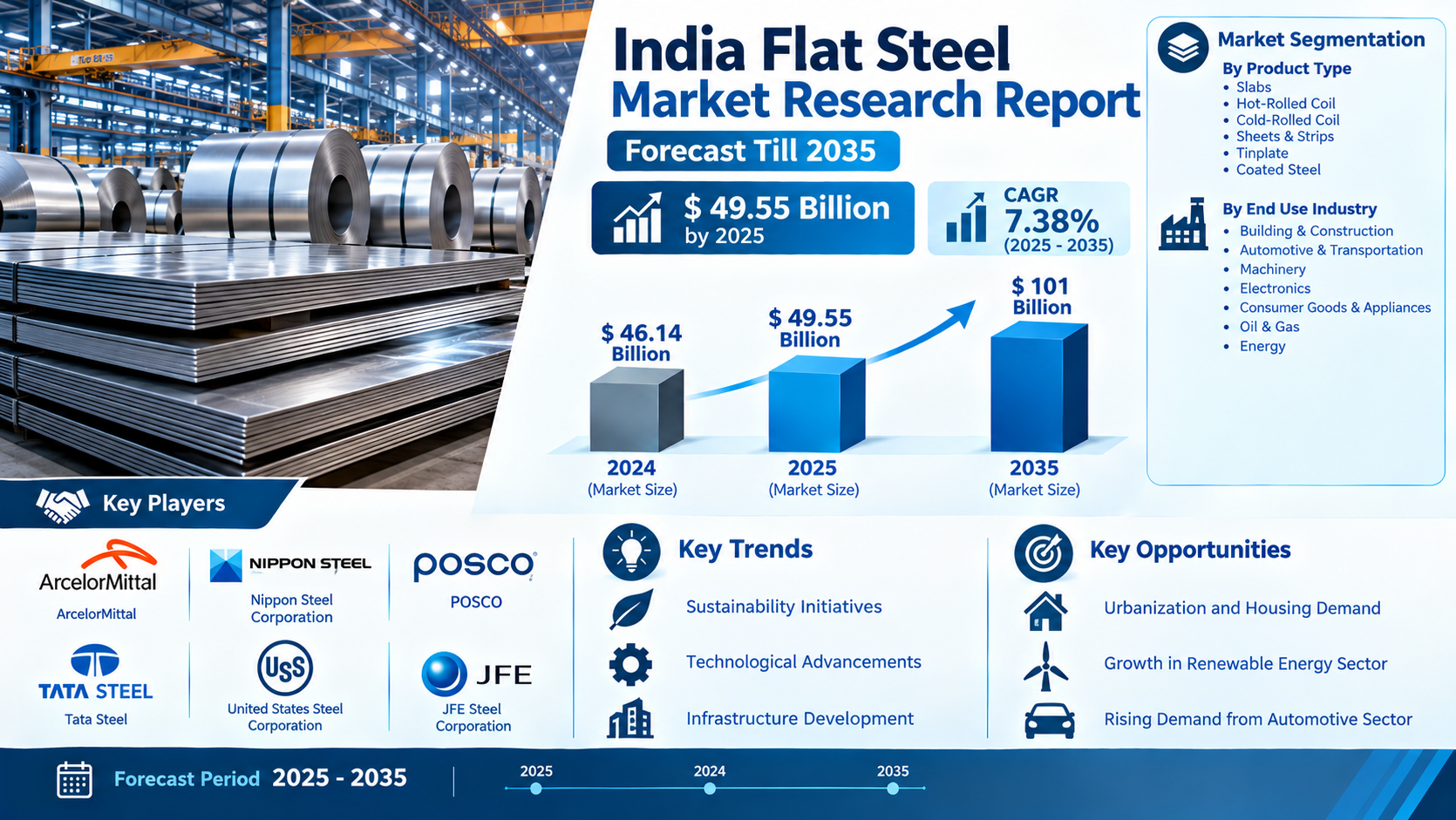
The India Flat Steel Market was valued at $49.55 billion in 2025, up from $46.14 billion in 2024. This increase establishes a larger base for the market’s forecast growth and reflects the importance of flat steel across multiple industries. Rather than relying on a single application, the market serves a diverse customer base that includes construction companies, automotive manufacturers, machinery producers, electronics businesses, appliance makers, and energy-related industries.
Product selection depends on end-use requirements and subsequent processing. Hot-rolled coils can support industrial fabrication and manufacturing applications, while cold-rolled coils may be used where surface quality and dimensional control are important. Sheets and strips, coated steel, and tinplate serve additional application-specific needs. Slabs form an important intermediate product in the steel production chain, supporting the manufacture of finished flat steel products.
This varied product structure allows producers to serve both large infrastructure projects and more specialized manufacturing customers. It also means that demand conditions can differ across product categories, depending on production requirements, purchasing cycles, and investment trends in the industries they serve.
Expected Market Size by 2035
The market is projected to reach $101 billion by 2035, indicating substantial expansion over the forecast period. This outlook creates opportunities for steel producers, processors, distributors, and downstream manufacturers. Urbanization and housing demand may support consumption in construction-related applications, while automotive manufacturing and machinery production can generate demand for flat steel products suited to industrial fabrication.
Renewable energy is another potential source of demand. Energy projects can require steel for equipment, infrastructure, enclosures, and associated manufacturing applications, depending on project design. Growth in this sector may create opportunities for suppliers capable of meeting application-specific quality and processing requirements.
Reaching the projected market value will depend on a combination of end-use demand, production capacity, investment conditions, and the competitiveness of domestic supply chains. Manufacturers may also need to adapt product portfolios to changing specifications and customer expectations. The ability to supply consistent materials and respond to varied requirements will remain important as the market grows.
Market CAGR
The India Flat Steel Market is expected to register a CAGR of 7.38% from 2025 to 2035. This forecast reflects the combined potential of infrastructure development, construction activity, industrial manufacturing, and demand from automotive and energy-related sectors. Although growth will not necessarily be uniform across every product category, the projected rate indicates an expanding role for flat steel in India’s industrial economy.
Different end-use industries place different demands on suppliers. Construction buyers may prioritize availability, specifications, and project delivery schedules, while automotive manufacturers can require consistent quality and production compatibility. Electronics and consumer appliance manufacturers may have additional requirements related to surface finish, formability, and product design. Suppliers that align production capabilities with these distinct needs may be better positioned to benefit from the forecast expansion.
Key Growth Drivers
Infrastructure development is a central driver of flat steel demand. Roads, buildings, industrial facilities, transport networks, and other infrastructure projects require steel products across construction and fabrication activities. As investment expands, suppliers may benefit from demand for sheets, coils, and coated products used in a variety of building and industrial applications. Project timelines and procurement requirements make dependable supply and product consistency important factors.
Urbanization and housing demand provide another growth avenue. Residential construction, commercial development, and related urban infrastructure can increase demand for materials used in building systems, equipment, and fabricated components. Flat steel producers may benefit as construction activity creates opportunities for downstream manufacturers and fabricators. The scale of this opportunity will depend on the pace of housing development and the material specifications adopted by individual projects.
Automotive and transportation manufacturing also supports the market. Flat steel products are used in vehicle bodies and various components, with product choice influenced by strength, formability, weight, and manufacturing requirements. Changes in vehicle production and evolving design priorities can affect demand for particular steel grades. Suppliers that can meet the technical and quality expectations of automotive customers may find opportunities to strengthen their position.
Emerging Market Trends
Sustainability initiatives are becoming increasingly relevant to steel production and purchasing decisions. Producers face incentives to improve resource efficiency, manage emissions, and explore production practices that reduce environmental impacts. These efforts may influence investment priorities and customer evaluations of steel suppliers. Progress depends on the technologies adopted, capital availability, and the practical requirements of production processes.
Technological advancements are another important trend. Improvements in manufacturing controls, product quality management, and process efficiency can help steel producers reduce inconsistencies and respond to specialized customer needs. Digital tools and more advanced production practices may also support better planning and operational performance. The commercial benefit depends on effective implementation and the ability to translate process improvements into dependable products.
Renewable-energy development provides additional opportunities for flat steel suppliers. Wind, solar, and associated energy infrastructure may require steel components and fabricated products. As energy projects expand, demand could develop for materials suited to specific design and operating conditions. Producers that understand these requirements may be able to serve a broader range of industrial customers.
Competitive Landscape
Key companies in the India Flat Steel Market include ArcelorMittal, Nippon Steel Corporation, POSCO, Tata Steel, United States Steel Corporation, and JFE Steel Corporation. Competition in the market can be shaped by product range, quality consistency, production efficiency, customer relationships, and the ability to serve different end-use industries.
As demand evolves, suppliers may seek to differentiate themselves through process improvements, sustainability initiatives, and products tailored to specific applications. Construction, automotive, machinery, electronics, and energy customers have different purchasing priorities, creating opportunities for producers with suitable technical capabilities and reliable supply arrangements. The market’s longer-term outlook will depend on how effectively participants respond to industrial growth while managing costs and adapting to changing production and environmental expectations.

 English
 Arabic
 French
 Portuguese
 Deutsch
 Turkish
 Dutch
Dutch
 Italiano
 Russian
 Romaian
 Portuguese (Brazil)
 Greek
Greek
 Bengali