


Bund Containment Tank with Worldwide Delivery Support
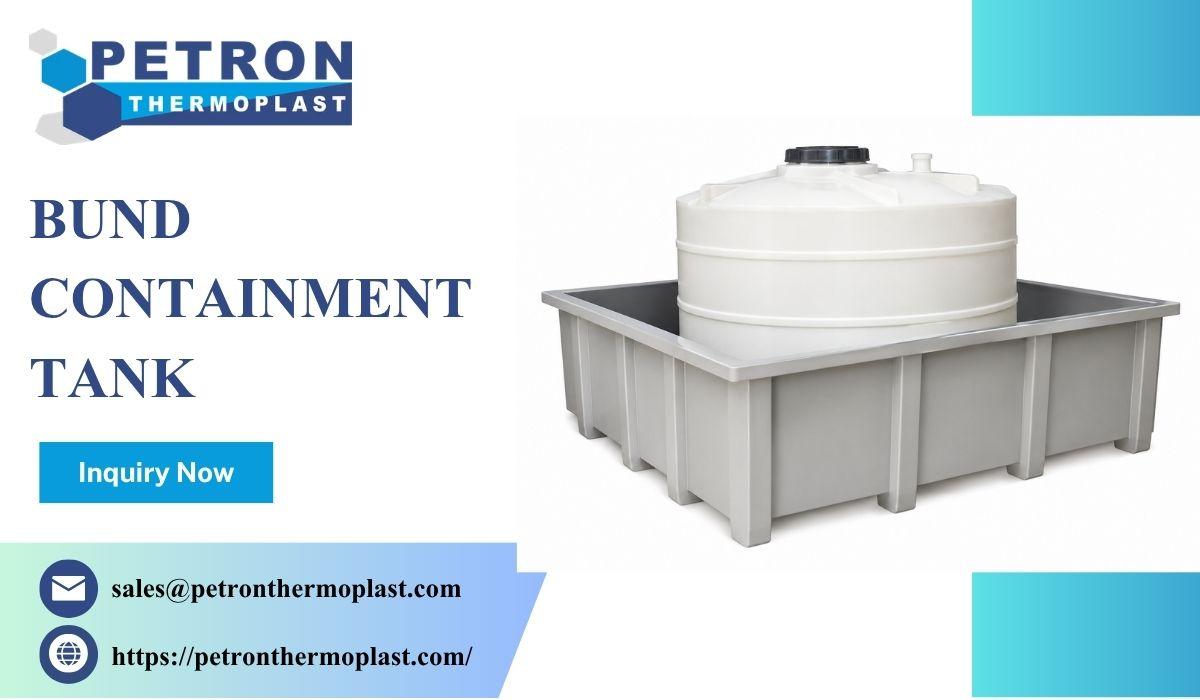
Chemical storage safety is an important concern for industrial facilities that handle acids, alkalis, solvents, and other process liquids. A leakage or accidental spill from a storage tank can damage equipment, affect workplace safety, and create environmental risks. A Bund Containment Tank system helps manage these risks by providing secondary containment around a primary storage tank.
Petron Thermoplast offers industrial thermoplastic products and fabricated tank solutions for different project requirements. For companies planning new installations or upgrading existing storage facilities, a Bund Containment Tank with Worldwide Delivery Support can be an important part of a suitable chemical storage and spill management arrangement.
This blog explains the purpose, features, applications, materials, customization options, and selection considerations for bund containment tanks.
What Is a Bund Containment Tank?
A bund containment tank is a secondary containment structure designed to collect liquid that escapes from a primary storage tank, pipework, valves, or connected equipment. It helps prevent accidental releases from spreading across the surrounding area.
In many industrial installations, the primary tank stores the process liquid, while the bund provides an additional barrier. The containment arrangement may be constructed as an outer tank, a surrounding enclosure, or a bunded storage area, depending on the project design.
The required containment capacity, construction material, drainage arrangement, and installation method depend on the stored liquid, local regulations, tank configuration, and site conditions. A properly designed bund containment system can support safer chemical handling, simplify spill management, and help facilities meet applicable environmental and safety requirements.
Key Features of Industrial Bund Containment Tanks
When selecting a bund containment tank, buyers should consider its material, capacity, construction quality, and compatibility with the intended application.
Chemical-Resistant Construction
Depending on the application, bund systems may be fabricated using materials such as polypropylene (PP), PPH, HDPE, or other chemically compatible materials. Material selection should account for the chemical, concentration, temperature, exposure duration, and potential stress conditions.
Customized Dimensions
Industrial facilities have different storage layouts and space restrictions. Bund dimensions can be developed according to the primary tank size, equipment arrangement, maintenance access, and available installation area.
Suitable Containment Capacity
The bund must provide the required effective containment volume under applicable regulations and project specifications. The design should account for displacement by the primary tank, supports, and other equipment, as well as rainfall or firefighting water where relevant.
Fabricated Design Options
Depending on the application, a bund may be supplied as a fabricated enclosure, a secondary containment tank, or part of an integrated storage arrangement. The final configuration should be confirmed through engineering review.
Access for Inspection and Maintenance
Inspection access helps operators check for leaks, accumulated liquid, damage, or other issues. Appropriate access provisions should be incorporated without compromising containment integrity. No material is suitable for every chemical. Before selecting a bund material, verify chemical compatibility, temperature limits, mechanical loading, fabrication requirements, and the expected service conditions.
Applications of Bund Containment Tanks
Bund containment systems are used in a wide range of industrial environments.
Chemical Manufacturing Plants
Chemical plants often store raw materials, intermediates, and finished liquids in dedicated tanks. Secondary containment helps control accidental releases around selected storage installations.
Water and Wastewater Treatment
Treatment facilities may handle chemical dosing solutions, cleaning chemicals, and other process liquids. Bunding can help manage spills around compatible storage equipment.
Pharmaceutical and Specialty Chemical Industries
Facilities handling process chemicals may require containment arrangements designed around specific materials, operating procedures, and site safety requirements.
Metal Finishing and Surface Treatment
Pickling, plating, and surface treatment operations can involve corrosive liquids. The primary tank and bund materials must be compatible with the actual chemical composition and operating temperature.
Manufacturing and Processing Facilities
Industrial sites may use storage tanks for cleaning solutions, treatment chemicals, and process liquids. Bund containment can be incorporated into the overall plant layout where required.
Bulk Liquid Storage Areas
Storage facilities handling multiple containers or tanks may require individual or shared secondary containment. The design should account for credible spill scenarios and applicable rules.
Customization Options for Bund Containment Tanks
Every project has its own storage requirements, installation conditions, and safety considerations. Customized fabrication can help match the containment system to the application.
Common customization options include:
- Tank dimensions: Length, width, height, and overall footprint according to the layout.
- Containment volume: Effective capacity based on the primary tank and relevant design requirements.
- Construction material: PP, PPH, HDPE, FRP, or another suitable material where technically feasible.
- Wall thickness: Determined by structural design, dimensions, liquid loading, and fabrication requirements.
- Tank arrangement: Individual bunds, integrated containment units, or shared bunded areas.
- Drainage and access: Provisions designed for safe inspection, liquid removal, and maintenance.
- Installation requirements: Support arrangements, lifting points, and transport dimensions where appropriate.
Worldwide Delivery Support for Industrial Projects
Industrial buyers often source specialized fabricated equipment for projects located in different regions. Delivery planning is therefore an important part of the purchasing process.
Petron Thermoplast can discuss project requirements and delivery arrangements for suitable thermoplastic products and fabricated tank solutions. Availability, export eligibility, lead times, and shipping options should be confirmed for each order.
For international projects, buyers should consider the following points:
- Technical drawing approval: Confirm the dimensions, construction material, and configuration before fabrication.
- Packaging requirements: Select packaging that protects the tank during handling and transport.
- Shipping dimensions: Check whether the tank can be transported using the planned freight method.
- Export documentation: Confirm the required commercial and shipping documents for the destination country.
- Delivery schedule: Agree on production time, dispatch arrangements, and estimated transit time.
- Site readiness: Prepare the foundation, access route, unloading equipment, and installation area before delivery.
Why Choose Petron Thermoplast?
Petron Thermoplast provides industrial thermoplastic products and fabricated solutions for customers with specialized piping and chemical storage requirements.
When discussing a bund containment tank project, buyers can share their application details, material preferences, primary tank dimensions, containment requirements, and delivery destination. These details help establish whether a proposed configuration is suitable and commercially feasible. Before confirming an order, customers should review the approved technical drawings, chemical compatibility, effective containment capacity, fabrication specifications, inspection requirements, and delivery terms.
Conclusion
A Bund Containment Tank with Worldwide Delivery Support can help industrial facilities manage the risk of accidental liquid releases around storage tanks and related equipment. When correctly designed, it provides secondary containment, supports spill management, and helps protect surrounding equipment and the environment.
The most suitable solution depends on the stored chemical, primary tank capacity, material compatibility, structural requirements, installation environment, and applicable regulations. Customized dimensions and carefully planned transportation can also help meet the needs of industrial projects in different locations. Petron Thermoplast supports industrial thermoplastic product and fabricated tank enquiries. Contact the team through the official website to discuss your project requirements, request a quotation, and confirm available customization and delivery options.

 English
 Arabic
 French
 Portuguese
 Deutsch
 Turkish
 Dutch
Dutch
 Italiano
 Russian
 Romaian
 Portuguese (Brazil)
 Greek
Greek
 Bengali