


Should a Custom Armored Motorcycle Hoodie Have Pockets? How Placement Can Affect Armor and Everyday Use
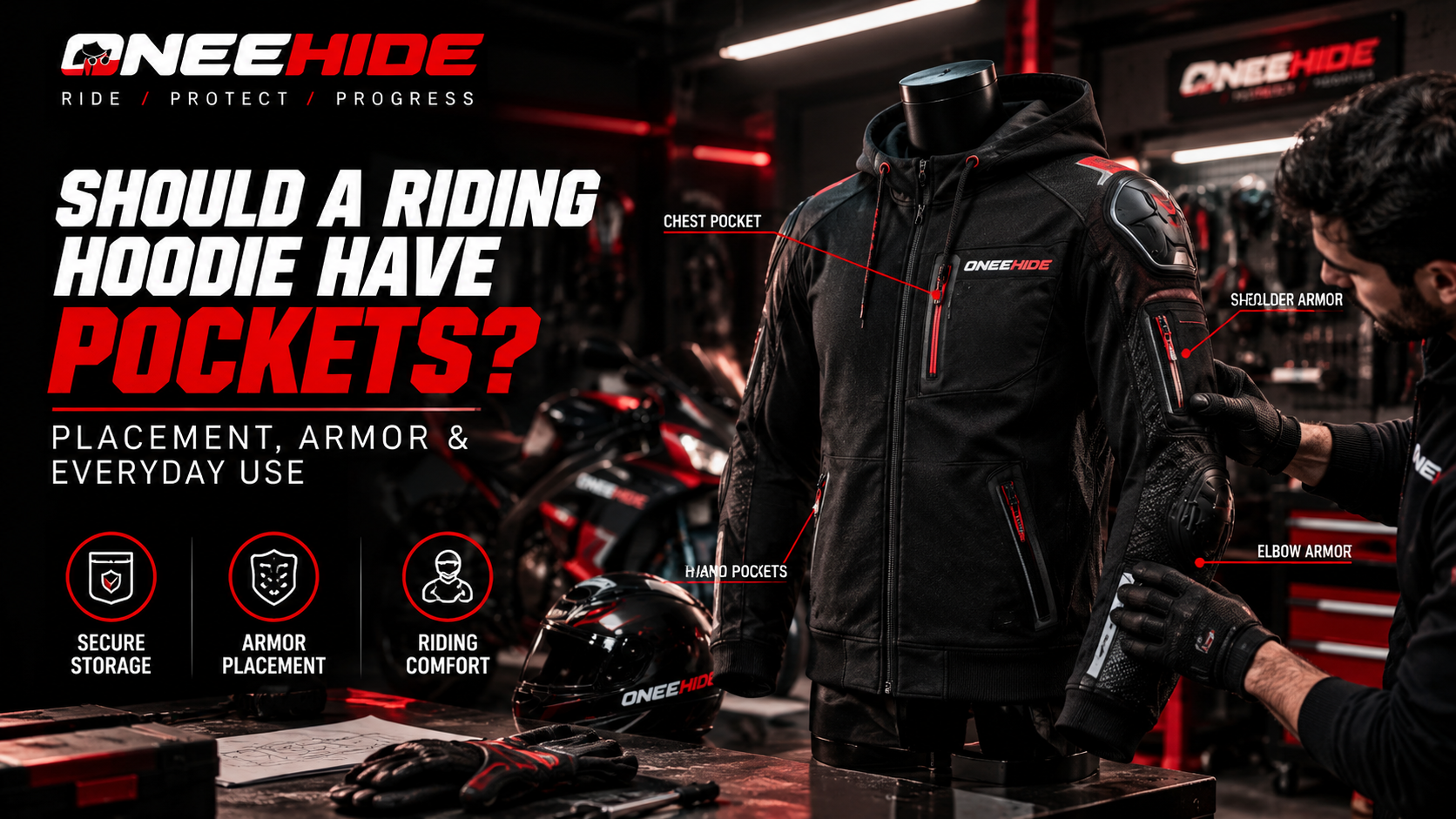
Pockets make a motorcycle hoodie more practical, but their placement matters when the garment also needs to accommodate protective armor. A pocket that works perfectly on an everyday sweatshirt may create bulk near an elbow protector, interfere with movement, or make the hoodie uncomfortable when a rider leans forward over the handlebars.
The answer is not to eliminate every pocket. It is to distinguish storage pockets from armor compartments and design each for its intended purpose. A well-planned hoodie can carry small everyday items while keeping protective components correctly positioned, provided the garment's construction and fit support both functions.
For riders considering custom gear, the important questions are where pockets should sit, what they should hold, how closures affect comfort, and whether adding storage changes the garment's protective performance.
Why Pocket Placement Matters on a Motorcycle Hoodie
Pocket placement affects more than appearance. It can influence how fabric hangs, how the garment moves around the body, and whether stored items create pressure points during a ride.
An ordinary hoodie is usually designed around an upright standing posture. A motorcycle hoodie must also accommodate bent elbows, forward-reaching arms, and a torso that may lean toward the handlebars. These different positions change how the fabric stretches and where seams and pocket openings sit.
A pocket that feels comfortable while standing may press against the abdomen when the rider bends forward. A bulky item in a sleeve pocket can interfere with wrist movement, while a poorly positioned pocket near an armor compartment can make the surrounding area stiff or crowded.
When evaluating a custom armored motorcycle hoodie, consider the intended riding position before deciding how many pockets to add. The goal is useful storage without compromising fit, mobility, or the placement of protective components.
Storage pockets and armor pockets serve different purposes
Storage pockets hold personal belongings. Armor pockets are designed to retain protective inserts over specific body areas. Although both may be sewn into the same garment, they have different requirements.
A storage pocket needs an opening that is convenient to reach and a construction that keeps its contents secure. An armor pocket needs compatible dimensions, suitable attachment points, and a fit that helps the protector remain correctly positioned during movement.
Combining these functions without a deliberate design can create problems. For example, placing a phone pocket directly over an elbow armor compartment may add bulk where the arm bends. A shared opening may also make it harder to access an item without disturbing the protective insert.
Separate compartments are generally easier to manage because each can be designed for its own purpose. The exact arrangement should still be assessed on the finished garment, rather than assumed to be safe simply because the pockets are separate.
Which Pocket Locations Work Best?
The best pocket location depends on what the rider needs to carry and how the hoodie is constructed. Front hand pockets, internal chest pockets, and small secure storage compartments each offer different advantages.
Front kangaroo pockets
A large kangaroo pocket is familiar and convenient, particularly for riders who want their motorcycle hoodie to retain the appearance of casual clothing. However, its usefulness while riding depends on the opening, depth, and position.
A wide opening may allow items to move around, while a bulky object can press against the abdomen when the rider leans forward. The pocket may also become uncomfortable if its contents shift during braking or changes in riding posture.
A front pocket is most suitable for lightweight items that do not interfere with movement. It should not be treated as a safe place for a phone, wallet, or keys during every riding situation simply because the opening feels secure while standing.
Internal chest pockets
An internal chest pocket can keep small belongings close to the body and reduce their exposure to wind and weather. Because it sits inside the garment, it may also avoid some of the snagging concerns associated with external storage.
Its position still matters. A pocket placed directly over a protective panel may create unwanted bulk, and a heavy object can pull the fabric downward. The pocket should not interfere with chest protection, restrict the rider's breathing, or press uncomfortably against the body.
For riders who carry a phone or wallet, an internal compartment with a secure closure may be more practical than an open front pocket. Check that the item remains comfortable when the arms extend toward the handlebars.
Sleeve and side pockets
Sleeve pockets can provide convenient access to small items, but they need careful placement. A pocket near the elbow may interfere with armor, while one near the wrist can affect glove overlap or create pressure when the hand bends.
Side pockets can work well for lightweight storage if they remain accessible without forcing the rider to twist awkwardly. Their openings should not interfere with waistbands, riding trousers, or the natural movement of the torso.
No pocket position is automatically safe for every rider. The final decision should account for the garment's pattern, the location of its armor, and the rider's posture.
Should Motorcycle Hoodie Pockets Have Zippers?
A secure closure can help prevent belongings from falling out, but the design of the closure matters just as much as the pocket itself. Zippers, concealed snaps, and other fasteners have different advantages depending on their location and construction.
A zipper can keep a pocket closed during movement, but a bulky zipper pull or exposed metal component may create an uncomfortable pressure point. A snap can provide a low-profile finish, although it must be securely attached and positioned so that it does not press against the wearer.
The NSW Government's guidance on motorcycle riding gear advises riders to look for clothing that secures and protects fasteners and avoids external pockets or straps that could become snagged or act as tear points. This is a useful reminder that extra storage features should not introduce avoidable weaknesses.
For a custom hoodie, inspect the following details:
-
Low-profile closures: Check that zipper pulls and other hardware do not create hard pressure points.
-
Protected fasteners: Look for construction that reduces exposure to abrasion and prevents hardware from catching on nearby equipment.
-
Secure openings: Make sure the pocket stays closed during normal riding movements.
-
Reinforced attachment points: Check whether the pocket corners and seams appear suitable for the intended load.
-
Comfort against the body: Sit in a riding position to determine whether the closure presses into the abdomen, chest, wrist, or arm.
A closure can improve convenience, but it does not make the pocket suitable for carrying every object. Heavy or hard items may remain uncomfortable or hazardous even when the pocket is securely fastened.
What Should You Carry in a Motorcycle Hoodie Pocket?
Pocket design should reflect the items the rider intends to carry. Small, lightweight belongings generally place less strain on the fabric than bulky or heavy objects, but their shape and hardness also matter.
A folded document, soft earplugs case, or lightweight cloth may be easier to accommodate than a large phone or metal key bundle. The suitability of any item depends on where it sits and whether it can press against the body during movement.
Avoid assuming that a pocket protects its contents or the rider in a crash. Ordinary hoodie pockets are not necessarily designed to retain objects under impact, and hard items may create localized pressure if the body lands on them.
Before riding, consider these practical guidelines:
-
Keep heavy items out of pockets that pull on the garment or restrict arm movement.
-
Avoid carrying sharp or bulky objects against the torso or joints.
-
Secure essential belongings so they cannot fall out during ordinary riding movements.
-
Move items that cause pressure when seated or leaning forward.
-
Use a suitable luggage compartment or motorcycle storage solution for objects that do not fit comfortably in the garment.
The safest arrangement may be to use the hoodie for a few small essentials and store everything else elsewhere. More pocket capacity is not necessarily more useful if it makes the garment uncomfortable or encourages riders to carry unsuitable objects close to the body.
Can Adding Pockets Affect Motorcycle Armor?
Yes, pocket design can affect how armor fits and how the garment behaves, especially when a new pocket is added close to an existing protective compartment. The effect depends on the pattern, materials, stitching, and placement rather than simply on the number of pockets.
An armor pocket needs to retain its protector in the intended position. If a storage pocket shares fabric with that compartment, added weight or tension may influence how the fabric hangs. A thick pocket bag can also create bulk that interferes with bending or reaching.
The Motorcycle Clothing Assessment Program, known as MotoCAP, evaluates motorcycle clothing using separate protection and comfort ratings. Its assessments consider factors such as abrasion resistance, seam strength, and impact protection, illustrating why overall garment performance matters more than any single feature. Riders can explore its motorcycle clothing assessment information when comparing protective gear.
Keep storage separate from impact protection
A separate storage compartment can make the garment easier to design and use, but separation alone does not prove that the arrangement is safe. The pocket must still avoid disrupting armor retention, reinforcement, seams, or protective coverage.
If you are commissioning a custom garment, ask the maker to identify the intended armor locations before finalizing pocket placement. This helps prevent a storage feature from being added later in a position that conflicts with the protective design.
Do not cut, sew through, or relocate an armor compartment without checking with the manufacturer. Changes to the finished garment may affect fit and could invalidate assumptions about its original protective performance or certification.
How to Test Pocket Placement Before Buying
A useful fitting should reproduce the movements and posture involved in riding, not just show how the hoodie looks while standing. Try the garment with the armor installed and with the riding layers you normally wear.
Use this simple check before committing to a custom layout:
-
Stand naturally. Check whether pockets hang evenly and whether their openings sit comfortably.
-
Sit on the motorcycle. Lean forward and reach for the handlebars. Notice whether pocket edges press into your abdomen or chest.
-
Bend your elbows. Confirm that sleeve pockets do not interfere with armor or restrict movement.
-
Test glove overlap. Check that wrist closures and sleeve pockets do not interfere with gloves.
-
Carry your intended essentials. Place lightweight everyday items in the pockets and repeat the movements.
-
Inspect armor position. Confirm that protectors remain correctly positioned and that storage does not create uncomfortable pressure.
-
Check the closures. Make sure openings remain secure and hardware does not catch on nearby equipment.
This test cannot establish crash protection, but it can reveal practical fit and usability problems before the garment is used on the road.
Choose Pocket Design Around the Way You Ride
A custom armored motorcycle hoodie can include useful storage without sacrificing everyday comfort, provided pocket placement is planned alongside the garment's protective construction. Front pockets suit lightweight essentials, internal compartments can keep small belongings close to the body, and sleeve pockets need particular attention around the elbows and wrists.
Prioritize correctly positioned armor, secure seams, comfortable movement, and suitable protective specifications before adding extra storage. Then choose pocket locations and closures that match the items you actually carry.
If a pocket interferes with armor, creates pressure in a riding position, or introduces exposed hardware that could snag, redesign it or leave it out. A simpler layout is often more practical than a crowded garment, especially when every feature must work comfortably on and off the motorcycle.

 English
 Arabic
 French
 Spanish
 Portuguese
 Deutsch
 Dutch
Dutch
 Italiano
 Russian
 Romaian
 Portuguese (Brazil)
 Greek
Greek
 Bengali