


flat rack shipping India
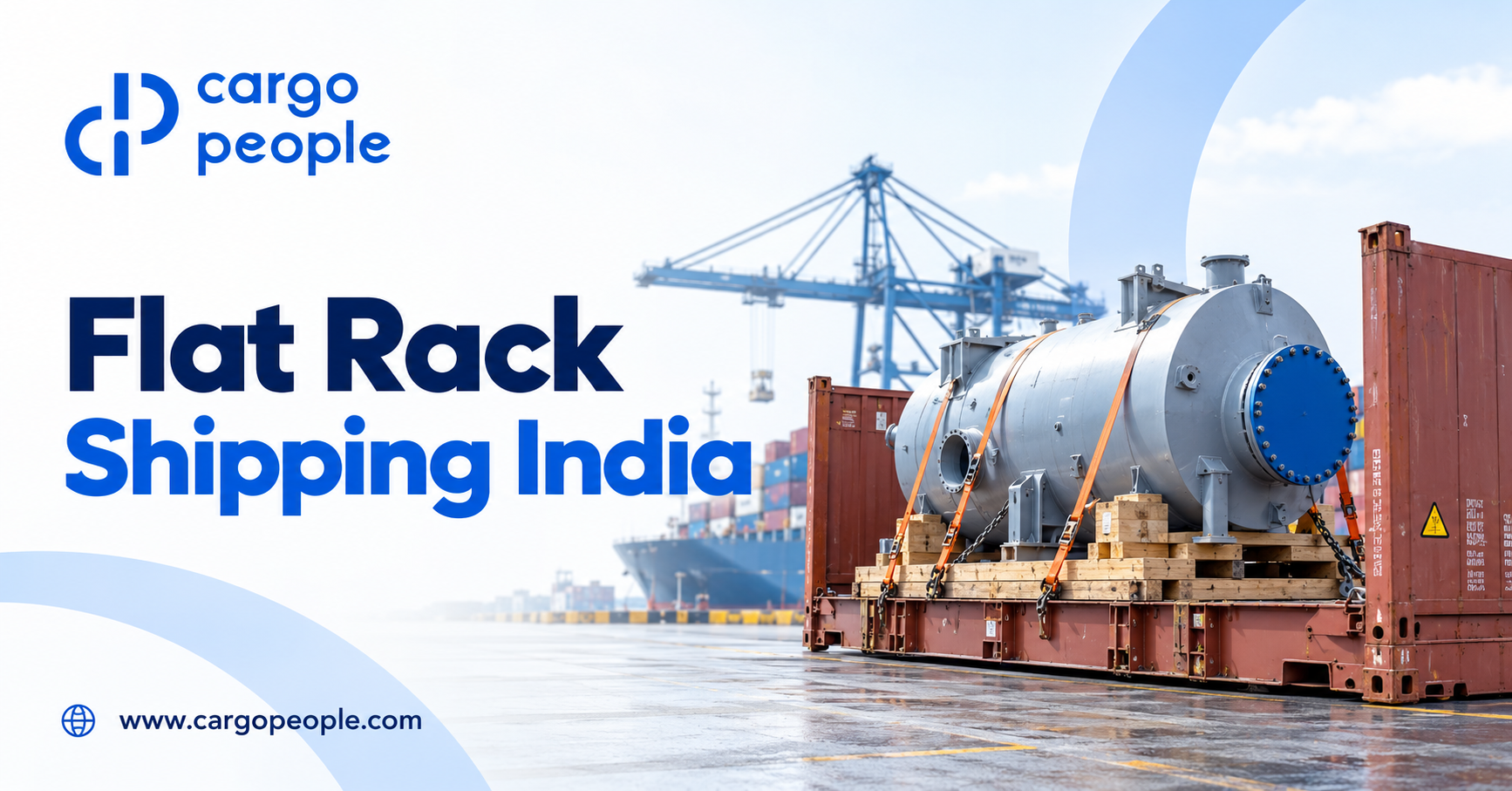
Industrial machinery, large equipment, steel structures, transformers, construction equipment and project cargo often exceed normal container dimensions. In such cases, flat rack shipping in India becomes a practical solution.
A flat rack container is designed to carry heavy, oversized or irregular cargo that cannot be loaded into a standard dry container. It has a strong base with end walls but usually no side walls or roof, allowing cargo to extend beyond the normal width or height limits.
For Indian manufacturers, importers and exporters, flat rack shipping can be an efficient way to move large industrial cargo by sea. However, it requires careful planning, lashing, port coordination and shipping-line approval.
What Is a Flat Rack Container?
A flat rack container is a special type of shipping equipment designed for cargo that is too large or heavy for a standard container.
Unlike a normal 20-foot or 40-foot container, a flat rack has an open structure.
It generally includes:
- A reinforced steel platform
- End walls
- No fixed side walls
- No fixed roof
- Strong lashing points for cargo securing
Some flat racks have collapsible end walls, while others are fixed-end units.
The open design makes them suitable for cargo that extends beyond the standard container dimensions.
Why Is Flat Rack Shipping Important in India?
India imports and exports a large volume of industrial machinery, engineering goods, infrastructure equipment and heavy project cargo.
Many of these shipments cannot be containerized in the normal way.
Flat rack shipping allows businesses to move oversized equipment through major Indian ports without depending entirely on breakbulk shipping.
It can be particularly useful when the cargo dimensions are large but still suitable for container vessel handling.
This gives businesses a more structured sea-freight option for transporting out-of-gauge cargo.
Who Needs Flat Rack Shipping Services?
Flat rack shipping is commonly used by companies in sectors where cargo is heavy, long, tall or wide.
Typical users include:
- Heavy engineering companies
- Infrastructure contractors
- Construction equipment suppliers
- Steel manufacturers
- Power and energy companies
- Automotive manufacturers
- Industrial machinery suppliers
- Oil and gas companies
- Renewable-energy businesses
- Project cargo importers and exporters
Companies moving individual pieces of equipment weighing several tonnes may also require specialized flat rack arrangements.
What Type of Cargo Can Be Shipped on a Flat Rack?
Flat racks are suitable for many types of oversized and heavy cargo.
Examples include:
Industrial Machinery
Large manufacturing equipment, CNC machines, presses, compressors and processing machinery may be shipped on flat racks when their dimensions exceed standard container limits.
Construction Equipment
Excavators, loaders, rollers and other construction machinery may require flat rack transportation.
Transformers and Electrical Equipment
Large transformers, generators and power equipment often have dimensions that make normal containerization impossible.
Steel Structures
Large beams, fabrication structures, industrial frames and steel components may be transported using flat racks.
Project Cargo
Specialized equipment for infrastructure, manufacturing and energy projects often uses flat rack or breakbulk solutions.
Flat Rack Shipping Process in India
Flat rack shipping involves more planning than a standard container shipment.
1. Cargo Assessment
The first step is to review the cargo dimensions and weight accurately.
The logistics provider needs:
- Length
- Width
- Height
- Gross weight
- Centre of gravity
- Lifting points
- Packaging details
Even a small mistake in dimensions can affect vessel planning and freight cost.
2. Select the Correct Flat Rack
Flat racks are commonly available in 20-foot and 40-foot sizes.
The correct choice depends on cargo length, weight, width and height.
A 40-foot flat rack may be used for longer cargo, while a 20-foot unit may be suitable for compact but very heavy equipment.
The shipping line also checks whether the cargo weight falls within the equipment's allowable limits.
3. Check Out-of-Gauge Dimensions
If cargo extends beyond the normal width, height or length of the flat rack, it is classified as out-of-gauge cargo, commonly called OOG cargo.
The shipping line must approve these dimensions before booking.
OOG approval is important because oversized cargo may occupy additional vessel space.
For example, a wide shipment may prevent containers from being loaded next to it.
This affects freight pricing.
4. Packaging and Protection
Because flat rack cargo is exposed from the sides and top, weather protection is important.
Depending on the cargo, protection may include:
- Tarpaulin covering
- Shrink wrapping
- Wooden crates
- Rust protection
- Moisture protection
- Edge guards
Machinery should be properly protected against rain, sea moisture and handling risks.
5. Cargo Lashing and Securing
Lashing is one of the most important parts of flat rack shipping.
Heavy cargo must be properly secured so that it does not shift during sea transport.
Common securing methods include:
- Chains
- Wire ropes
- Heavy-duty straps
- Timber blocking
- Welding or securing frames
- Chocks and braces
The method depends on cargo weight, centre of gravity and movement risk.
6. Shipping-Line Approval
The shipping line generally reviews cargo dimensions, weight and sometimes photographs or technical drawings before approving the booking.
For complex cargo, they may also request a lashing plan or loading arrangement.
This approval should be obtained before the cargo reaches the port.
7. Port Handling and Loading
Flat rack cargo may require cranes, forklifts or special handling equipment.
Depending on the shipment, cargo can be loaded onto the flat rack at the factory, warehouse, container yard or port.
Proper coordination is required to avoid unnecessary handling and storage charges.
8. Ocean Transportation
Once loaded and approved, the flat rack is moved onto the vessel.
The container may be loaded in a specific vessel position because of the cargo dimensions.
OOG cargo may require special planning by the shipping line.
Documents Required for Flat Rack Shipping
The exact documentation depends on the cargo and destination.
Common documents include:
- Commercial invoice
- Packing list
- Bill of lading
- Import Export Code
- Shipping bill or bill of entry
- Cargo dimensions and weight details
- Equipment drawings
- Photographs of cargo
- Lashing plan, where required
- Insurance documents
- Product-specific certificates or approvals
For machinery shipments, technical drawings can help the shipping line understand the cargo dimensions and lifting requirements.
What Affects Flat Rack Shipping Cost?
Flat rack shipping cost depends on several factors.
Cargo Dimensions
Width and height are particularly important.
Cargo that exceeds standard container dimensions can occupy additional vessel slots, which increases freight cost.
Weight
Very heavy cargo may require specialized equipment and handling arrangements.
Route
Rates vary based on origin port, destination port and vessel availability.
Shipping Line
Different shipping lines have different flat rack availability and OOG pricing structures.
Loading Requirements
Crane charges, special trailers and lashing expenses can increase the total cost.
Seasonal Availability
Flat racks are specialized equipment and may not always be readily available at every port.
Early booking is recommended for major project shipments.
Benefits of Flat Rack Shipping
Flat rack shipping offers several advantages for oversized cargo.
Suitable for large cargo: Equipment that cannot fit in a standard container can still move through container shipping networks.
Flexible loading: Cargo can be loaded from the top or sides.
Strong cargo base: Flat racks are built to handle heavy industrial cargo.
Suitable for project logistics: They work well for industrial and infrastructure shipments.
Global connectivity: Flat racks can move through many major container shipping routes.
For certain shipments, flat rack shipping may also be more practical than arranging full breakbulk transport.
Common Challenges in Flat Rack Shipping
Despite the advantages, flat rack shipping requires careful coordination.
Incorrect Cargo Measurements
If the final cargo dimensions are different from the dimensions submitted during booking, the shipping line may revise the freight or reject the shipment.
Equipment Availability
Flat rack equipment can be limited, particularly during busy shipping periods.
Poor Lashing
Improperly secured cargo can create serious safety and damage risks.
Weather Exposure
Because the cargo is not fully enclosed, it requires suitable weather protection.
High OOG Charges
Oversized cargo may occupy multiple container slots on the vessel, which can increase the ocean freight significantly.
Port Handling Restrictions
Some ports or terminals may have limitations on very heavy or oversized cargo.
These restrictions should be checked before booking.
Flat Rack Shipping vs Breakbulk Shipping
Both options are used for oversized cargo, but they are different.
Flat rack cargo is transported on containerized equipment and generally moves through container shipping networks.
Breakbulk cargo is loaded directly onto a vessel as individual pieces.
Flat rack shipping can be suitable when the cargo dimensions remain manageable within container vessel handling limits.
Breakbulk may be more suitable when the equipment is extremely large, heavy or difficult to secure on a flat rack.
A freight forwarder should compare both options before finalizing the shipment.
How Can a Freight Forwarder Help?
Flat rack shipments require more coordination than normal sea freight.
An experienced freight forwarder can support businesses with:
- Cargo measurement review
- Flat rack selection
- Shipping-line approvals
- OOG freight quotations
- Lashing coordination
- Port handling
- Customs clearance
- Heavy-haul transportation
- Cargo insurance
- Door-to-door delivery
The freight forwarder can also compare flat rack, open-top and breakbulk options based on the cargo.
This helps the shipper choose the most practical logistics solution instead of selecting equipment only on the basis of basic freight rates.
Why Early Planning Matters
Oversized shipments should ideally be planned before the cargo leaves the factory.
Shipping lines may need time to check vessel space, flat rack availability and OOG dimensions.
Transporting the cargo from the factory to the port may also require special trailers or road permissions.
If the cargo is measured and planned early, businesses can reduce the risk of last-minute changes and additional costs.
For large machinery or project shipments, logistics planning should ideally begin as soon as the equipment dimensions are finalized.
Conclusion
Flat rack shipping in India is an important sea-freight solution for oversized, heavy and irregular industrial cargo.
It is widely used for machinery, construction equipment, transformers, steel structures and project cargo that cannot fit inside standard containers.
However, successful flat rack shipping depends on accurate measurements, suitable equipment, shipping-line approval, professional lashing and proper port coordination.
Working with an experienced project cargo and freight forwarding company can help reduce handling risks, improve cost planning and ensure smoother movement from origin to destination.
Get Expert Assistance for Flat Rack Shipping in India
Cargo People Logistics & Shipping Pvt. Ltd. assists Indian manufacturers, importers and exporters with flat rack shipping, OOG cargo, project cargo, international sea freight, customs clearance and door-to-door logistics.
If you are planning to move heavy or oversized equipment, share the cargo dimensions, weight, photographs and pickup/delivery locations so that the suitable shipping option can be evaluated.
👉https://cargopeople.com/blog/heavy-machinery-sea-freight-breakbulk-flat-rack-or-open-top-container/
Website: https://www.cargopeople.com/
Phone: +91 97174 65454
Email: wecare@cargopeople.com

 English
 Arabic
 French
 Spanish
 Portuguese
 Deutsch
 Turkish
 Italiano
 Russian
 Romaian
 Portuguese (Brazil)
 Greek
Greek
 Bengali