


Battery Recycling Plant Setup in India
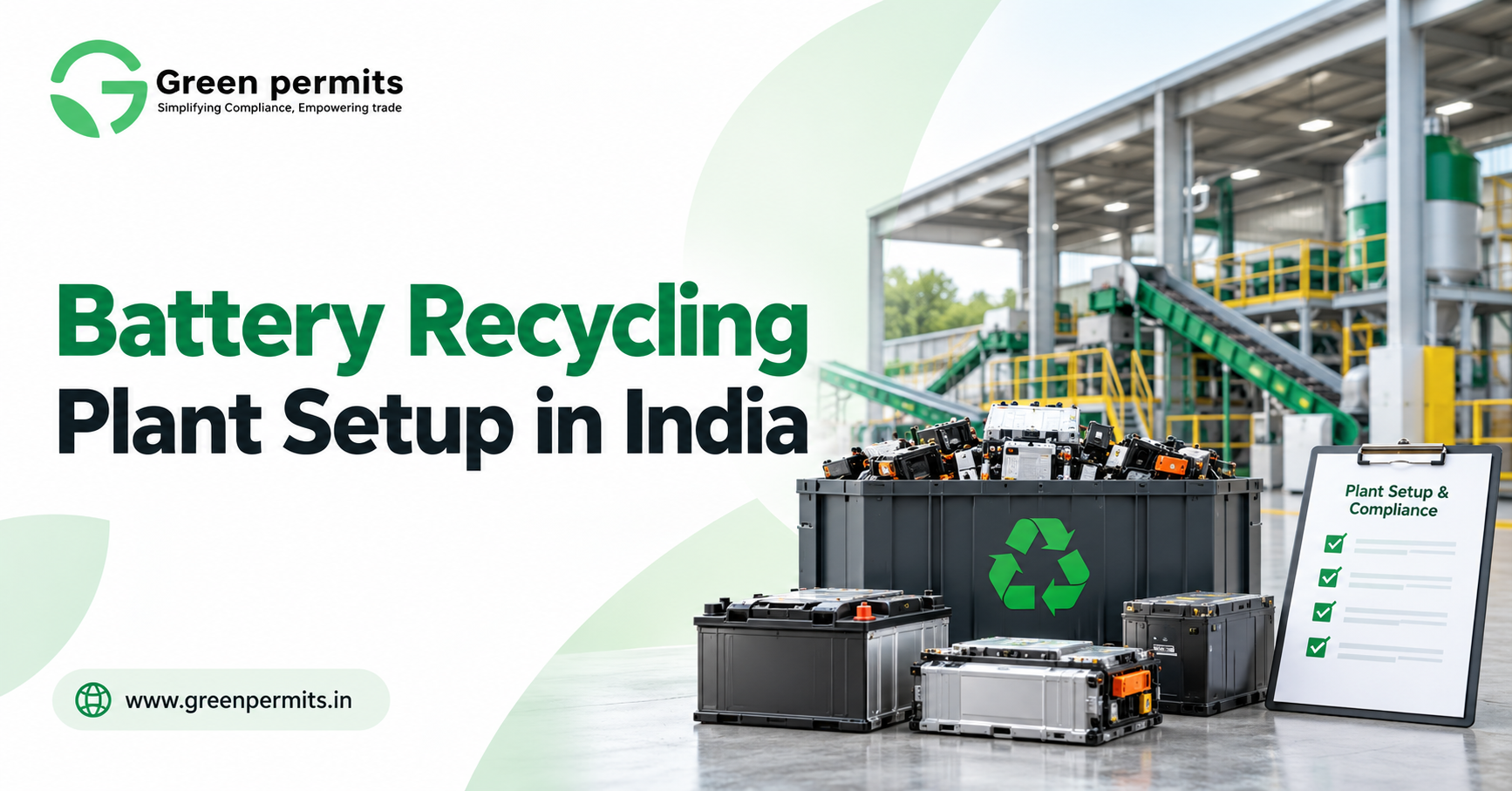
A Battery Recycling Plant Setup in India can be a strong industrial opportunity as battery consumption increases across electric vehicles, automotive applications, consumer electronics, industrial equipment and Battery Energy Storage Systems. Used batteries contain recoverable metals and other materials that can be returned to the manufacturing supply chain instead of being discarded.
However, battery recycling is not one single business model. The technology, machinery, investment and recovery economics change significantly depending on whether the plant processes lithium-ion batteries, lead-acid batteries or other battery chemistries. Investors should therefore define the target feedstock and final recovered products before deciding plant capacity or purchasing machinery.
Green Permits Consulting supports investors with Battery Recycling Plant feasibility studies, DPR preparation, feedstock mapping, technology assessment, CPCB/SPCB compliance, CAPEX and OPEX modelling and complete plant setup planning.
Understanding the Battery Recycling Business
A battery recycling facility receives used, rejected or scrap batteries and processes them to recover reusable materials.
Depending on the battery chemistry and recycling route, recoverable outputs can include lithium-bearing material, nickel, cobalt, manganese, copper, aluminium, lead, steel, plastics and other fractions.
For a lithium-ion recycling project, the process may broadly follow:
Battery Collection → Inspection → Safe Discharge → Dismantling → Shredding → Separation → Black Mass → Further Material Recovery
A plant may stop at mechanical processing and sell black mass and separated metals, or it may add hydrometallurgical processing to recover higher-purity battery materials.
The business model should therefore be selected before machinery specifications are finalised.
Step 1: Select the Battery Chemistry
The first major decision is identifying which battery types the plant will accept.
Lithium-ion batteries themselves include different chemistries such as LFP, NMC, NCA and LCO. Their material composition and economic value differ substantially.
NMC batteries may contain lithium, nickel, manganese and cobalt, while LFP batteries do not have the same nickel and cobalt value. This changes both feedstock pricing and recovery economics.
The project should therefore begin with:
Battery Type → Chemistry → Material Composition → Recovery Route → Saleable Product
A plant designed around cobalt-rich batteries should not use the same revenue assumptions if most future feedstock is expected to be LFP.
Step 2: Map Battery Scrap Feedstock
Feedstock security is one of the biggest factors determining whether a battery recycling plant succeeds.
Potential suppliers can include battery manufacturers, EV companies, automotive workshops, electronics manufacturers, service centres, energy-storage operators, collection networks, scrap aggregators and bulk consumers.
The feedstock study should identify:
Supplier → Battery Type → Chemistry → Monthly Quantity → Purchase Price → Distance
It is also important to distinguish between current and future battery availability.
Rapid EV growth does not mean all batteries sold today will immediately become recycling feedstock. EV and energy-storage batteries can remain in service for several years.
For new plants, manufacturing scrap, warranty returns, damaged batteries and smaller end-of-life batteries may provide more immediate feedstock than future EV retirement volumes.
Step 3: Decide the Recycling Model
Battery recycling plants can operate at different processing depths.
A mechanical recycling plant may focus on discharge, dismantling, shredding and separation. This can recover copper, aluminium, steel and black mass.
The process may look like:
Battery → Dismantling → Shredding → Physical Separation → Metals + Black Mass
A more integrated project may add hydrometallurgical processing.
In such a plant, black mass can undergo leaching, purification and precipitation to recover lithium, nickel, cobalt or manganese compounds depending on chemistry.
Integrated processing can provide higher value addition, but it also increases CAPEX, chemical consumption, wastewater-treatment requirements and operating complexity.
The feasibility study should compare both models before selecting the final route.
Step 4: Select Battery Recycling Machinery
Machinery should be selected according to battery chemistry, plant capacity and final product.
A lithium-ion battery recycling facility may require safe discharge systems, dismantling stations, shredders, crushers, sieves, magnetic separators, air-separation systems and dust-control equipment.
Where hydrometallurgical recovery is included, the plant may also require reactors, filtration systems, chemical dosing equipment, purification units, precipitation systems and drying equipment.
The correct sequence is:
Feedstock → Recovery Target → Process Flow → Machinery → Plant Capacity
Investors should avoid choosing machinery only because a supplier offers a high nominal throughput.
Actual performance depends on battery format, chemistry, contamination, operating hours and recovery efficiency.
Step 5: Battery Safety and Fire Protection
Battery recycling requires stronger safety planning than many conventional recycling businesses.
Lithium-ion batteries can retain electrical energy even after removal from equipment. Damaged or improperly handled cells may create fire and thermal-runaway risk.
The plant should therefore provide suitable areas for battery receiving, inspection, isolation and storage.
Fire detection, emergency procedures, material segregation and employee training should form part of the plant design from the beginning.
Battery packs from EVs can also require specialised dismantling procedures because of higher voltages and larger stored energy.
Safety systems should therefore be treated as core production infrastructure rather than an additional compliance expense.
Step 6: Choose the Right Plant Location
Location affects feedstock cost, approvals, utilities and buyer access.
A suitable site should ideally provide access to battery-manufacturing clusters, EV markets, industrial centres and collection networks.
The location should be assessed using:
Feedstock Availability + Logistics + Industrial Land + Power + Water + Buyer Access + Expansion Potential
For integrated hydrometallurgical plants, water availability and wastewater-management infrastructure can become particularly important.
The facility should also have enough space for incoming battery storage, quarantine areas, production, finished material, waste storage, fire access and future capacity expansion.
Step 7: Identify Buyers Before Plant Installation
A battery recycling project needs a clear market for its recovered materials.
For mechanical recycling plants, black mass can be one of the most important outputs. However, its commercial value depends on chemistry, metal concentration, moisture, impurities and buyer specification.
The plant may also sell separated copper, aluminium, steel and other material fractions.
The buyer study should therefore follow:
Recovered Material → Quality Specification → Buyer → Selling Price
An integrated plant producing battery-grade or intermediate metal compounds requires even more detailed buyer qualification.
The machinery and purification system should be designed around what the buyer actually accepts rather than only what the process can technically produce.
Step 8: Environmental and Regulatory Approvals
Battery recycling plants in India operate within the applicable environmental and battery waste management framework.
Depending on the project and location, approvals may include Consent to Establish, Consent to Operate, CPCB registration as a battery recycler, hazardous-waste-related requirements where applicable, fire approvals, factory-related permissions and other local industrial approvals.
The practical project sequence can be:
Site Finalisation → CTE → Plant Installation → CTO → Applicable Recycler Registration → Commercial Operation
The exact approval route should be reviewed for the specific technology, battery chemistry and state before implementation.
Compliance planning should begin before the plant layout is frozen so that waste storage, pollution-control and safety infrastructure can be incorporated into the project.
Step 9: Prepare a Material Balance
A proper material balance is essential for both technical and financial planning.
One tonne of batteries does not become one tonne of saleable high-value material.
The incoming battery may contain casing, copper, aluminium, electrolyte, active materials, plastics and other components.
The DPR should therefore calculate:
Battery Input = Recovered Metals + Black Mass / Recovered Compounds + Plastics + Waste + Process Loss
Revenue should then be calculated separately for each saleable material.
This provides a much more realistic financial picture than applying one average revenue figure per tonne of battery scrap.
Step 10: CAPEX, OPEX and Working Capital
Battery recycling investment can vary substantially according to processing depth.
CAPEX may include land, civil works, dismantling equipment, shredding systems, separation machinery, pollution-control systems, hydrometallurgical equipment where applicable, laboratory infrastructure, fire systems and utilities.
The complete project investment can be considered as:
Land + Civil + Machinery + Recovery Systems + Environmental Infrastructure + Safety + Laboratory + Working Capital
Working capital is particularly important because battery scrap can itself be expensive.
The recycler may need to purchase feedstock before processing and may then wait for payment from downstream buyers.
This cash cycle should be included in the financial model from the beginning.
Step 11: Financial Feasibility and EPR Revenue
The core financial model should be based on feedstock procurement and recovered material sales.
A simple approach is:
Battery Feedstock × Recoverable Material × Recovery Efficiency × Selling Price = Recovery Revenue
From this, the plant should deduct battery purchase cost, transport, electricity, labour, chemicals, maintenance, waste treatment and financing costs.
Eligible registered recyclers may also participate in the applicable EPR framework and generate certificates according to the regulatory mechanism.
However, EPR certificate income should be treated as an additional revenue stream rather than the only reason the project appears profitable.
The strongest plant should remain commercially viable through material recovery and product sales.
Battery Recycling Plant DPR and Implementation Roadmap
A professional Battery Recycling Plant DPR should combine feedstock, technology, regulation and financial viability.
The complete development roadmap should be:
Market Study → Feedstock Mapping → Chemistry Analysis → Buyer Study → Technology Selection → Site → DPR → Approvals → Machinery → Installation → Trial Production → Commercial Operation
This approach reduces the risk of purchasing machinery before confirming whether enough feedstock and downstream demand actually exist.
How Green Permits Helps with Battery Recycling Plant Setup
Green Permits Consulting supports entrepreneurs, recyclers and industrial investors with Battery Recycling Plant feasibility studies, DPR preparation, feedstock mapping, technology evaluation, machinery planning, site selection, CTE/CTO support, CPCB recycler registration, CAPEX and OPEX modelling and project implementation support.
We help connect battery chemistry, feedstock availability, recovery technology and buyer demand before major investment decisions are made.
Learn More About Battery Recycling Plant Setup
If you are planning a battery recycling facility in India, the project should be evaluated for battery chemistry, feedstock availability, recycling technology, plant capacity, recovered material buyers, safety systems and environmental approvals before major machinery investment begins.
Read more about recycling plant setup and DPR consulting services here:
👉 https://www.greenpermits.in/10/lithium-ion-battery-recycling-plant-setup-in-india-cpcb-compliance/
📞 Get Expert Assistance for Battery Recycling Plant Setup in India
If you need support for a Battery Recycling Plant Setup in India, Green Permits Consulting can assist with feasibility study, DPR preparation, feedstock assessment, machinery planning, CTE/CTO, CPCB recycler registration, financial modelling and complete project implementation coordination.
🌐 Website: www.greenpermits.in
📞 Phone: +91 78350 06182
📧 Email: wecare@greenpermits.in

 English
 Arabic
 French
 Spanish
 Portuguese
 Turkish
 Dutch
Dutch
 Italiano
 Russian
 Romaian
 Portuguese (Brazil)
 Greek
Greek
 Bengali