


Plastic Recycling Plant Setup in India
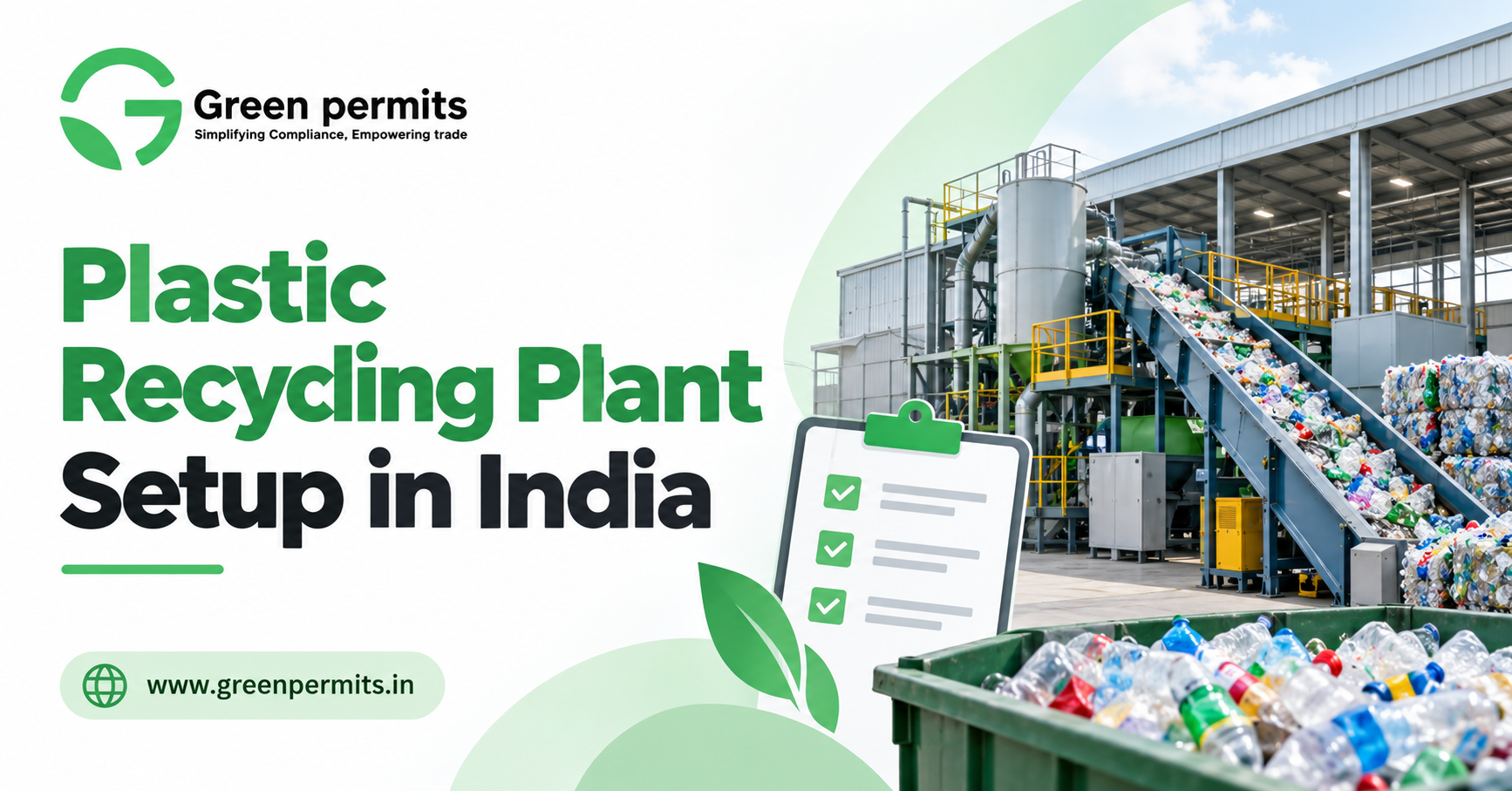
A Plastic Recycling Plant Setup in India can be a strong business opportunity because large volumes of plastic waste are generated from packaging, manufacturing, retail, consumer products and industrial applications. At the same time, demand for recycled plastic continues to grow across packaging, automotive, construction, household products and other manufacturing sectors.
However, a plastic recycling project should not begin only with machinery selection. The commercial success of the plant depends on feedstock availability, polymer type, contamination level, recycling technology, product quality, buyer demand, plant location, environmental approvals and working capital.
Green Permits Consulting supports investors and entrepreneurs with Plastic Recycling Plant feasibility studies, DPR preparation, feedstock mapping, machinery planning, site selection, CAPEX and OPEX modelling, CTE/CTO support and complete project implementation planning.
Understanding the Plastic Recycling Business
A plastic recycling plant converts collected plastic waste into reusable material that can be supplied back to manufacturers.
Depending on the type of waste and plant configuration, the output may include washed flakes, reprocessed granules, pellets or other recycled plastic products.
A typical mechanical recycling process can be understood as:
Plastic Waste → Sorting → Size Reduction → Washing → Drying → Separation → Extrusion → Granules / Pellets
Not every plant needs every stage. For example, a facility receiving clean industrial scrap may require less intensive washing compared with a plant processing mixed post-consumer packaging waste.
The project should therefore be designed around the actual waste stream rather than purchasing a standard recycling line first.
Step 1: Identify the Plastic Waste Feedstock
Feedstock is the foundation of the entire project.
Plastic waste may come from scrap dealers, aggregators, industrial manufacturers, packaging units, warehouses, Material Recovery Facilities, municipal collection systems and other authorised channels.
However, total plastic waste generated in a region should not automatically be considered available to one recycler. Competition, collection efficiency, contamination and existing supply relationships can substantially reduce the material that can actually be secured.
The feedstock study should map:
Supplier → Polymer Type → Monthly Quantity → Contamination → Purchase Price → Distance
A plant should ideally have multiple suppliers rather than depending on only one source.
Step 2: Segregate Plastic by Polymer Type
Different plastics behave differently during recycling.
Common streams can include HDPE, LDPE, PP, PET and other recyclable polymers depending on the plant's target market.
Mixing incompatible plastics can reduce product quality and selling price. A plant producing recycled PP granules, for example, needs a very different feedstock strategy from a PET bottle recycling facility.
The project should therefore define:
Plastic Type → Source → Quality → Recycling Process → Final Product
This classification should happen before the machinery and capacity are finalised.
Better segregation usually leads to better output consistency and stronger buyer acceptance.
Step 3: Decide the Final Recycled Product
One of the most important decisions is whether the plant will sell flakes, granules, pellets or finished recycled products.
A basic washing plant may produce cleaned plastic flakes. A more integrated facility may include extrusion and pelletisation to produce recycled granules.
Some investors may go further and manufacture finished products such as crates, pallets, boards, profiles or other suitable plastic items.
Each additional processing stage increases value addition but also increases CAPEX, quality-control requirements and operating complexity.
The correct sequence should be:
Buyer Requirement → Product Specification → Feedstock → Process → Machinery
A plant should not manufacture recycled granules without first understanding what melt flow, colour, contamination or other characteristics the buyer expects.
Step 4: Select the Recycling Process
The recycling process depends largely on feedstock condition.
Mixed post-consumer plastic may require sorting, shredding, washing, friction cleaning, density separation and drying before extrusion. Clean industrial scrap may require a much simpler process.
A typical plant process may look like:
Waste Receiving → Manual Sorting → Shredding → Washing → Separation → Drying → Extrusion → Filtration → Pelletising
The process should also account for rejects.
Labels, dirt, metals, paper, non-compatible plastics and other contamination do not become saleable recycled polymer.
The DPR should therefore prepare a proper material balance:
Plastic Waste Input = Saleable Recycled Plastic + Recoverable Material + Rejects + Process Loss
This calculation directly affects plant revenue and profitability.
Step 5: Select Machinery According to Capacity
Machinery selection should come after feedstock and product decisions.
Typical equipment may include sorting conveyors, shredders, crushers, washing tanks, friction washers, centrifuges, dryers, agglomerators, extruders, screen changers and pelletisers.
The plant may also require water-treatment systems, air-compression systems, storage and material-handling equipment.
A common mistake is buying a high-capacity line because the machinery supplier offers attractive pricing.
The better approach is:
Available Feedstock → Realistic Utilisation → Required Output → Machinery Capacity
A smaller plant running consistently can be more profitable than a larger plant operating at low utilisation.
Step 6: Choose the Right Site
Plastic recycling is highly sensitive to logistics.
Waste plastic can be bulky and expensive to transport, particularly before compaction or shredding. Therefore, the plant should ideally be located near large feedstock clusters while still maintaining access to buyers.
Site selection should consider:
Feedstock Distance + Industrial Land + Road Connectivity + Power + Water + Buyer Distance + Expansion Potential
If the project includes washing, water availability and wastewater treatment become especially important.
Adequate space should also be provided for incoming waste, sorting, processing, finished goods, rejects and vehicle movement.
A cheap land parcel far from suppliers and customers can become expensive over the operating life of the project.
Step 7: Water and Effluent Management
Washing-based plastic recycling plants can consume significant water.
The project should prepare a realistic water balance covering washing, make-up water, treatment and reuse.
The broad flow may be:
Fresh Water → Washing Process → Wastewater → Treatment → Reuse / Disposal
Water recycling can reduce fresh-water requirement and operating cost, depending on the process design.
The plant should also account for sludge and other residues generated during washing and wastewater treatment.
Water and ETP requirements should therefore be included in the plant CAPEX rather than being added later after the main machinery has already been purchased.
Step 8: Environmental Approvals and Plastic Waste Compliance
Plastic recycling plants in India need to plan environmental approvals before operations begin.
Depending on the activity, location and process, the project may require Consent to Establish, Consent to Operate and applicable registration or compliance under the plastic waste management framework, along with other industrial approvals.
A typical project sequence can be:
Site Finalisation → CTE → Plant Installation → CTO → Applicable Recycler Registration → Commercial Operations
The exact approval requirement should be reviewed based on the plant's process, capacity and state.
Fire safety, factory-related approvals and local permissions may also apply depending on the project.
Step 9: Buyer Mapping and Selling Price
The plant's commercial success depends heavily on buyer quality requirements.
Potential buyers can include packaging manufacturers, injection moulders, extrusion companies, pipe manufacturers, household-product manufacturers and other plastic processors depending on the recycled polymer grade.
The market study should identify:
Buyer → Polymer Grade → Required Quality → Monthly Demand → Selling Price
Recycled plastic prices can vary significantly depending on colour, purity, contamination, consistency and polymer type.
A plant should therefore avoid using one generic selling price across all output.
If the plant produces multiple grades, each should have a separate revenue assumption.
Step 10: CAPEX and Working Capital
Plastic recycling investment varies substantially depending on plant capacity, feedstock and processing depth.
CAPEX may include land, building, sorting equipment, shredders, washing line, drying equipment, extrusion and pelletisation systems, utilities, ETP, storage and pollution-control infrastructure.
The complete investment should be evaluated as:
Land + Civil Works + Recycling Machinery + Utilities + ETP + Pollution Control + Working Capital
Working capital is equally important because the plant may need to purchase scrap continuously while payment from buyers may be received later.
The operating cash cycle can be:
Plastic Scrap Purchase → Inventory → Recycling → Finished Granules → Sale → Customer Payment
This requirement should be included in the financial model from the beginning.
Step 11: Financial Feasibility
The revenue model should be based on saleable recycled output, not only input tonnage.
A simplified calculation is:
Plastic Feedstock × Recovery Yield × Selling Price = Product Revenue
From this, the project should deduct feedstock cost, transport, electricity, water, labour, packaging, maintenance, waste disposal and finance costs.
Sensitivity analysis is essential because scrap purchase prices and recycled plastic selling prices can change.
The DPR should test lower selling prices, higher feedstock costs, lower recovery yield and reduced plant utilisation.
A commercially strong project should remain workable under moderate downside scenarios.
Plastic Recycling Plant DPR and Implementation Roadmap
A professional DPR should connect the market, technical, regulatory and financial sides of the project.
The project-development roadmap should be:
Market Study → Feedstock Mapping → Product Selection → Process → Site → DPR → Approvals → Machinery → Installation → Trial Production → Commercial Operations
This sequence reduces the risk of investing in machinery before confirming raw material and buyer availability.
How Green Permits Helps with Plastic Recycling Plant Setup
Green Permits Consulting supports entrepreneurs, recyclers and investors with Plastic Recycling Plant feasibility studies, DPR preparation, feedstock assessment, site selection, machinery planning, CTE/CTO support, plastic waste compliance, CAPEX and OPEX modelling and complete project implementation assistance.
We help connect feedstock, technology, product quality and buyer demand before major investment decisions are made.
Learn More About Plastic Recycling Plant Setup
If you are planning a plastic recycling facility in India, the project should be evaluated for feedstock, polymer type, plant capacity, machinery, site, water requirement, buyer demand and environmental approvals before major investment begins.
Read more about recycling plant setup and DPR consulting services here:
👉 https://www.greenpermits.in/12/plastic-recycling-plant-setup-in-gujarat-costs-approvals/
📞 Get Expert Assistance for Plastic Recycling Plant Setup in India
If you need support for a Plastic Recycling Plant Setup in India, Green Permits Consulting can assist with feasibility study, DPR preparation, feedstock assessment, machinery planning, CTE/CTO, regulatory compliance and complete project implementation coordination.
🌐 Website: www.greenpermits.in
📞 Phone: +91 78350 06182
📧 Email: wecare@greenpermits.in

 English
 Arabic
 French
 Spanish
 Portuguese
 Turkish
 Dutch
Dutch
 Italiano
 Russian
 Romaian
 Portuguese (Brazil)
 Greek
Greek
 Bengali