


Homomorphic Encryption Market Forecast: UK Growth at 22.5% CAGR Highlights European Opportunities
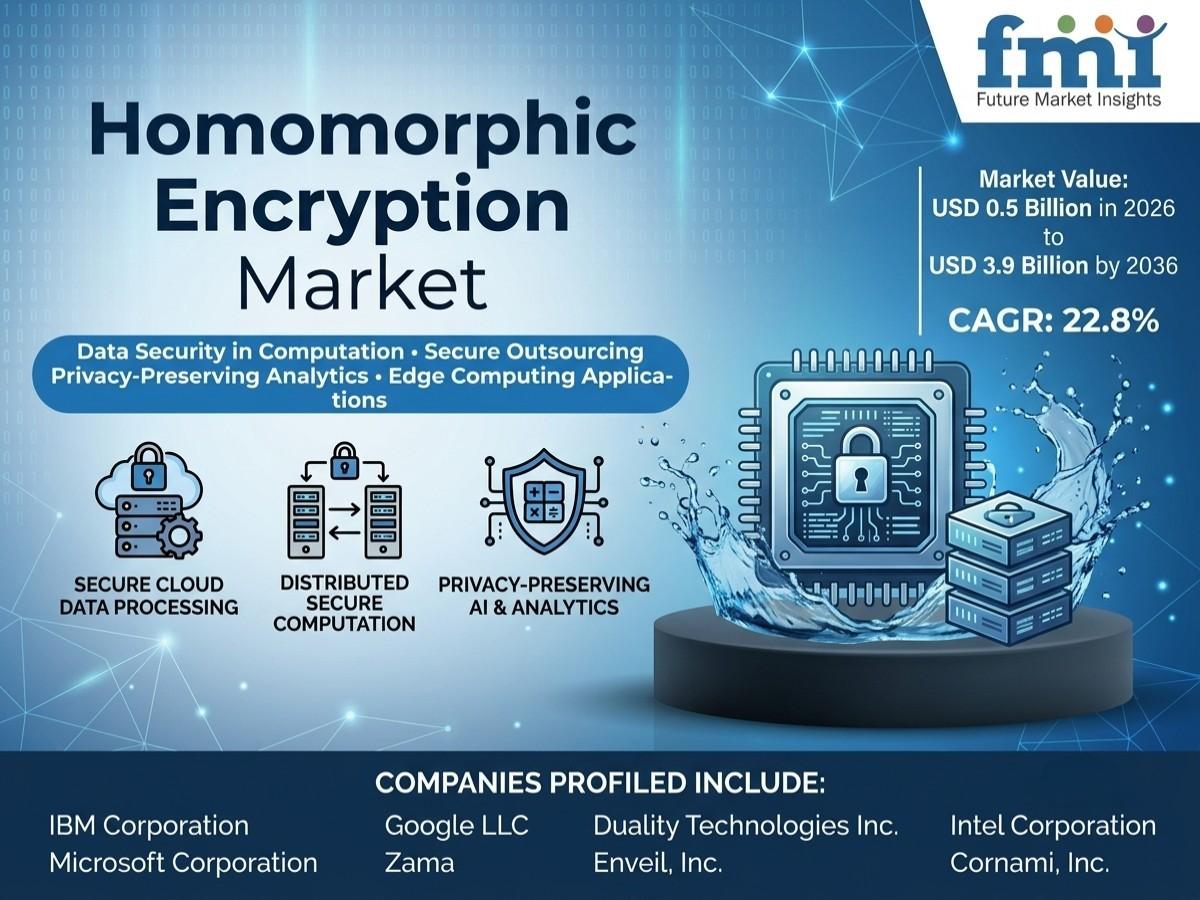
NEWARK, Del., October 9, 2026. The global homomorphic encryption market is projected to grow from USD 0.5 billion in 2026 to USD 3.9 billion by 2036, registering a compound annual growth rate (CAGR) of 22.8%, according to Future Market Insights (FMI). Adoption is gaining attention as businesses and public institutions explore ways to perform analytics on encrypted information across cloud infrastructure and organizational boundaries without exposing underlying data.
The technology offers a potential route for financial institutions, healthcare organizations and enterprises that need to collaborate on sensitive information while maintaining control over access. However, commercial adoption depends on whether encrypted workloads can meet practical requirements for processing speed, accuracy, integration and operating cost.
Privacy-preserving computing moves into practical evaluation
The immediate challenge for buyers is to establish where encrypted computation can deliver business value without creating unacceptable performance overhead. The National Institute of Standards and Technology (NIST) updated its privacy-enhancing cryptography overview on July 1, 2026, providing technical context for organizations assessing approaches that allow computation over encrypted data without access to the secret key.
Performance remains a significant consideration. In January 2026, France's National Commission on Informatics and Liberty (CNIL) discussed the computing costs associated with homomorphic encryption and noted that the technology cannot support every artificial intelligence model. Buyers therefore need to evaluate individual workloads rather than assume that every analytics process can be transferred to encrypted computing.
FMI identifies demand for protected external analytics as a central market driver. The main restraint is the additional computation required to process ciphertext, which can increase latency and infrastructure expenses. Reusable software libraries and hardware acceleration offer opportunities to reduce engineering effort for workloads with well-defined security and performance requirements.
Access the Sample Report — Explore Key Insights Today!
https://www.futuremarketinsights.com/reports/sample/rep-gb-34561
Where growth is fastest
Country-level forecasts indicate strong expected expansion across Asia, North America and Europe. Japan leads the five profiled markets, while the United Kingdom and France represent important European growth opportunities.
- Japan — CAGR 22.9%: Financial and medical programs are connecting cryptography research with operational use cases. Japan's National Institute of Information and Communications Technology (NICT) reported in July 2025 that six organizations began a radiology artificial intelligence program using advanced cryptography.
- United Kingdom — CAGR 22.5%: Trusted research environment initiatives provide a route for institutions to evaluate privacy-enhancing technologies. UK Research and Innovation (UKRI) included homomorphic encryption in its April 2025 call for next-generation trusted research environment capabilities.
- United States — CAGR 22.1%: A broad software engineering base and public technical forums support implementation reviews across enterprise and government applications. NIST's January 2026 workshop included presentations on threshold fully homomorphic encryption.
- France — CAGR 21.8%: Cryptography expertise and regulator-led technical evaluation support testing for encrypted cloud analytics and artificial intelligence applications. Performance limitations remain an important consideration for deployment decisions.
- Germany — CAGR 21.4%: Applied research and institutional projects support evaluation in healthcare and industrial applications. Legal review and specialist integration remain factors in the transition from research to production.
These forecasts measure expected growth rates, not the current size of each national market. Procurement timelines will also depend on technical readiness, governance requirements and the economics of individual deployments.
What leads the market
FMI's 2026 estimates identify four leading categories across the component, encryption type, application and deployment segments.
- Software — 61.0% share: Libraries, data protection platforms and privacy-preserving analytics software provide the integration layer needed to implement encrypted workloads.
- Fully homomorphic encryption — 42.0% share: This encryption type supports arbitrary operations on eligible encrypted data, extending the range of computations that can be evaluated without first decrypting the information.
- Cloud data security — 34.0% share: Organizations seeking to limit plaintext exposure during outsourced analytics are creating demand for encrypted processing approaches.
- Cloud deployment — 58.0% share: Cloud infrastructure offers flexible capacity for testing different circuits and parameter settings, although actual operating costs and latency must still meet workload requirements.
The figures describe separate segment categories and should not be added together. Each share reflects a different classification of the market.
The hurdle: computation costs and production readiness
The main barrier is the computational overhead associated with encrypted arithmetic. Ciphertext expansion and intensive calculations can increase processing time and infrastructure requirements compared with equivalent operations on plaintext data.
For technology teams, a successful proof of concept is therefore not sufficient by itself. Production deployment requires evidence that the chosen encryption scheme preserves the required numerical accuracy, supports the intended computation depth and delivers results within an acceptable service level.
Key management and integration add further complexity, particularly when several organizations need to collaborate without sharing control of their source data. These requirements can extend qualification cycles and increase the need for specialist implementation and validation services.
Recent developments and industry participants
Recent company developments illustrate how providers are addressing different parts of the encrypted-computing workflow.
- June 2026: Duality Technologies released version 4.6, adding data harmonization and custom federated workloads for distributed sensitive datasets.
- January 2026: Zama completed a sealed-bid token auction on its mainnet using fully homomorphic encryption. The auction received 24,697 bids, with USD 118.5 million committed.
- July 2025: Enveil released ZeroReveal Search 6.0, adding cloud hardware configuration and server integrations for protected queries across separate organizations.
These are distinct company developments, not evidence that every product is suitable for every enterprise workload.
Companies profiled by FMI include IBM Corporation, Microsoft Corporation, Google LLC, Zama, Duality Technologies Inc., Enveil, Inc., Intel Corporation and Cornami, Inc. Their activities span developer libraries, enterprise privacy platforms, protected search and encrypted-compute acceleration.
Analyst perspective
"Homomorphic encryption becomes commercially useful when a defined workload preserves confidentiality without missing its required production service level. Technical teams should compare circuit depth and precision loss against key custody, integration effort and recurring compute cost before selecting software or acceleration."
— Sudip Saha, Principal Consultant, Future Market Insights
What this means for enterprise technology buyers
Organizations considering encrypted computation should focus on measurable operating requirements rather than technology adoption alone.
- Start with a defined workload. Identify an analytics process where sensitive data must be processed by an external provider or shared across institutions. Establish latency, accuracy and confidentiality requirements before selecting an encryption approach.
- Test total operating costs. Benchmark ciphertext growth, processing time, infrastructure consumption and key-management requirements against the existing workflow. Include integration and ongoing support costs when evaluating whether a pilot can become a production service.
- Assess reusable tools and acceleration carefully. Compare available software libraries and hardware options against the intended computation, security requirements and deployment environment. Require evidence from representative workloads before committing to long-term infrastructure or implementation spending.
The commercial opportunity will depend on whether providers can make encrypted computation practical for repeatable workloads while preserving confidentiality and meeting operational requirements.
About the report
Future Market Insights' Homomorphic Encryption Market report examines market size and forecasts for 2026–2036, alongside component, encryption type, application, end-user, deployment and regional trends. It also assesses country-level growth prospects, market drivers, restraints, opportunities and key companies.
Read the full report: https://www.futuremarketinsights.com/reports/homomorphic-encryption-market
Explore More Related Reports -
AI Workload Power Smoothing Software Market - https://www.newstrail.com/ai-workload-power-smoothing-software-market-to-reach-usd-993-9-million-by-2036-at-10-1-cagr/
3D Camera Market - https://www.newstrail.com/3d-camera-market-to-reach-usd-82-1-billion-by-2036-at-6-7-cagr-india-leads-at-8-2-china-follows-at-7-5/
AI Rack Power Budgeting Software Market - https://www.newstrail.com/ai-rack-power-budgeting-software-market-to-reach-usd-1717-4-million-by-2036-at-11-9-cagr/
Voice Cloning Market - https://www.futuremarketinsights.com/reports/voice-cloning-market
Voice Search Market - https://www.futuremarketinsights.com/reports/voice-search-market
Model-Based Manufacturing Technologies Market - https://www.futuremarketinsights.com/reports/model-based-manufacturing-technologies-market
About Future Market Insights
Future Market Insights, Inc. (FMI) is an ESOMAR-certified market research and consulting firm headquartered in Delaware, USA, with offices in the United Kingdom, the United Arab Emirates and India. FMI delivers syndicated and custom research across food and beverage, healthcare, chemicals, technology, packaging, consumer goods and industrial sectors.
Media contact: Future Market Insights, Inc. | Email: sales@futuremarketinsights.com | Phone: +1-347-918-3531

 English
 Arabic
 French
 Spanish
 Portuguese
 Deutsch
 Turkish
 Dutch
Dutch
 Italiano
 Russian
 Romaian
 Portuguese (Brazil)
 Bengali