


Best Shampoo for Dandruff: What Should You Buy?
It can be frustrating to see flakes on a dark-colored shirt, deal with itchy scalp, or are trying shampoo after another without knowing what actually suits you. There are numerous different anti-dandruff shampoos on the market, so how do you know which shampoo works best for dandruff? Should you choose a regular dandruff shampoo, a sulfate-free formula, or a medicated shampoo?
The answer is that there is no single best shampoo which suits for everyone. The right choice depends on the type of scalp you have, the extent and frequency of your dandruff, the type of your hair and the active ingredients in the formula. This guide will show you what to consider, so you can make an informed purchase rather than relying solely on marketing claims.
How Do You Know If You Actually Have Dandruff?
Dandruff is a regular condition of the scalp that leads to the shedding of skin flakes from the scalp. It can also cause itching. These flakes may be more prominent if they are darker in color such as dark hair or dark-colored clothing. Dandruff is not solely due to poor hygiene practices and there are a number of contributing factors such as oily skin, hair care and some skin disorders that can lead to dandruff.
Dandruff can occur and disappear. While symptoms may improve, they can return, and with that, it's possible that ongoing scalp care can be important.
Dandruff vs. dry scalp: What's the difference?
Dandruff and dry scalp can look similar, but they aren't necessarily the same thing.
A dry scalp can be tight or dry and may flake. Dandruff may go hand-in-hand with an oily scalp and a tendency to flake or itch. But, sometimes symptoms do overlap, and it is not always possible to distinguish by observing just a few flakes.
If you have any other areas of the face or body that have continued redness, major inflammation, thick scaling, soreness or flaky patches, it may be a sign of another scalp or skin condition such as seborrheic dermatitis, eczema or psoraisis.
If symptoms are severe, painful, very inflamed or if appropriate dandruff care is not working, consult a dermatologist or other health care professional.
What Should You Look for in a Dandruff Shampoo?
Don't just look for the brand name or the packaging of the shampoo when you're making your choice; read the label. Always check the active ingredients first.
Each ingredient has its own unique mode of action and one isn't “better” than all others. Many dermatologists suggest choosing a dandruff shampoo that contains ketoconazole, zinc pyrithione, selenium sulfide, salicylic acid, sulfur, malic acid and coal tar.
Dandruff shampoo ingredients explained
|
Ingredient |
What it is generally used for |
What to consider |
|
Ketoconazole |
Antifungal treatment used for dandruff and seborrhoeic dermatitis |
Often used in treatment-focused shampoos; follow product or medical instructions |
|
Zinc pyrithione |
Helps control dandruff |
Found in many anti-dandruff formulations |
|
Selenium sulfide |
Helps control symptoms of dandruff and seborrhoeic dermatitis |
Follow label directions carefully |
|
Salicylic acid |
Helps loosen and remove scalp scale |
Can be useful when visible buildup is a concern |
|
Sulfur |
Used in some dandruff treatments |
Suitability depends on the formulation and scalp |
|
Coal tar |
Helps control scaling and flaking |
Can increase sun sensitivity and may affect light-colored hair |
Not all of these ingredients can be substituted in all scenarios. For instance, antifungal drugs like ketoconazole are available, and salicylic acid is especially effective at breaking up scaling.
Key takeway: select the ingredient which is best for your particular scalp issue; instead of searching for the “strongest” or “best”.
Medicated vs. Regular Anti-Dandruff Shampoo: Which Should You Choose?
Medicated Shampoo Contains an active ingredient that is used to help treat a specific scalp problem. Medicated dandruff shampoos can be purchased over the counter, or with professional advice depending on the product, ingredient, concentration and location.
In some cases, a mild case of dandruff can be managed with regular shampooing and a suitable over-the-counter anti-dandruff shampoo. If normal dandruff treatments aren't working, a medicated treatment may work.
When might a medicated shampoo make sense?
You may want to discuss a medicated shampoo with a pharmacist, doctor or dermatologist if:
- Your dandruff keeps returning
- Flaking is persistent
- Your scalp is very itchy
- Regular anti-dandruff care isn't helping
- You suspect something other than ordinary dandruff
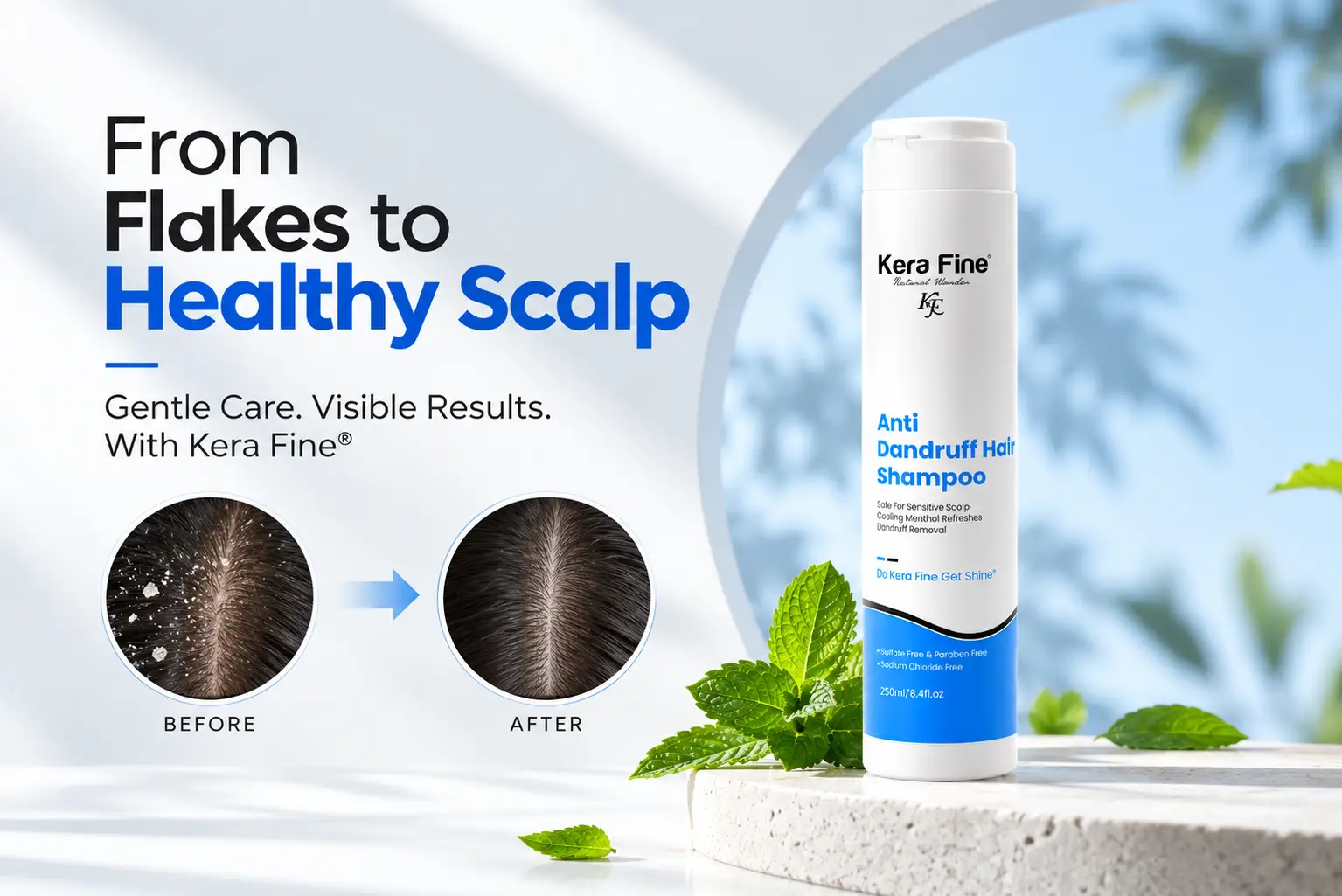
· For example, Kera Fine Anti Dandruff Shampoo is used for dandruff but its directions and frequency of use should be followed carefully.
Follow the label
Dandruff shampoos don't all work the same way. Some must be left on the scalp for a few minutes before rinsing. Some dandruff shampoos require 5-10 minutes of contact time, depending on the product and the type of hair. So, do not think that it'll work better if you leave all the shampoos on longer.
Is a Sulfate-Free Dandruff Shampoo Better?
If you are looking for sulfate-free anti dandruff shampoo or anti dandruff shampoo without sulfates, you might be thinking that if it doesn't have sulfates, it must be better.
It doesn't.
A lot of shampoos contain sulfates that serve as a cleansing agent. Sulfate-free formulas are also chosen by some people, due to their personal preference, texture of the hair or how the scalp and hair feel after cleaning. However, the term “sulfate-free” does not indicate that the shampoo will be effective in treating dandruff.
What matters more?
If you have dandruff, watch out for:
- The anti-dandruff active ingredient
- Your scalp concern
- Your hair type
- How your scalp responds to the formula
- The product's directions
For those that find some shampoos irritating, a sulphate free anti dandruff shampoo might be a better choice; however, sulfate free does not indicate superior dandruff efficacy.
Similarly, picking a sulphate free dandruff shampoo shouldn't imply the disregard of the active ingredient.
Take into account your type of hair as well.
However, individuals with curly, coily or textured hair might need to use dandruff shampoo less frequently and target it towards the scalp; some anti-dandruff products can cause drying.
Dandruff Shampoo for Men: What Should You Look For?
Searching for the best dandruff shampoo for men can make it seem as though men need an entirely different kind of dandruff treatment.
They generally don't.
The same basics are used to choose a best anti dandruff shampoo for men: scalp condition, hair type and symptoms, and active ingredients.
For example, consider:
- Is your scalp oily or dry?
- Do you have occasional or recurring flakes?
- Do you use styling products frequently?
- Is your hair straight, wavy, curly or coily?
- Does your scalp become irritated easily?
Occasionally, if there is facial flaking or a beard, seborrhoeic dermatitis also occurs. If symptoms continue, a health care professional should evaluate the condition instead of assuming it is a normal flaking of the skin.
So whether you're searching for a dandruff shampoo for men, an antidandruff shampoo for men, or simply the best dandruff shampoo for men, focus on the formula—not the gender label on the bottle.
How to Choose the Right Dandruff Shampoo for Your Scalp
The best way to select a product is to start with identifying your particular scalp concern.
|
Your scalp concern |
What to consider |
|
Oily + flaky |
An appropriate anti-dandruff active and a formula that cleanses effectively without unnecessary buildup |
|
Dry + flaky |
A suitable dandruff active combined with a hair-care routine that doesn't leave your hair excessively dry |
|
Itchy + persistent |
An appropriate active ingredient; seek professional advice if symptoms persist |
|
Sensitive |
A formula your scalp tolerates well; avoid products that cause burning or irritation |
|
Curly/coily |
Focus the dandruff shampoo on the scalp and adjust frequency according to the product directions and hair needs |
|
Frequent styling-product use |
Pay attention to scalp cleansing and product buildup |
The objective is not to choose the shampoo that contains the most ingredients. The key is to find one that suits the needs of your scalp.
How to Use Dandruff Shampoo Properly
No matter how well formulated a dandruff shampoo is, it may not be effective unless used properly.
1. Focus on the scalp
Dandruff begins at the scalp so only apply the shampoo to the scalp and not to the entire length of the hair.
2. Follow the product directions
The frequencies and contact times vary with different formulations.
3. Give it the recommended contact time
A few dandruff shampoos require a longer dwell time on the scalp. Follow the directions on the given product.
4. Don't assume more is better
Do not use a medicated or active shampoo more often than recommended; it could irritate or dry the scalp.
5. Look after your hair, too
Conditioner can assist in hair care if hair becomes dry after using the dandruff shampoo. Those with curly or coily hair might want to take extra care to ensure that the shampoo is applied to the scalp.
How to Get Rid of Dandruff: A Realistic Approach
If you're searching for how to get rid of dandruff, it's important to set realistic expectations.
While dandruff can sometimes be controlled, it may come back even when symptoms improve. As dandruff may come back and treatment usually aims at controlling symptoms, not curing them.
A practical routine can include:
· Use a suitable dandruff shampoo.
· Be sure to review the active ingredient.
· Apply it correctly to the scalp.
· Use it consistently according to its directions.
· Do not unnecessarily irritate the scalp.
· Seek professional advice if symptoms persist or become severe.
· If symptoms do not improve or they become more severe, consult a professional.
When one dandruff shampoo doesn't work, it may be best to switch to a dandruff shampoo with a different active ingredient, according to dermatology advice.
What to Look for Before You Buy a Dandruff Shampoo
Before you add a product to your cart, check this list of questions:
· Check the active ingredient: Be familiar with what the shampoo does.
· Consider your scalp type: Some products may be effective on a dry hair, but not on an oily, sensitive and combination scalp.
· Think about your hair type: If you have curly or coily hair, or dense textured hair, then you should particularly note this.
· Consider how often you experience dandruff: Sometimes, flakes and symptoms can persist and need other strategies.
· Check the full formula: If you have a sensitive scalp, you should see if the formula as a whole is comfortable for you.
· Decide whether sulfate-free matters to you: Personal preference may be the reason for using it, but that doesn't mean it works better in treating dandruff hair.
· Understand whether it's medicated: Understand if you're purchasing a regular cosmetic anti-dandruff product or one that is designed to treat dandruff.
· Read the instructions: The length of time and the frequency of contact may vary widely.
· Consider value, not just price: If the formula is not suitable for your scalp, then a larger bottle may not be the best value.
When Should You See a Dermatologist for Dandruff?
Treatment of dandruff can be quite effective for most mild cases with proper hair and scalp care. However, not all flaky scalps are typical dandruff.
If you think you should see a health care provider, do so if:
· If proper use of an anti-dandruff shampoo does not help relieve your dandruff, do not use it again.
· Your scalp becomes very itchy
· You have redness or swelling of the scalp.
· Flaking becomes severe
· Your scalp becomes painful
· You get flaky or itchy rashes in other areas of your body.
· You're not sure if the issue is dandruff or another scalp issue
The NHS advises to have medical evaluation for persistent dandruff after a few weeks of using the anti-dandruff shampoos, if it's become more severe or if there's a lot of itching, redness or swelling.
Frequently Asked Questions
Q1. Which shampoo is best for dandruff?
Best Dandruff shampoo for you will depend on your scalp, symptoms, hair type and active ingredient. There isn't one formula that is ideal for everyone. Some common anti-dandruff ingredients include: ketoconazole, zinc pyrithione, selenium sulfide, salicylic acid, sulfur and coal tar.
Q2. What is the best shampoo for dandruff?
When selecting a shampoo you might want to choose one that is marketed as “best” but ask yourself what is the active ingredient in the shampoo and what is the formula of the shampoo and does it fit your scalp needs. When dandruff is persistent or severe, professional advice might be warranted.
Q3. Is anti-dandruff shampoo safe for regular use?
Some anti-dandruff shampoos can be used in combination with the regular shampoo, but the frequency of use will vary for each product, active ingredient, hair type and symptoms. Follow label instructions.
Q4. Is a sulfate-free dandruff shampoo better?
Not automatically. While a sulfate-free formula might be better for some individuals' hair-care regimen, “sulfate-free” doesn't necessarily indicate the effectiveness of the formula in combating dandruff. The active ingredient and suitability for the scalp is more important.
Q5. What is the best dandruff shampoo for men?
Do not have to be a separate “best” formula for men. Men should select according to their scalp oiliness, hair type, symptoms, and styling methods and ingredients.
Q6. Should I use a medicated shampoo for dandruff?
Depending on the active ingredient in it and the condition being treated, a medicated shampoo may be helpful when regular dandruff care is not sufficient. Do not try to "try another product" repeatedly; see a health care professional for treatment if symptoms persist or are severe.
Q7. How often should I use dandruff shampoo?
This will depend on the product and your type of hair. Some dandruff shampoos can be applied more than once a week, others less. Always follow the product's directions.
Q8. Why does my dandruff keep coming back?
Dandruff can recur even after symptoms improve. There are people who require continued care using a suitable dandruff shampoo. If symptoms keep coming back or are not easily controlled, professional assessment may be needed to find out if there is another scalp condition present.
Q9. Can dandruff shampoo dry out hair?
It can, especially when active ingredients are applied to hair lengths, and/or when the product is not ideally suited to the person's hair type. For people with curly or coily hair, the AAD suggests targeting dandruff shampoo to the scalp and using it at the discretion of the user and the instructions on the package. American Academy of Dermatology
Q10. When should I see a dermatologist?
If dandruff does not get better when treated properly, it gets worse and/or causes severe itching, redness, swelling, pain or unusual skin changes, seek professional advice.
Conclusion: So, What Is the Best Shampoo for Dandruff?
The best shampoo for dandruff isn't necessarily the most popular product on the shelf or the one making the biggest promise.
Instead, consider your scalp, your hair, your symptoms and the ingredients in the formula. Consider using an everyday anti-dandruff shampoo or a more treatment-oriented product, and stick to the directions, allowing enough consistency to evaluate the response of your scalp.
It's OK if you want a dandruff shampoo without sulfates, but it's important not to get distracted by the word sulfate when you should be focusing on the ingredients that are actually effective for dandruff.
Even if your dandruff persists, becomes intense, painful, abnormally reddened or fails to respond to adequate treatment, it's worth talking to your dermatologist.
Finally, the best buy is not necessarily the product that's the “best.” It's the one that is appropriate for your scalp and your needs.

 English
 Arabic
 French
 Spanish
 Portuguese
 Deutsch
 Turkish
 Dutch
Dutch
 Italiano
 Russian
 Portuguese (Brazil)
 Greek
Greek
 Bengali