


3D Printed Shoes Market Advances with New Commercial Footwear Launches
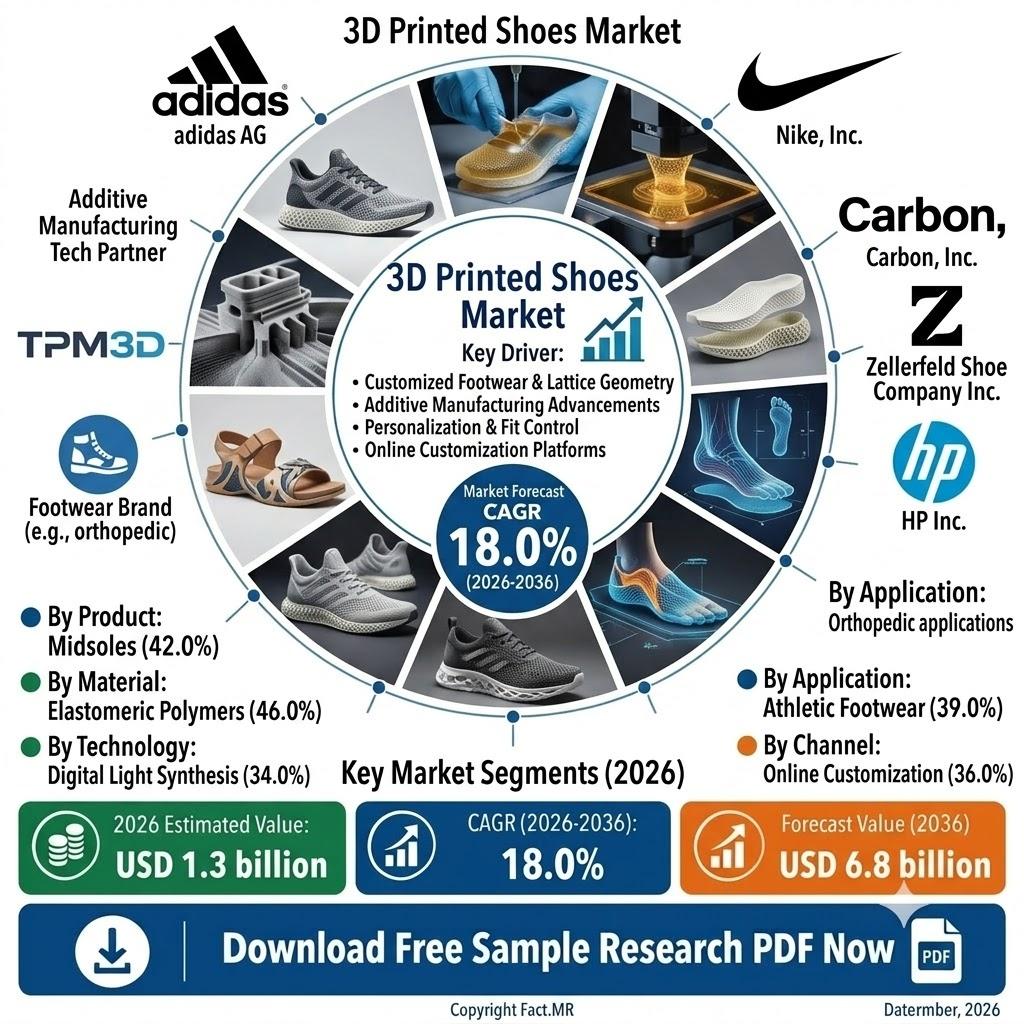
The 3D printed shoes market is projected to grow at an 18.0% CAGR from 2026 to 2036, driven by customized footwear and additive manufacturing.
The global 3D printed shoes market is projected to reach USD 6.8 billion by 2036, rising from USD 1.3 billion in 2026 at a compound annual growth rate (CAGR) of 18.0%, according to Fact.MR. The market was valued at USD 1.1 billion in 2025. Footwear brands are increasingly exploring additive manufacturing to develop cushioning structures, test new designs, and create footwear tailored to individual foot shapes.
The shift is moving beyond experimental prototypes. Commercial launches by adidas AG and Nike, Inc. demonstrate how established sportswear companies are exploring printed footwear for performance, design differentiation, and consumer customization. However, broader adoption will depend on material durability, production speed, and the ability to deliver consistent comfort at commercially viable prices.
Get detailed market forecasts, competitive benchmarking, and pricing trends: https://www.factmr.com/connectus/sample?flag=S&rep_id=15094
3D Printed Shoes Market Growth Reflects a Shift Toward Customization
The 3D printed shoes market covers footwear and shoe components manufactured through additive manufacturing. Products include midsoles, insoles, uppers, full shoes, and sandals designed for athletic, lifestyle, and orthopedic applications.
Market fact block: Fact.MR is a market research and consulting firm that provides industry forecasts, competitive analysis, and strategic intelligence to support business decisions.
One of the clearest opportunities lies in personalized fit. Digital foot scans can inform product designs, allowing footwear manufacturers to develop structures suited to individual requirements. Online customization platforms can connect these digital files with production workflows, helping brands respond to specific orders without maintaining extensive inventories of finished custom footwear.
The product development process is changing, too. Printed midsoles allow sportswear companies to test cushioning and lattice geometries without relying entirely on conventional tooling. This gives product teams more flexibility when evaluating underfoot response and refining footwear designs before commercial release.
Midsoles and Elastomeric Polymers Lead Key Market Segments
Midsoles are expected to account for 42.0% of the 3D printed shoes market by product type in 2026, according to Fact.MR. Their position reflects the practical application of lattice structures in cushioning and performance footwear. Insoles also serve comfort-focused and orthotic applications, while fully printed shoes offer opportunities to reduce assembly steps.
Elastomeric polymers are projected to represent 46.0% of the market by material in 2026. These materials support flexible cushioning and underfoot comfort, both important considerations for shoes intended for repeated daily use. Thermoplastic polyurethane also supports durable footwear components and integrated shoe designs.
By technology, Digital Light Synthesis is expected to hold a 34.0% share in 2026. The technology supports complex lattice midsoles and flexible polymer components. Selective laser sintering, fused deposition modeling, Multi Jet Fusion, and stereolithography serve other footwear manufacturing and product development requirements.
Athletic footwear is projected to capture 39.0% of the market by application in 2026. Sports brands can use printed structures to test cushioning characteristics and establish distinctive product designs. Meanwhile, online customization platforms are expected to account for 36.0% of sales channels, reflecting the connection between digital ordering, foot scanning, and made-to-order production.
Commercial Launches Put Printed Footwear in Focus
Product launches provide a closer look at how the technology is progressing. On March 3, 2026, adidas announced CLIMACOOL LACED, describing the sneaker as a 3D-printed design developed through advanced additive manufacturing with an emphasis on breathability and wearability.
Nike, Inc. unveiled the 3D-printed Air Max 95000 in October 2025, associating the product with Project Nectar. These launches illustrate how established footwear brands are testing additive manufacturing in products designed for consumer markets rather than restricting the technology to development laboratories.
Production methods are also evolving. On July 8, 2025, TPM3D introduced a footwear solution focused on small-batch and on-demand manufacturing. The company reported a production time of 25 minutes per shoe for its solution, offering a specific example of efforts to improve manufacturing efficiency.
Still, production speed alone will not determine commercial success. Manufacturers must establish that printed footwear can withstand repeated bending and daily wear while maintaining reliable comfort. Price sensitivity and the capacity to fulfil orders at scale remain practical challenges.
India and China Set a Fast Growth Pace
India is projected to record the fastest growth among the countries assessed by Fact.MR, with a CAGR of 20.7% from 2026 to 2036. Expanding online sneaker demand and interest in customized designs are expected to support adoption, although premium pricing could limit the addressable consumer base.
China is forecast to register a 19.9% CAGR over the same period. Its footwear manufacturing base and additive manufacturing capabilities provide opportunities to test printed components and develop new product designs.
The United States is expected to grow at an 18.8% CAGR, supported by sneaker innovation and direct-to-consumer platforms. Germany is projected to record a 17.4% CAGR, with sportswear engineering and orthotic applications supporting demand. The United Kingdom is forecast to advance at a 16.9% CAGR as scan-based fitting and customized footwear attract greater retail attention.
Analyst Opinion and Competitive Outlook
Shambhunath Jha, Principal Consultant at Fact.MR, said, “3D printed shoes are moving beyond concept pairs. Retail testing is showing the value of fit control and faster design cycles. Brands that link digital design with comfort and scalable output will gain stronger market access.”
The competitive landscape includes adidas AG, Nike, Inc., Carbon, Inc., Zellerfeld Shoe Company Inc., and HP Inc. These companies participate in footwear development, additive manufacturing, or the production technologies that support printed components.
Commenting on the practical requirements for adoption, the report's findings point to a straightforward priority: “Comfort has to come first. A printed shoe may attract attention, but consumers still expect it to hold up through everyday wear.” This is an editorial summary, not a direct quotation attributed to a named analyst.
Through 2036, market development will depend on material performance, manufacturing efficiency, and the integration of digital fitting with production. Brands that can translate foot-scan data into wearable products while controlling costs will be better positioned to serve customized footwear demand.
Read the full Printed Shoes Market analysis and forecast by Fact.MR for detailed segment forecasts, regional growth estimates, and competitive intelligence. For background on additive manufacturing applications, consult National Institute of Standards and Technology's additive manufacturing resources.
View Trending Reports :
https://ontoplist.in.net/article/led-headlamps-lead-heavy-duty-truck-lighting-market-in-2026
https://ayushjadhavblogs.blogspot.com/2026/10/aroma-infused-liners-market-to-reach.html
https://uddokta64.com/blogs/11125/Multilayer-Film-Waste-Drives-Innovation-in-AI-Sorting-Systems
About Fact.MR
Fact.MR is a market research and consulting firm that provides market intelligence, industry analysis, and forecasts across multiple sectors. Its research combines primary interviews, desk research, supplier checks, and market-sizing methodologies to assess industry developments, competitive positioning, and future demand.

 English
 Arabic
 French
 Spanish
 Portuguese
 Deutsch
 Dutch
Dutch
 Italiano
 Russian
 Romaian
 Portuguese (Brazil)
 Greek
Greek
 Bengali