


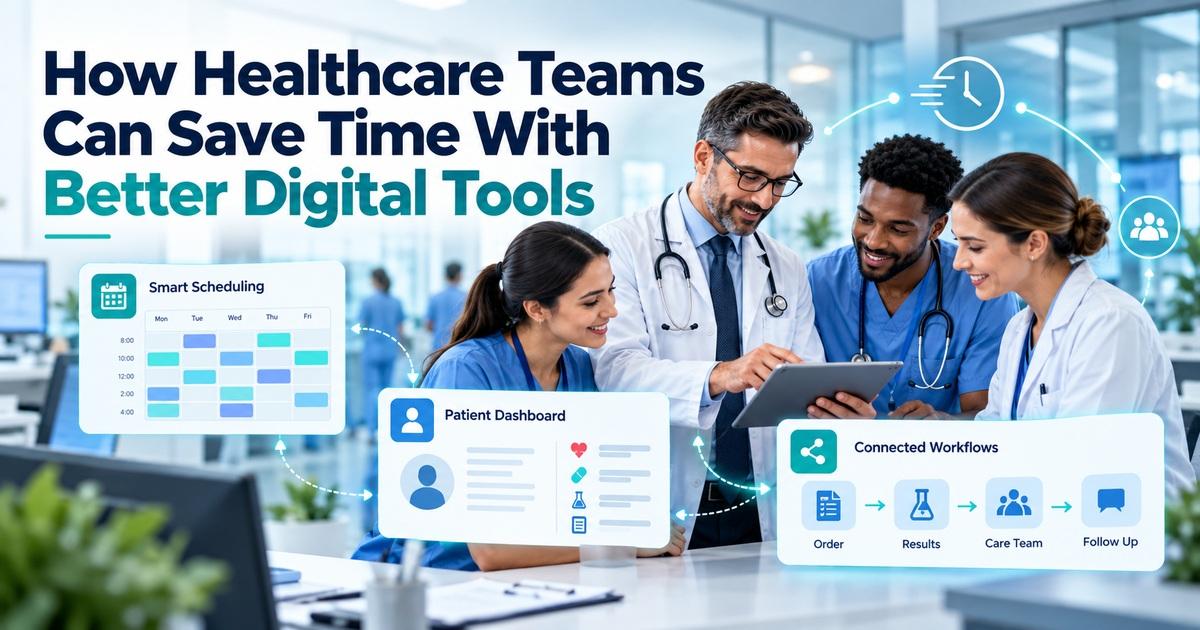
How Healthcare Teams Can Save Time With Better Digital Tools
Time is one of the most valuable resources in healthcare.
Doctors need time to assess patients.
Nurses need time for direct care.
Reception staff need time to manage visitors and appointments.
Laboratory teams need time to process tests accurately.
Administrators need time to solve operational problems.
Yet healthcare organizations often lose large amounts of time to routine administrative work.
Employees search for records.
They enter the same information repeatedly.
They contact other departments for basic updates.
They manually prepare reports.
They update multiple spreadsheets.
Better digital tools can reduce many of these activities.
The goal is not simply to make employees work faster.
The goal is to remove work that does not need to exist.
Start by Understanding Where Time Is Lost
Healthcare organizations should not begin with software.
They should begin with workflows.
Management can ask employees:
Which activities take longer than they should?
Where is information difficult to find?
Which tasks are repeated?
Which reports require manual work?
Which departments call each other most frequently?
These questions reveal where digital tools may create value.
Measure Existing Processes
Before introducing improvements, organizations can measure current performance.
For example:
How long does registration take?
How long does appointment booking take?
How long does staff spend finding records?
How long does a standard report take to prepare?
These baseline measurements make improvement easier to evaluate.
Improve Registration Speed
Registration is a common source of repetitive work.
Returning patients may already have most of their information stored.
Staff should be able to locate the record, verify important details, and update only what has changed.
A connected Health Management System can help link registration with appointments and patient records.
Reduce Duplicate Patient Creation
When existing records are difficult to find, staff may create duplicates.
This creates future work.
Employees later need to determine which record is correct.
Better search saves time immediately and prevents additional problems later.
Improve Appointment Scheduling
Scheduling often requires staff to check several things:
- Doctor availability
- Patient preference
- Room availability
- Service availability
- Follow-up requirements
A centralized scheduling system brings this information together.
This makes booking faster.
Reduce Rescheduling Work
Appointment changes are unavoidable.
Patients cancel.
Doctors become unavailable.
Services may need to move.
Digital schedules make affected appointments easier to identify.
Staff can update information in one place rather than several calendars.
Help Doctors Find Information Faster
Doctors should not spend consultation time searching for records.
Relevant patient information should be accessible quickly.
This may include:
- Previous consultation notes
- Test results
- Medications
- Diagnoses
- Allergies
Better information access saves clinical time.
Support Pre-Visit Preparation
Healthcare teams can sometimes review relevant information before the patient arrives.
This allows clinicians to begin the consultation with better context.
Digital records make this preparation easier.
Reduce Doctor Documentation Burden
Documentation remains important.
However, systems can reduce unnecessary repetition.
Existing demographic information should not need to be re-entered.
Common documentation structures can use templates.
The purpose is to make documentation efficient, not incomplete.
Improve Nursing Task Management
Nurses manage many responsibilities simultaneously.
Digital task lists can make priorities clearer.
Instead of relying entirely on handwritten notes, staff can see which activities are pending.
This saves time spent repeatedly checking status.
Improve Shift Handoffs
Incoming teams need to understand what happened earlier.
Digital records and task status reduce the amount of information that has to be reconstructed verbally.
This creates faster, clearer handoffs.
Improve Laboratory Communication
Laboratory workflows often generate repeated questions.
Has the sample been collected?
Is the result ready?
Was the request received?
Digital status tracking reduces the need for these calls.
Clinicians can check progress directly.
Improve Pharmacy Efficiency
Pharmacy teams can save time when prescription information and inventory are connected.
Staff can see what was prescribed and whether the medicine is available.
This reduces manual checking.
Improve Billing Efficiency
Billing staff often spend time collecting information from different departments.
If completed services automatically connect with the patient's account, less reconciliation is required.
This speeds the billing process.
Automate Routine Reports
Recurring reports are a major source of administrative work.
Employees may create the same weekly or monthly spreadsheet repeatedly.
If data already exists digitally, reporting can often be automated.
Platforms such as ehealthmatrix support this wider trend toward connected healthcare reporting and operations.
Let Employees Analyze Rather Than Compile
The most valuable part of reporting is understanding what the information means.
Employees should spend less time copying numbers and more time interpreting them.
Automated reporting supports this shift.
Reduce Internal Calls and Messages
Healthcare organizations can lose significant time to interruptions.
Employees repeatedly contact colleagues for status updates.
Connected systems make routine information visible.
This allows employees to check information without interrupting others.
Improve Management Efficiency
Managers also lose time gathering information.
They may request separate updates from several departments.
Centralized dashboards give management a faster operational view.
This allows leaders to spend more time addressing problems.
Improve Inventory Management
Manual stock checking can consume hours.
Digital inventory systems can show current quantities and reorder needs.
Alerts can identify low stock.
This saves administrative and procurement time.
Use Barcode or Similar Identification Where Appropriate
Depending on the environment, inventory identification technologies can make stock movement easier to record.
The objective is to reduce manual entry.
Any implementation should still fit the organization's real operational requirements.
Automate Predictable Work
Automation is particularly useful for repetitive, rules-based activities.
Examples include:
- Appointment reminders
- Routine reports
- Low-stock alerts
- Status changes
- Administrative notifications
Automation should not replace professional judgment where judgment is required.
Avoid Automating Bad Processes
An inefficient process does not automatically become efficient when software performs it.
Organizations should simplify the workflow first.
Then automation can be applied.
Otherwise, technology may simply make a poor process happen faster.
Reduce the Number of Systems Employees Use
Every additional system creates switching time.
Employees need to log in.
They need to learn navigation.
They may need to copy information between platforms.
Integration can reduce this overhead.
Improve Interface Design
Small usability problems waste time repeatedly.
Common tasks should be easy to access.
Frequently used information should not be hidden.
Employees should not need several unnecessary clicks for routine work.
Use Role-Based Interfaces
Different staff need different functions.
Reception teams should see scheduling and registration.
Clinicians should see patient information.
Laboratory staff should see test workflows.
Managers should see reports.
Role-based interfaces reduce clutter.
Train Employees to Use Efficient Workflows
A good system can still be used inefficiently.
Employees may not know about search functions, templates, shortcuts, or workflow features.
Training should focus on completing real tasks efficiently.
Create Simple Internal Guides
Organizations can document common workflows.
Short internal guides may cover:
- Registration
- Scheduling
- Patient search
- Laboratory requests
- Billing
- Reporting
This helps employees work consistently.
Standardize Repetitive Processes
When every employee completes the same task differently, efficiency becomes difficult to improve.
Standard procedures create consistency.
They also make training easier.
Reduce Unnecessary Meetings
Digital visibility can also reduce some status meetings.
If managers can see routine operational information directly, teams may not need to meet simply to exchange numbers.
Meetings can then focus on decisions and problems.
Improve Multi-Location Reporting
Healthcare groups often ask individual branches to submit recurring reports.
This can consume substantial staff time.
Centralized systems can collect information automatically.
Locations spend less time preparing updates.
Measure Time Savings
Organizations should track whether changes actually saved time.
Possible indicators include:
- Registration duration
- Appointment booking time
- Record retrieval time
- Laboratory status calls
- Billing completion time
- Report preparation effort
- Inventory check time
These metrics help demonstrate value.
Convert Time Savings Into Better Work
Saving time should not simply mean asking staff to do more.
Healthcare organizations can use saved time to improve patient communication, planning, training, quality improvement, or other meaningful activities.
The objective is better use of employee capacity.
Review Workflows Continuously
Healthcare operations change.
A digital tool that saves time today may become inefficient as the organization grows.
Regular review helps identify new opportunities.
Final Thoughts
Healthcare teams cannot create more hours in the day, but they can reduce time lost to inefficient administration.
Better digital tools can simplify registration, scheduling, patient records, laboratory workflows, pharmacy management, billing, inventory, reporting, and internal communication.
The most effective technology removes unnecessary steps.
It does not simply make employees click through a digital version of the same complicated process.
When healthcare organizations focus on real time savings, digital transformation becomes much more practical.
Frequently Asked Questions
Which healthcare tasks can digital tools make faster?
Common examples include registration, scheduling, patient search, laboratory coordination, pharmacy, billing, inventory, and reporting.
Can digital patient records save doctors time?
Yes. Organized records can make relevant history and results easier to retrieve.
How does automation save time in healthcare?
It can handle predictable repetitive tasks such as reminders, routine reports, alerts, and status updates.
Can digital tools help small clinics?
Yes. Even basic improvements in scheduling, registration, and records can reduce administrative work.
Can poorly designed software waste time?
Yes. Software that creates unnecessary steps or duplicate entry can make workflows slower.
How should healthcare organizations measure time savings?
They can compare workflow duration, communication volume, report preparation effort, and staff feedback before and after implementation.

 English
 Arabic
 French
 Spanish
 Portuguese
 Deutsch
 Turkish
 Dutch
Dutch
 Italiano
 Russian
 Romaian
 Greek
Greek
 Bengali