


Robust Gate Barrier Systems for Every Facility in Saudi Arabia
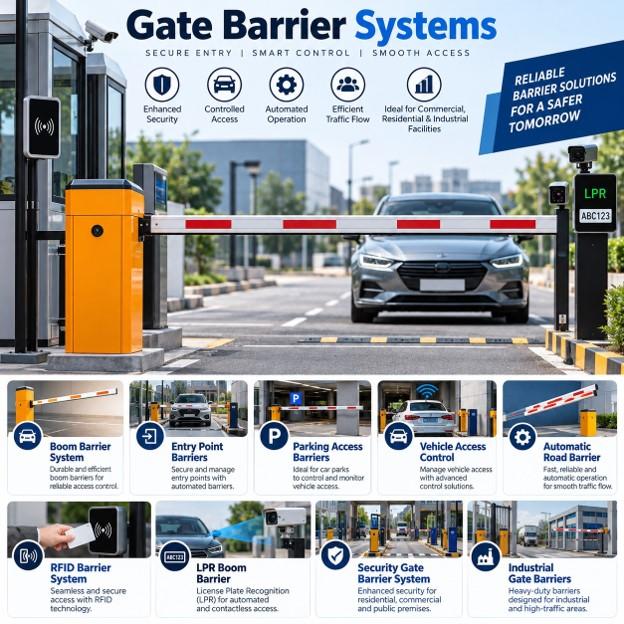
A hospital, a logistics yard, a government ministry, and a residential compound all need vehicle access control, but no two of them need exactly the same equipment. A well-specified Gate Barrier System looks completely different depending on the facility it protects, which is precisely why a one-size-fits-all approach so often disappoints once real daily operations begin.
A barrier rated for a quiet residential driveway will fail quickly at a distribution hub processing hundreds of truck movements a day, while an industrial-grade unit is needlessly expensive and mechanically excessive for a small clinic's staff parking area.
Getting this match right matters more in Saudi Arabia than in many markets, given the sheer diversity of facility types being developed simultaneously across the Kingdom — from giga-project logistics corridors to expanding healthcare networks and new government service centers.
This article walks through how barrier specification should genuinely change by facility type, so procurement and facilities teams can make an informed choice rather than defaulting to whatever a supplier happens to have readily in stock.
One Technology, Many Facility Types
At a fundamental level, every automated vehicle barrier performs the same function: verify a credential, raise an arm, and log the event. What genuinely differs across facility types is duty cycle, verification method, and the surrounding safety and integration requirements each sector demands.
Understanding those differences before specifying equipment prevents two of the most common and costly mistakes in vehicle access projects: over-speccing a low-traffic site with unnecessary capability, or under-speccing a high-traffic site with equipment that fails within its first year of operation.
Boom Barrier System Basics: What Every Facility Manager Should Know
Whatever the sector, a Boom Barrier System uses a motorized arm paired with a sensor or credential reader to control vehicle passage, cycling the arm only once a vehicle has been verified as authorized to enter or exit the site.
The core mechanism stays consistent across applications, but the motor rating, arm length, and cycle speed all need to be matched to the specific traffic volume and vehicle type a given facility actually experiences on a normal working day.
Entry Point Barriers for Government and Public Sector Facilities
Government ministries and public service centers require Entry Point Barriers that balance strong verification with the throughput needed to process citizens, staff, and official visitors without creating the kind of queue that undermines public confidence in a facility's operational efficiency.
These sites also typically require integration with a visitor pre-registration system, since government facilities routinely host scheduled appointments and official delegations that benefit from pre-approved, time-limited access rather than manual verification at the point of arrival.
No single Gate Barrier System configuration fits every Saudi facility. A properly rated Boom Barrier System, consistent Entry Point Barriers, and well-managed Parking Access Barriers each serve a different purpose. Reliable Vehicle Access Control, a heavy-duty Automatic Road Barrier, and rugged Industrial Gate Barriers, paired with RFID Barrier System and LPR Boom Barrier technology, form a complete Security Gate Barrier System. For Gate Barrier System KSA compliance, or a Gate Barrier System Riyadh rollout, Tektronix matches the right barrier to every facility type.

 English
 Arabic
 French
 Spanish
 Portuguese
 Deutsch
 Turkish
 Dutch
Dutch
 Italiano
 Russian
 Portuguese (Brazil)
 Greek
Greek
 Bengali