


Edge AI Market Size, Growth Analysis, Industry Trends & Forecast 2034
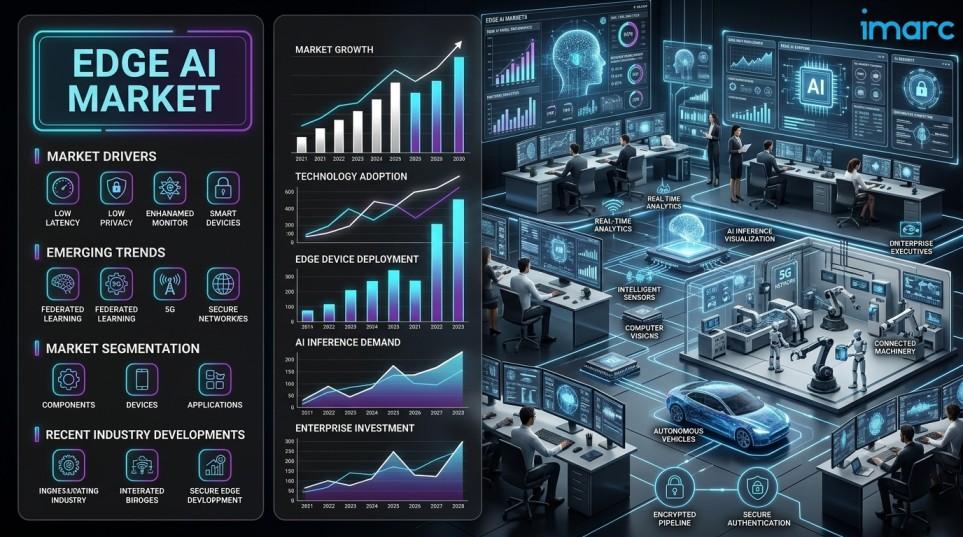
IMARC Group, a leading global market research and management consulting firm, has published its latest market intelligence report on the edge AI market. The global edge AI market size was valued at USD 21.5 Billion in 2025. Looking forward, IMARC Group estimates the market to reach USD 90.8 Billion by 2034, exhibiting a CAGR of 16.83% from 2026-2034.
The market benefits from robust demand as organizations across industries prioritize solutions that deliver instantaneous insights without the delays or connectivity dependencies of centralized cloud systems. Busy industrial operators, healthcare providers, and automotive developers seek intelligence that operates directly on sensors, cameras, and embedded systems, ensuring consistent performance even in remote or bandwidth-constrained environments. Simultaneously, advances in specialized processors and optimized software frameworks are extending on-device capabilities without compromising accuracy or power efficiency, enabling both enterprises and consumers to deploy broader ranges of intelligent applications.
How AI is Reshaping the Future of the Edge AI Market
- AI-Powered Real-Time Inference and Local Decision Optimization for Industrial and Consumer Operators: Machine learning platforms enable manufacturers and device makers to analyze sensor streams, visual inputs, and operational patterns directly on hardware, optimizing production scheduling, reducing latency in autonomous systems, and improving predictive maintenance without constant cloud reliance, ensuring consistent availability across factories, vehicles, and smart infrastructure.
- Intelligent Hardware Acceleration and Automated Model Deployment: AI-driven chip architectures and neuromorphic processors integrated into edge devices automate visual inspection, anomaly detection, and adaptive learning at speeds and energy levels that traditional cloud pipelines cannot match, reducing transmission costs and exposure while ensuring compliance with data residency rules across regulated markets in North America, Europe, and Asia Pacific.
- Personalized On-Device Experiences Using Local Analytics and Adaptive Models: AI-powered frameworks allow developers to refine models based on usage patterns, environmental conditions, and privacy preferences, shortening deployment cycles from concept to field and enabling targeted solutions for healthcare monitoring, retail analytics, and smart city applications with greater confidence in reliability before large-scale rollouts.
Grab a sample PDF of this report: https://www.imarcgroup.com/edge-ai-market/requestsample
Edge AI Market Trends and Drivers
The global edge AI market is witnessing steady expansion, fueled by the convergence of real-time operational needs, structural shifts toward distributed computing, and accelerating hardware and software innovation that is repositioning local intelligence as a core capability rather than a niche option. Demand for minimal latency is the foundational driver across both industrial and consumer segments, with manufacturers, healthcare systems, and mobility providers prioritizing solutions that deliver immediate responses without the delays inherent in remote processing. Telecom and IT operators, which manage massive data flows from connected networks, rely heavily on edge AI to support 5G applications, autonomous network management, and intelligent content delivery, a model that reduces congestion, controls bandwidth economics, and ensures performance consistency across distributed sites.
Data privacy and security considerations have emerged as both a regulatory necessity and a commercial efficiency argument that actively reinforces edge AI adoption across retail, healthcare, defense, and smart infrastructure channels. Organizations can process sensitive information such as health records or financial transactions on-device, eliminating the exposure risks associated with continuous data transmission. For consumers and enterprises alike, the ability to keep private data local addresses growing concerns over breaches and compliance mandates. Improved chip efficiency, including low-power neuromorphic designs and specialized accelerators, further reinforces credentials among environmentally and cost-conscious users where energy constraints and sustainability carry high influence.
The rapid diversification of edge AI capabilities to address specific vertical requirements is unlocking new application segments previously limited by compute or connectivity barriers. Solutions supporting computer vision, predictive analytics, and generative features on constrained hardware are now developed by both established semiconductor firms and specialist innovators, supported by development frameworks that give teams confidence to trial and scale. Artisan-positioned platforms that deliver high performance within tight power and thermal envelopes are simultaneously driving premiumization across automotive, industrial, and consumer electronics, with users demonstrating willingness to adopt advanced on-device intelligence when quality, reliability, and integration meet expectations.
Ask an analyst for customized report: https://www.imarcgroup.com/request?type=report&id=12130&flag=E
Edge AI Industry Segmentation
The report has segmented the market into the following categories:
Breakup By Component
- Hardware
- Network
- Edge Cloud Infrastructure
- Software
- Support Services
Software accounts for the largest component segment, driven by its role as the intelligence layer that powers edge devices. Solutions such as AI frameworks, development kits, machine learning models, and inference engines enable real-time data processing directly on hardware, reducing dependency on cloud infrastructure while ensuring faster decision-making, lower latency, enhanced privacy, and optimized bandwidth usage across diverse applications.
Breakup By Industry
- BFSI
- Government and Utilities
- Telecom and IT
- Healthcare
- Real Estate
- Retail and E-Commerce
- Travel and Hospitality
- Others
Telecom and IT command the largest industry share, distinguishing themselves through enhanced network efficiency and digital service delivery. Operators use edge AI to manage massive data traffic, reduce latency, and enable applications such as autonomous networks and smart connectivity, while IT firms deploy it for real-time analytics, cybersecurity, and hybrid solutions that support predictive maintenance and personalized experiences.
Breakup By Region
- North America (United States, Canada)
- Asia Pacific (China, Japan, India, South Korea, Australia, Indonesia, Others)
- Europe (Germany, France, United Kingdom, Italy, Spain, Russia, Others)
- Latin America (Brazil, Mexico, Others)
- Middle East and Africa
North America dominates the global edge AI market with the largest regional share, driven by the region's robust technology base, extensive use of AI and IoT solutions, and the presence of advanced semiconductor and electronics industries. Strong investments in research and development, supportive government policies, early 5G adoption, and high demand from automotive, healthcare, industrial automation, and smart city sectors further reinforce leadership across the United States and Canada.
Competitive Landscape
The report provides a comprehensive analysis of the competitive landscape in the edge AI market with detailed profiles of all major companies, including:
- NVIDIA Corporation
- Qualcomm Technologies, Inc.
- Intel Corporation
- Google LLC
- Microsoft Corporation
- Amazon Web Services, Inc.
- IBM Corporation
- Huawei Technologies Co., Ltd.
- Advanced Micro Devices, Inc.
- Samsung Electronics Co., Ltd.
- BrainChip Holdings Ltd
- Hailo Technologies Ltd.
- Edge Impulse (Qualcomm)
- Microchip Technology Inc.
- Advantech Co., Ltd.
What Does The Full Report Cover?
If you are tracking the edge AI market for investment decisions, market entry planning, competitive benchmarking, or strategic advisory, IMARC Group's report gives you everything in one place:
- Complete market sizing with revenue forecasts covering the full projection period
- Quantified growth driver analysis with impact scoring across component, industry, and regional markets
- Sub-segment breakdowns for hardware, software, edge cloud infrastructure, telecom and IT, healthcare, and other categories with individual share data
- Country-level data for the United States, Canada, China, Japan, India, South Korea, Australia, Germany, France, the United Kingdom, Italy, Spain, Brazil, and Mexico
- Competitive profiles of leading companies with strategic landscape assessment
- Porter's Five Forces, value chain analysis, and pricing intelligence
- Latest product innovation trends covering neuromorphic processors, low-power AI accelerators, on-device generative capabilities, hybrid cloud-edge architectures, and privacy-preserving frameworks shaping market competition and enterprise preference across key regional markets
Recent News and Developments in Edge AI Market
- March 2025: Qualcomm Technologies entered an agreement to acquire Edge Impulse, a leading edge AI development platform. The move expands support for computer vision, audio, speech recognition, and generative AI on Dragonwing processors while continuing broad hardware compatibility for developers.
- November 2025: BrainChip unveiled its AKD1500 neuromorphic edge AI co-processor at Embedded World North America. The chip delivers 800 giga operations per second while operating under 300 milliwatts, targeting battery-powered wearables, smart sensors, and heat-constrained environments with on-chip learning capabilities.
- November 2025: Advantech and Qualcomm Technologies announced a collaboration to accelerate next-generation edge AI applications. The partnership combines Advantech platforms with the Dragonwing IQ-9075 processor and Edge Impulse tools for industrial, robotics, and smart manufacturing deployments delivering up to 100 TOPS of performance.
- January 2026: Qualcomm Technologies completed its IE-IoT expansion, launching new Dragonwing Q-series processors including the Q-7790 and Q-8750. The portfolio, supported by prior acquisitions, targets drones, smart cameras, industrial vision, and video systems with advanced on-device AI capabilities.
- June 2026: SDG&E, Qualcomm Technologies, and UC San Diego launched the Edge Alert Sentinel collaboration. The initiative deploys on-device AI for wildfire and extreme weather monitoring, beginning with a system on Mt. Palomar to analyze environmental data and improve grid resilience.
- July 2026: Microchip Technology agreed to acquire Hailo, an Israeli edge AI chip developer. The transaction strengthens Microchip's portfolio with processors used in industrial, automotive, and vision applications, including the Hailo-10 designed for generative AI on devices.
Note: If you require specific details, data, or insights that are not currently included in the scope of this report, we are happy to accommodate your request. As part of our customization service, we will gather and provide the additional information you need, tailored to your specific requirements. Please let us know your exact needs, and we will ensure the report is updated accordingly to meet your expectations.
Key Questions This Report Answers
- What is the current global edge AI market size and what is its projected value?
- Which component segment holds the largest share in the global edge AI market?
- What are the key drivers of global edge AI market growth?
- Which region dominates the global edge AI market and why?
- How are real-time processing needs, data privacy requirements, and 5G deployment reshaping product development and competitive strategies in the edge AI industry?
- Who are the top companies in the global edge AI market and what are their competitive strategies?
- What are the investment and market entry opportunities across hardware accelerators, on-device software, industrial automation, and telecom-focused edge AI segments?
About Us
IMARC Group is a global management consulting firm that helps the world's most ambitious changemakers to create a lasting impact. The company provides a comprehensive suite of market entry and expansion services. IMARC offerings include thorough market assessment, feasibility studies, company incorporation assistance, factory setup support, regulatory approvals and licensing navigation, branding, marketing and sales strategies, competitive landscape and benchmarking analyses, pricing and cost research, and procurement research.
Media and Sales
Contact IMARC Group
Email: sales@imarcgroup.com
United States: +1-201-971-6302
India: +91-120-433-0800
United Kingdom: +44-753-714-6104

 English
 Arabic
 French
 Spanish
 Portuguese
 Deutsch
 Turkish
 Dutch
Dutch
 Italiano
 Russian
 Portuguese (Brazil)
 Greek
Greek
 Bengali