


CUET General Test Syllabus and English CUET Syllabus: Complete Preparation Guide for Students
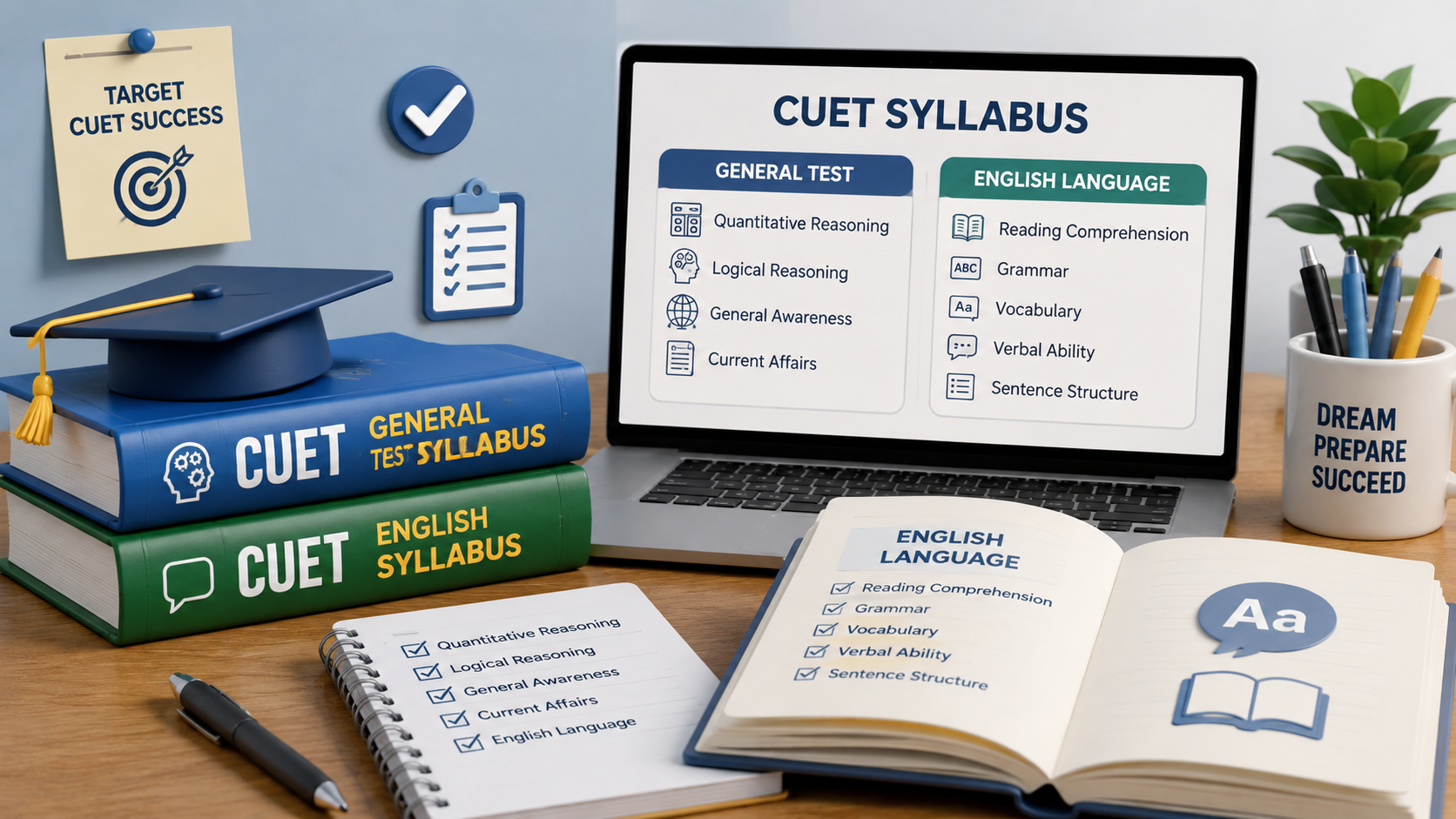
Two areas that often require focused preparation are the cuet general test syllabus and english cuet syllabus. While the General Test evaluates reasoning, numerical ability, general awareness, and problem-solving skills, the English section focuses strongly on comprehension, vocabulary, grammar, and language usage.
Students should not treat these sections as subjects that can be completed through memorisation alone. Good preparation requires regular practice, conceptual clarity, reading habits, speed, and accuracy. Understanding the syllabus first allows students to create a realistic study plan, identify their weaker areas, and dedicate more time to topics that need improvement.
What Is the CUET General Test Syllabus?
The cuet general test syllabus is designed to evaluate a student’s overall aptitude rather than knowledge of one academic subject. It generally focuses on logical thinking, quantitative skills, awareness, and the ability to solve everyday analytical problems.
This section is particularly useful for courses where universities want to assess a candidate’s broader reasoning and decision-making abilities.
Important preparation areas include:
-
General knowledge and awareness
-
Current affairs awareness
-
Logical and analytical reasoning
-
Numerical ability
-
Quantitative reasoning
-
Basic mathematical concepts
-
Data-based problem solving
-
Mental ability
-
Pattern recognition
-
Everyday analytical situations
Students preparing for this section should concentrate on understanding how a question works rather than simply remembering answers.
Important Areas in the CUET General Test Syllabus
A structured approach to the cuet general test syllabus can make preparation more manageable.
General Knowledge and Awareness
This area measures how aware students are of important subjects around them. Preparation can include science, geography, history, culture, important organisations, significant events, technology, sports, awards, and other general topics.
Instead of studying random information, students should organise their learning into categories.
Logical and Analytical Reasoning
Reasoning questions test how quickly a student can identify relationships, patterns, sequences, and logical connections.
Common practice areas may include:
-
Number and letter series
-
Analogies
-
Coding and decoding
-
Classification
-
Direction-based reasoning
-
Blood relationships
-
Ranking problems
-
Statements and conclusions
-
Logical sequences
Daily reasoning practice can gradually improve both accuracy and speed.
Numerical Ability
Mathematical questions usually test fundamental problem-solving skills. Students should strengthen their understanding of arithmetic and learn efficient methods for calculations.
Important topics may include percentages, averages, ratios, profit and loss, simple calculations, time and work, speed and distance, basic algebra, and numerical relationships.
Why Fundamentals Matter
Advanced tricks are helpful only when basic concepts are clear. Students who understand the fundamentals can often solve unfamiliar questions more confidently than those who depend entirely on shortcuts.
What Is the English CUET Syllabus?
The english cuet syllabus evaluates a student’s ability to understand and use English effectively. It is not simply a grammar examination. Students are expected to interpret passages, understand vocabulary in context, recognise correct language usage, and answer questions accurately.
The major preparation areas usually revolve around:
-
Reading comprehension
-
Vocabulary
-
Synonyms and antonyms
-
Word meanings
-
Grammar
-
Sentence usage
-
Verbal ability
-
Rearrangement of words or sentences
-
Contextual language understanding
A balanced combination of reading and question practice is therefore important.
Reading Comprehension in English CUET Syllabus
Reading comprehension is one of the most important areas of the english cuet syllabus because it tests several skills at the same time.
Students may need to understand:
-
The central idea of a passage
-
Supporting information
-
The meaning of words through context
-
The writer’s intention
-
Logical conclusions
-
Information directly stated in the passage
Reading comprehension improves through regular reading rather than last-minute memorisation.
Students can practise with informative articles, essays, editorials, short passages, and educational content. While reading, they should identify the main idea before focusing on smaller details.
Vocabulary and Verbal Ability Preparation
Vocabulary should be learned through context instead of memorising long lists without understanding usage.
A practical vocabulary routine can include:
-
Learning a few new words every day
-
Understanding their meanings
-
Studying synonyms and antonyms
-
Creating sentences using new words
-
Revising previously learned vocabulary
-
Observing how words change meaning in different contexts
This method supports both vocabulary questions and reading comprehension.
Grammar Topics for English CUET Preparation
Grammar provides the foundation for accurate English usage. Students studying the english cuet syllabus should develop clarity about sentence construction rather than depending entirely on memorised rules.
Useful grammar areas include:
-
Parts of speech
-
Tenses
-
Subject-verb agreement
-
Articles
-
Prepositions
-
Pronouns
-
Conjunctions
-
Modifiers
-
Sentence correction
-
Common grammatical errors
The best approach is to understand one concept and immediately solve related questions.
CUET General Test Syllabus vs English CUET Syllabus
| Preparation Area | CUET General Test | English CUET |
|---|---|---|
| Main Focus | Aptitude and reasoning | Language ability |
| Reading Skills | Moderate | Highly important |
| Mathematics | Important | Usually not central |
| Logical Reasoning | Major area | Limited |
| Vocabulary | Limited role | Major area |
| Grammar | Not a core focus | Important |
| General Awareness | Important | Not the main focus |
| Practice Requirement | High | High |
| Speed | Essential | Essential |
| Accuracy | Essential | Essential |
The table shows why students need different preparation techniques for the two sections.
Best Study Strategy for Both CUET Sections
Students preparing for both syllabi should avoid studying without a schedule. A clear preparation cycle creates consistency.
Follow this simple approach:
-
Understand the complete syllabus.
-
Identify strong and weak topics.
-
Divide preparation time by topic.
-
Study concepts before attempting difficult questions.
-
Practise questions every day.
-
Analyse incorrect answers.
-
Revise regularly.
-
Attempt timed practice sets.
-
Improve question-selection strategy.
-
Track progress every week.
A student struggling with numerical ability may require more General Test practice, while someone with weak vocabulary may need additional English reading and revision.
How to Improve Speed and Accuracy
Competitive entrance examinations reward correct answers completed within limited time. Therefore, preparation should gradually move from concept learning to timed problem solving.
Students should first practise without strict time pressure. Once accuracy improves, they can introduce a timer.
For the cuet general test syllabus, practise calculations, reasoning patterns, and short problem-solving techniques regularly.
For the english cuet syllabus, focus on faster reading, contextual vocabulary, grammar recognition, and eliminating clearly incorrect options.
Avoid Blind Guessing
Speed does not mean answering every question immediately. A better strategy is to identify easy questions first, complete them accurately, and then attempt questions requiring more thought.
Common Mistakes Students Should Avoid
Many students lose valuable preparation time because their study method lacks structure.
Avoid these common mistakes:
-
Starting preparation without understanding the syllabus
-
Studying only favourite topics
-
Ignoring revision
-
Memorising answers instead of understanding concepts
-
Learning vocabulary without context
-
Ignoring reading comprehension
-
Avoiding quantitative questions because they appear difficult
-
Practising without reviewing mistakes
-
Taking mock tests without analysing results
-
Changing preparation resources repeatedly
Consistency usually produces better results than collecting excessive study material.
Why Mock Tests Are Important
Mock tests connect syllabus preparation with examination performance.
They help students understand:
-
Which topics consume too much time
-
Where repeated mistakes occur
-
Whether concepts are properly understood
-
How accurately questions are attempted
-
Which areas need immediate revision
After completing a mock test, students should spend time analysing errors rather than checking only the final score.
Frequently Asked Questions
1. What does the CUET General Test syllabus mainly cover?
The cuet general test syllabus mainly focuses on reasoning, numerical ability, general awareness, quantitative aptitude, analytical thinking, and problem-solving skills.
2. Is mathematics important for the CUET General Test?
Basic numerical and quantitative skills are important. Students should develop strong fundamentals and practise calculation-based questions regularly.
3. What is included in the English CUET syllabus?
The english cuet syllabus broadly focuses on reading comprehension, vocabulary, verbal ability, grammar, sentence usage, and understanding English in context.
4. How should I prepare for CUET English?
Read regularly, improve vocabulary, revise grammar concepts, solve comprehension questions, and practise timed English question sets.
5. How can I prepare for CUET General Test reasoning?
Practise logical questions daily and understand the method behind each question instead of memorising solutions.
6. Is reading important for CUET English?
Yes. Regular reading can improve comprehension speed, vocabulary, contextual understanding, and the ability to identify important information quickly.
7. Can I prepare both sections together?
Yes. Students can divide their daily schedule between General Test aptitude practice and English reading, vocabulary, grammar, and comprehension.
8. How can I improve vocabulary for CUET?
Learn words in context, use them in sentences, revise them regularly, and study synonyms and antonyms instead of memorising isolated definitions.
9. Are mock tests necessary for CUET preparation?
Mock tests are highly useful because they improve time management, question selection, examination confidence, and accuracy.
10. How often should I revise the syllabus?
Weekly revision is helpful. Topics that are difficult or frequently forgotten may require shorter revision intervals.

 English
 Arabic
 Spanish
 Portuguese
 Deutsch
 Turkish
 Dutch
Dutch
 Italiano
 Russian
 Romaian
 Portuguese (Brazil)
 Greek
Greek
 Bengali