


Free Flow Salt Manufacturers in India: A Buyer's Guide to Quality, Packaging and Supply Reliability
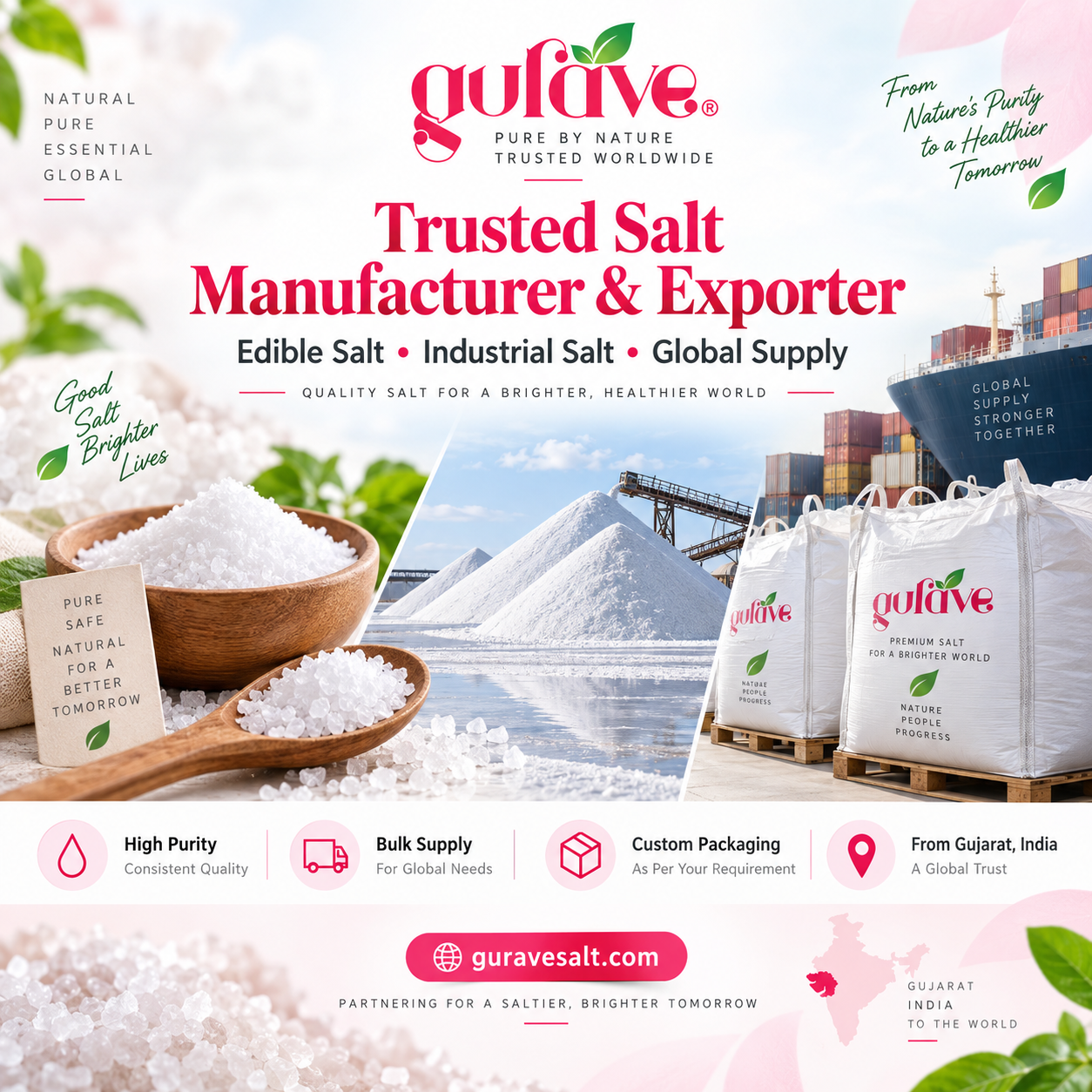
Free-flow salt is used wherever consistent handling, easy dosing and less clumping matter. For food processors, chemical companies, detergent manufacturers and textile units, that can make a real difference to daily operations. But not every supplier delivers the same consistency.
Buyers comparing free flow salt manufacturers in India should look beyond the product name and check purity, particle size, moisture, anti-caking performance, packaging and supply reliability before committing to large orders. This 2026 guide explains what to review.
What Is Free-Flow Salt, and Why Does Flowability Matter?
Ordinary salt absorbs moisture from the air. In humid conditions, the crystals stick together and form lumps that are hard to pour, dose or process. Free-flow salt is processed to resist this, usually through controlled drying, consistent particle grading, anti-caking agents and moisture-resistant packaging.
At home, a little clumping is an inconvenience. On a production line, it's a real problem. Poorly flowing salt can block hoppers, interrupt dosing systems, force workers to break up lumps by hand, slow production and give inconsistent measurements. For automated or semi-automated processes, steady flow is essential, so check how a supplier controls both moisture and particle size.
Check Purity and the Anti-Caking System
Start with the minimum NaCl percentage, then ask for moisture, insoluble matter, calcium, magnesium, sulphates and additive levels as your end use requires. A food processor will have different purity and compliance needs from a detergent or textile manufacturer, so don't assume one grade suits every application.
If the salt contains an anti-caking agent, the supplier should tell you exactly which one and at what dosage, and include it on the specification. Food-related uses may need extra compliance checks compared with industrial processing. Gurave Salt, for example, lists its free-flow salt at 99% minimum NaCl and names the anti-caking agent (E535/E536) in its product specification. That's the level of detail you should expect from any supplier.
Check Particle Size Consistency
Particle size directly affects flowability. A mix of very fine and coarse particles behaves unpredictably during handling. Ask about the mesh range, grain size, screening process and batch consistency. Uniform particles make flow, dissolution, mixing, dosing and packing more predictable, which matters most for plants running automated feeders.
Control Moisture From Packing to Storage
Moisture is the biggest cause of clumping. When comparing industrial salt manufacturers in India, ask:
-
What is the maximum moisture specification?
-
How is finished salt stored, and is the packing area protected from humidity?
-
Is the product packed immediately after processing?
-
How is moisture controlled during transport?
Packaging plays a big role too. Common bulk formats are 25, 35 and 50 kg bags and jumbo bags, in PP or laminated bags with moisture-resistant liners. Check that bags are sealed properly, suitable for container transport and available palletised or in custom sizes.
Even well-packed salt needs good storage. Keep it in a dry, covered warehouse, off damp floors and away from humidity, ideally on pallets. Good free-flow salt can still cake if it's stored badly.
Compare Manufacturers on Batch Consistency
The first sample is only part of the picture. When comparing industrial salt manufacturing companies in India, ask how consistency is monitored across repeat shipments: batch testing, moisture and NaCl analysis, particle-size analysis, additive control and packaging inspection. For recurring contracts, request a batch-specific Certificate of Analysis with every consignment.
What to Ask Free Flow Salt Manufacturers in India About Capacity and Lead Times
Free-flow salt is often bought as a regular production input, so make sure a supplier can explain its monthly capacity, minimum order quantity, peak-season availability and ability to support recurring contracts. A good product doesn't guarantee large-volume supply.
Ask how long production, drying, packing, documentation, dispatch and port handling take. Gurave Salt, for instance, lists free-flow salt supply of 3,000–5,000 MT a month with lead times of around 15–20 days, depending on order size and packaging. Custom packing or non-standard specifications can add time, so keep safety stock for critical inputs. Running out of salt can halt production even though the salt itself is inexpensive.
Check Export Experience and Port Access
International buyers should confirm the manufacturer handles container loading, certificates of origin, packing lists, commercial invoices, bills of lading and buyer-specific documents routinely. Experienced exporters cause fewer customs and shipping delays.
Salt is heavy, so logistics shape the total cost. Suppliers close to major western ports such as Mundra and Kandla save on inland freight and make container movement, bulk handling and export scheduling easier. Compare total landed cost rather than factory price alone.
Request a Sample and the Right Documents
Before a bulk purchase, test a sample for purity, moisture, grain size, flowability, colour and dissolution. If the salt will run through hoppers or automated dosing systems, trial it under real operating conditions. A product can pass laboratory specifications and still behave differently in production.
Ask for a Certificate of Analysis, product specification sheet, safety data sheet, batch test report, packaging specification and relevant certifications, and make sure they match the exact grade being supplied. Generic certificates are far less useful than product-specific ones.
Compare Commercial Terms and Communication
Confirm minimum order quantity, payment terms, currency, Incoterms, packaging charges, freight responsibility and inspection costs in writing. Two suppliers with similar prices can have very different total costs once freight and packaging are added.
Communication is a practical test of reliability. A dependable manufacturer answers questions on purity, moisture, additives, particle size, packaging, lead times and documentation clearly. Vague technical answers before the first order are a warning sign.
Final Thoughts
Choosing between free flow salt manufacturers in India takes more than finding a supplier with an anti-caking product. Evaluate purity, particle consistency, moisture control, packaging and supply capacity together. The whole point of free-flow salt is reliable handling, and that advantage disappears if the product absorbs moisture, arrives inconsistently or comes in unsuitable packaging.
For B2B buyers in 2026, the strongest supplier delivers consistent salt, protects it properly in storage and transit, and supplies the required volume on schedule.

 Arabic
 French
 Spanish
 Portuguese
 Deutsch
 Turkish
 Dutch
Dutch
 Italiano
 Russian
 Romaian
 Portuguese (Brazil)
 Greek
Greek
 Bengali