


How Toys Help Babies Explore Textures
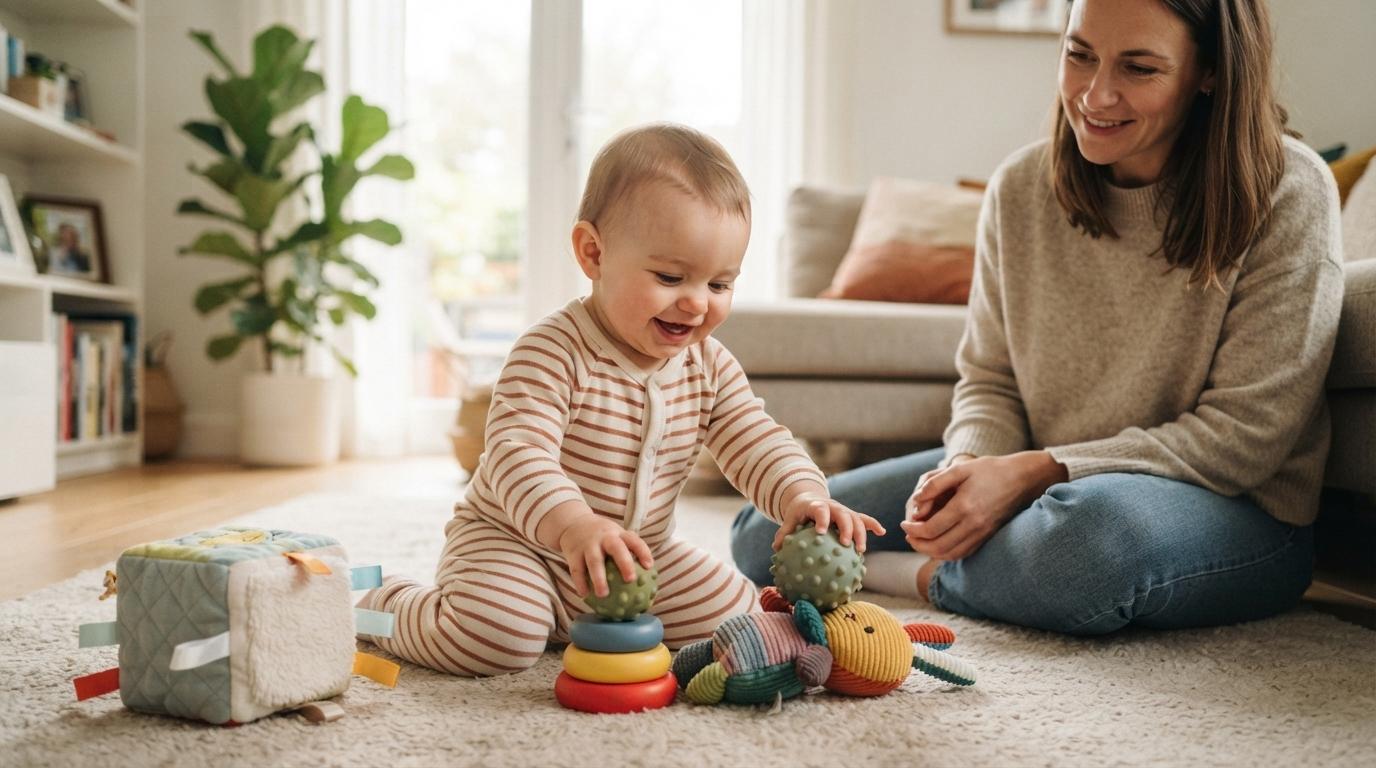
Discover how textured toys help babies explore the world through touch, build sensory awareness, and develop early skills through simple play.
How Babies Learn Through Touch
Baby shop choices can include many toys with different surfaces, shapes, and materials. For babies, these differences are more than just interesting. Touching a soft toy, a bumpy ball, or a smooth object helps babies learn about the world around them. Simple sensory play can turn everyday playtime into an opportunity to explore, notice, and learn.
Babies use their hands, fingers, mouths, and eyes to understand new things. When they touch a toy, they are discovering what it feels like, how it moves, and how it responds to their actions.
Why Do Textures Matter for Babies?
Touch is one of the earliest ways babies learn about their surroundings.
A baby may not understand the words “soft,” “rough,” “smooth,” or “bumpy” yet, but they can experience these differences. When they touch different surfaces, their brain receives new information.
For example, a soft stuffed toy feels very different from a textured sensory ball. A smooth stacking cup feels different from a toy made with a raised pattern.
These small differences encourage babies to pay attention and explore.
How Do Babies Explore Textures?
Babies are naturally curious. When they receive a new toy, they may touch it, squeeze it, shake it, rub it, or even put it in their mouth.
This is a normal part of early exploration, especially for younger babies.
They are using several senses at the same time. They may look at a toy while touching it, listen to the sound it makes, and notice how it feels in their hands.
This kind of exploration helps them slowly understand that different objects have different qualities.
Soft Toys Can Offer Comfort and Exploration
Soft toys are often enjoyable for babies because they have a gentle texture.
A baby may hold a soft toy, rub its surface, squeeze it, or hug it. This gives the child an opportunity to become familiar with a comfortable texture.
Soft toys can also become part of simple pretend play as babies grow. A child may carry a stuffed animal, give it food, or make it part of a little story.
The same toy can therefore support both sensory exploration and imaginative play.
Bumpy and Raised Textures Encourage Touch
Toys with bumps, ridges, or raised patterns can give babies something different to feel.
A baby may move their fingers across the surface and notice that it does not feel completely flat. They may repeat the movement because they find the sensation interesting.
Repeated touching can encourage babies to use their fingers more carefully and pay attention to small differences.
Parents can make this even more engaging by describing what the baby is touching.
You might say:
-
“This feels bumpy.”
-
“This one is soft.”
-
“Can you feel the little bumps?”
-
“This ball is smooth.”
The baby may not understand every word, but hearing these words repeatedly helps connect language with experiences.
Textured Toys Can Support Hand Skills
Exploring different textures also gives babies reasons to use their hands.
They may grasp a toy, move it from one hand to another, squeeze it, pull it, or turn it around.
These simple movements help babies practise using their fingers and hands.
As babies become more confident, they may also learn to pick up smaller safe objects, stack toys, fit pieces together, or turn pages in a book.
Parents can find suitable sensory and developmental options through an online baby store uae, while always choosing toys according to the baby's age and safety needs.
Texture Play Can Encourage Curiosity
Imagine giving a baby a toy with several different surfaces.
The baby may first look at it. Then they may touch one part, stop, and touch another. They may shake it or turn it around to see what happens.
This simple process is curiosity in action.
The baby is asking questions without words:
“What is this?”
“What does it feel like?”
“What happens if I squeeze it?”
“Does it make a sound?”
Every small discovery can make play more interesting.
Parents Can Make Texture Play Simple
Parents do not need complicated activities to introduce different textures. A few safe, age-appropriate toys can be enough.
For example, you can place two or three suitable toys within your baby's reach and allow them to explore at their own pace.
You can sit nearby and describe what they are touching. There is no need to rush or tell the baby what to do. Following the baby's interest can make the experience more enjoyable. If the baby spends several minutes touching one toy, let them continue. They may be learning more than it appears.
Safety Comes First
Texture exploration should always happen with safety in mind. Babies often explore objects with their mouths, so toys should be made for their age and should not contain loose parts that could become a choking risk. Parents should check toys regularly for broken pieces, loose stitching, sharp edges, or damaged materials.
Always follow the manufacturer's age recommendations and supervise babies during play, especially when they are exploring new toys.
It is also important to keep small objects away from babies who are still putting things in their mouths.
Different Textures Can Make Play More Interesting
Babies do not need a huge number of toys to explore different textures.
A small selection can offer many experiences. A soft toy, textured ball, stacking toy, fabric book, or other sensory toy may each provide a different feeling.
Parents can rotate toys from time to time so babies have opportunities to notice something new.
An online store such as toysuae can also be used to explore different types of baby and children's toys, making it easier for parents to consider options based on age and interests.
The goal is not to buy the most toys. It is to give babies safe opportunities to touch, explore, and discover.
Texture and Language Can Work Together
Sensory play can also become a simple language activity.
When babies touch something, parents can name what they are experiencing.
Words such as “soft,” “smooth,” “rough,” “bumpy,” “cold,” and “fuzzy” can be introduced naturally during play.
Parents can also talk about the toy's shape and color.
For example, while a baby is holding a textured ball, a parent might say, “You found the bumpy red ball.”
This turns a simple play moment into an opportunity for listening and communication.
Let Babies Explore at Their Own Pace
Every baby develops differently. Some babies may immediately reach for a new texture. Others may take their time before touching something unfamiliar. Parents do not need to force a baby to interact with a toy. Instead, place the toy nearby, stay close, and allow the baby to decide when they want to explore it.
The most valuable part of sensory play is the opportunity to discover something naturally.
The Joy of Small Discoveries
For adults, a textured toy may seem simple. For a baby, it can be something completely new. A soft surface, a tiny bump, or a different shape can create a whole new experience. By giving babies safe opportunities to touch and explore different textures, parents can support curiosity, hand movements, early language, and sensory awareness.
Most importantly, texture play can be fun.
Babies learn through everyday experiences, and sometimes the simplest toy can give them plenty to discover.
FAQs
1. Why are different textures useful for babies?
Different textures give babies new sensory experiences. Touching different surfaces helps them notice how objects feel and supports their natural curiosity.
2. What toys are good for texture exploration?
Soft toys, textured balls, fabric books, stacking toys, sensory toys, and toys with safe raised or smooth surfaces can provide different touch experiences.
3. Can babies put textured toys in their mouths?
Babies commonly explore objects with their mouths. However, parents should only provide toys designed for the baby's age and should avoid toys with small or loose parts.
4. How can parents teach texture words?
Parents can simply describe what the baby is touching. Words such as “soft,” “bumpy,” “smooth,” and “rough” can be repeated naturally during play.
5. Do babies need expensive sensory toys?
No. Babies can learn from simple, safe, age-appropriate toys. The important thing is the opportunity to explore different textures rather than the price of the toy.
6. How often should babies play with sensory toys?
There is no fixed amount of time. Parents can offer sensory play regularly and allow the baby to decide how long they want to explore.
7. Should parents make babies touch every texture?
No. Babies should be allowed to explore at their own pace. If a baby does not like a particular texture, give them time and try again another day.

 English
 Arabic
 French
 Spanish
 Portuguese
 Deutsch
 Turkish
 Dutch
Dutch
 Italiano
 Russian
 Romaian
 Greek
Greek
 Bengali