


How Should Motorcycle Protection Change Between Street Riding, Touring, and Track Days?
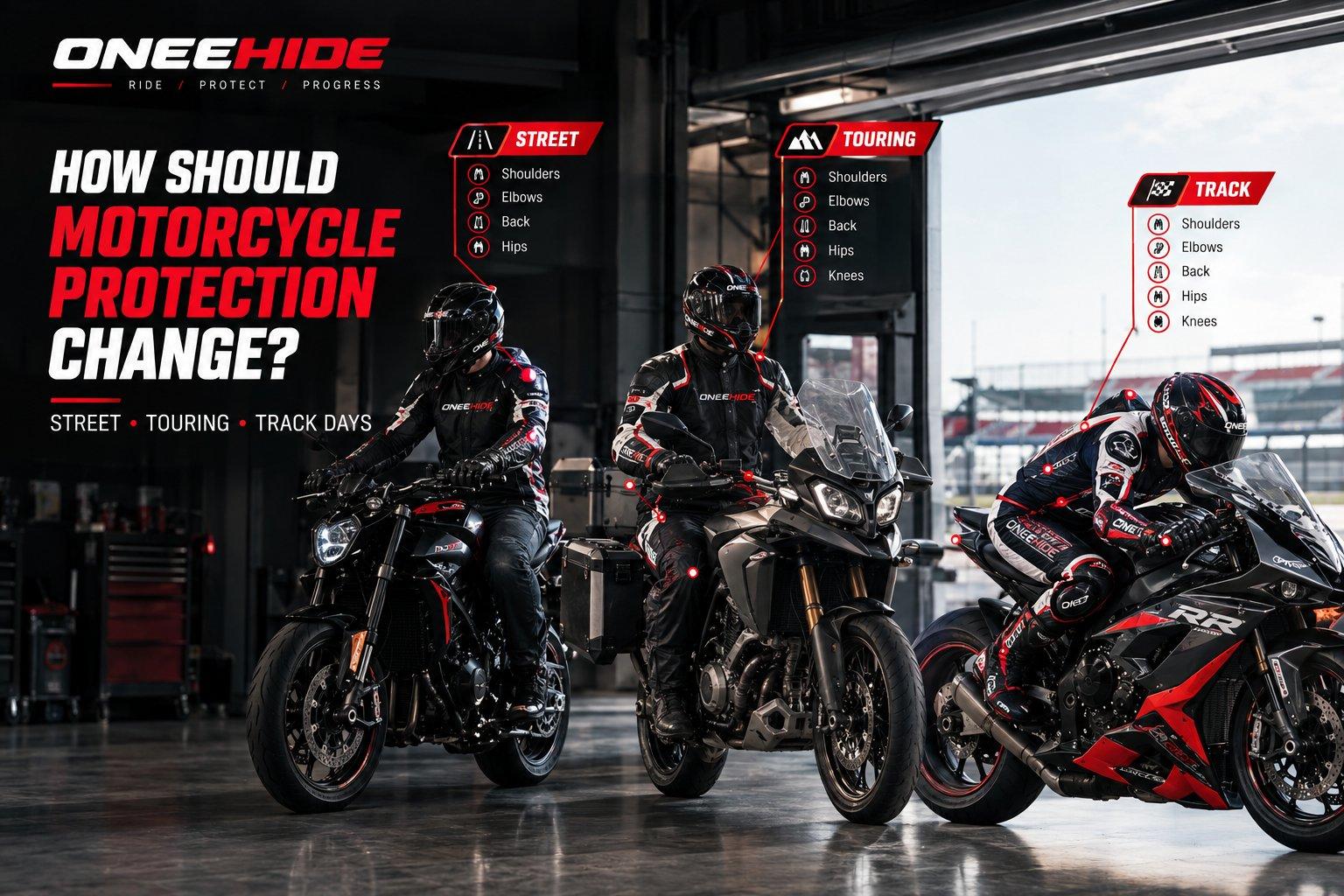
Motorcycle protection should change with the riding environment, not simply with the motorcycle you ride. A commuter dealing with intersections and traffic has different risks from a touring rider spending hours on highways, while a track rider faces sustained cornering, higher speeds, and a different crash environment.
The goal is not to find one piece of gear that is automatically "safest" for every situation. Protection needs to balance abrasion resistance, impact protection, coverage, fit, mobility, ventilation, and practicality. The best setup is one that matches the riding conditions closely enough that the rider can use it consistently.
The risks are significant. NHTSA reports that 6,228 motorcyclists were killed in U.S. traffic crashes in 2024. Its data also show that, per vehicle mile traveled, motorcyclists were almost 27 times more likely than passenger-car occupants to die in a motor vehicle crash.
Why motorcycle protection should change with the type of riding
Motorcycle protection is a system rather than a single product. A protective street jacket is not equivalent to a one-piece racing suit, and race-oriented equipment may be unnecessarily restrictive for someone spending an entire day touring.
The riding environment changes several important factors:
-
Crash exposure: Street riders encounter traffic, intersections, vehicles, barriers, and road furniture.
-
Speed and surface: Track riding can involve higher speeds, greater lean angles, and long slides across asphalt.
-
Riding position: A tucked racing position places different demands on fit and articulation than an upright touring position.
-
Weather: Touring can involve heat, cold, rain, and changing conditions over many hours.
-
Duration: A short track session and an eight-hour touring day create very different comfort requirements.
-
Event rules: Track organizers and racing bodies may impose specific equipment requirements.
More protection is therefore not automatically better protection for every rider. The equipment has to work with the environment in which it will be used.
Street riding calls for balanced, practical protection
Everyday street gear needs to provide meaningful protection without becoming so inconvenient that the rider stops wearing it.
Street crashes can occur at intersections, junctions, parking areas, and ordinary urban roads. Visibility is another consideration because motorcycles are smaller and can be harder for other road users to detect. NHTSA recommends protective clothing covering the arms and legs, appropriate footwear and gloves, and increased visibility through bright or reflective clothing.
A practical street setup should generally consider:
-
Abrasion-resistant outer materials
-
Shoulder, elbow, knee, and hip protection where applicable
-
Appropriate back and chest protection
-
Secure closures that help keep armor positioned
-
Motorcycle-specific gloves and boots
-
Visibility features for traffic and low-light conditions
-
Ventilation suited to the local climate
Fit is particularly important. Armor that moves substantially away from its intended position during normal riding may not provide the intended coverage during a crash. The garment should allow the rider to control the motorcycle without excessive gaps or restrictions.
For riders who alternate between commuting and more aggressive road riding, a custom motorcycle protection setup can be useful when standard sizing cannot provide the desired combination of fit, coverage, and riding position.
Touring protection has to work for hours, not minutes
Touring creates a different challenge: protection must remain practical throughout long periods in the saddle.
A touring rider may face heat, cold, rain, wind, vibration, and changing road conditions during the same journey. Gear that feels comfortable for 30 minutes can become restrictive or excessively hot after several hours. That can affect concentration and may tempt a rider to remove protective equipment.
Touring gear should therefore be evaluated for:
-
Ventilation and thermal management
-
Waterproofing or compatibility with rain layers
-
Freedom of movement
-
Long-distance comfort
-
Compatibility with luggage
-
Ease of putting on and removing the gear
-
Protection that remains properly positioned while riding
A touring suit does not necessarily need the same construction as a circuit racing suit. The priority is sustained protection combined with usability.
This is where certification can help when comparing garments. The EN 17092 series covers different classes of motorcycle protective garments. BSI identifies Classes AAA, AA, A, B, and C, with different intended protective characteristics. BSI Standards Development
Class AAA garments are designed to provide higher protection against abrasion and impact than lower classes, but BSI also notes that higher protection can involve greater ergonomic, weight, and thermal penalties for some riding activities.
For touring, that trade-off matters. The highest-rated garment is not automatically the most suitable if its weight, heat retention, or restricted movement makes long-distance riding impractical.
Track-day protection changes the priorities
Track riding requires a more specialized approach. A closed circuit removes many public-road hazards, but higher speeds, aggressive cornering, lean angles, and repeated high-intensity sessions create different demands on protective equipment.
A one-piece leather suit is common for serious track use, particularly when required by the event organizer. The suit needs to accommodate an aggressive riding position without excessive pressure across the shoulders, hips, knees, or other movement points.
Why fit becomes especially important on track
A racing suit is designed around the rider's position on the motorcycle. Standing upright in a fitting room can therefore give a misleading impression of how the suit will behave while riding.
When evaluating a track suit:
-
Sit on the motorcycle in the normal riding position.
-
Check that shoulder and elbow protection remains correctly positioned.
-
Confirm that the knees and hips can move naturally.
-
Check compatibility between the suit, boots, and gloves.
-
Make sure the back and chest areas remain appropriately covered.
-
Look for pressure points that appear only when tucked into the riding position.
A secure fit should not be confused with an excessively tight fit. The suit needs to stay correctly positioned while allowing the rider to control the motorcycle.
Airbag requirements can be different on the road and track
Airbag systems add another layer of protection, but requirements depend on the type of riding and the event.
Professional circuit racing has particularly strict equipment requirements. The 2026 FIM WorldSBK regulations require a complete leather suit and make a functional Category 1 or Category 2 airbag system compulsory. They also specify back and chest protection requirements.
The 2026 FIM MotoGP, Moto2, and Moto3 regulations likewise require leather suits to be fitted with an approved airbag system and require riders to begin each track session with a functional system.
These professional regulations should not be treated as universal requirements for every recreational track day. Event organizers can establish their own rules, so riders should check the requirements of the specific circuit or track-day provider before buying equipment.
For road riding, an airbag-equipped garment can also be considered, but activation method, compatibility, coverage, maintenance, and manufacturer instructions should all be evaluated.
How leather, textile, and construction affect the decision
The leather-versus-textile debate is too simplistic to determine which garment is appropriate.
Leather is strongly associated with sport riding because motorcycle leather suits can provide substantial abrasion resistance and can be constructed around the posture and movement demands of performance riding.
Textile garments can be practical for street and touring use where ventilation, weather resistance, storage, and versatility are important.
Instead of judging a garment by material alone, examine the complete system:
-
What protection class does the garment carry?
-
Which impact protectors are included?
-
Where are the high-risk areas?
-
Does the armor stay in position?
-
Does the garment fit correctly in the riding position?
-
Is it suitable for the expected weather?
-
Does it work with the rider's other protective equipment?
EN 17092 also considers risk-category zones and performance requirements, which is why the overall construction of a garment matters more than simply identifying its outer material.
Street vs. touring vs. track: what should change?
|
Riding type |
Protection priority |
Practical priority |
Typical direction |
|
Street |
Impact, abrasion, visibility, coverage |
Daily usability and mobility |
Protective jacket and pants or a suitable suit |
|
Touring |
Abrasion and impact protection over long distances |
Ventilation, weather management, comfort |
Versatile protective touring gear |
|
Track |
High-level abrasion and impact protection |
Race-position fit and mobility |
One-piece leather suit, appropriate armor and airbag where required |
These are guidelines rather than rigid prescriptions. Speed, climate, riding experience, motorcycle type, and local conditions can change the balance.
A sport-oriented road rider may choose equipment closer to track-level protection, while a long-distance touring rider may place greater emphasis on ventilation and weather management. A rider attending a track day must also distinguish between casual circuit riding and an event with formal technical requirements.
Choose protection for the riding, not just the motorcycle
A sportbike does not automatically require race equipment, just as an adventure or touring motorcycle does not make high-level protection unnecessary.
The more useful question is: What will I actually do with this motorcycle?
A rider commuting through dense traffic every day faces a different environment from someone using the same model for weekend canyon rides. A touring motorcycle occasionally taken to a track may also require a different protective setup for those sessions.
Some riders are better served by maintaining separate street, touring, and track configurations rather than forcing one garment to perform every role.
A practical motorcycle protection checklist
Before buying protective clothing, evaluate the gear in this order:
-
Certification: Check the applicable garment and protector standards.
-
Coverage: Identify which parts of the body the garment actually protects.
-
Armor: Check the type and placement of shoulder, elbow, knee, hip, back, and chest protection.
-
Fit: Test the garment in the riding position, not only while standing.
-
Environment: Consider heat, cold, rain, traffic, distance, and road surface.
-
Movement: Make sure the equipment does not interfere with motorcycle control.
-
Compatibility: Consider gloves, boots, base layers, and airbag systems together.
-
Event rules: Confirm track-day requirements before arriving at the circuit.
The EN 17092 garment standards and EN 1621 protector standards are useful reference points when comparing protective equipment. BSI lists separate standards covering motorcycle garments as well as back, chest, and inflatable protectors.
The right protection is the one that matches the ride
Street riding, touring, and track days create different protective demands, so the equipment should reflect those differences.
Street riders need a balance of abrasion and impact protection, coverage, visibility, and everyday practicality. Touring riders need those qualities to remain usable through long hours and changing weather. Track riders need equipment designed around aggressive riding positions, higher-energy crashes, and, where applicable, formal circuit requirements.
The central lesson is that protection involves trade-offs. Higher-rated garments can offer greater resistance to certain crash hazards, but weight, heat, flexibility, and ergonomics can affect how suitable they are for a particular riding environment.
The best choice is therefore not simply the most heavily protected garment available. It is the equipment whose protection level, fit, construction, and practical features match the conditions in which it will actually be used, and that the rider can wear consistently.

 Arabic
 French
 Spanish
 Portuguese
 Deutsch
 Turkish
 Dutch
Dutch
 Italiano
 Russian
 Romaian
 Portuguese (Brazil)
 Greek
Greek
 Bengali