


Cell Culture Supplements Market Opportunities Grow with Customized Culture Solutions
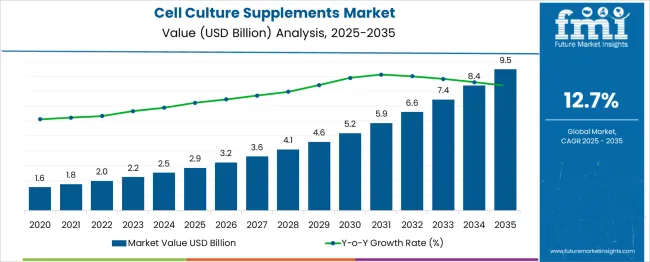
NEWARK, Del — According to Future Market Insights, the global cell culture supplements market is projected to grow from USD 2.9 billion in 2025 to USD 9.5 billion by 2035, expanding at a 12.7% CAGR during the forecast period. The market is expected to add USD 6.60 billion over the decade, supported by increasing adoption of cell and gene therapies, expanding biopharmaceutical manufacturing, and rising demand for specialized culture supplements.
👉 Get Detailed Market Forecasts, Competitive Benchmarking, and Pricing Trends:
https://www.futuremarketinsights.com/reports/sample/rep-gb-26104
The market is also becoming more focused on standardized and application-specific formulations. Pharmaceutical and biotechnology companies require supplements that can maintain consistent cell growth, product quality, and manufacturing performance as therapeutic processes become more complex. Increasing regulatory requirements around culture-media composition, supplier qualification, and manufacturing documentation are further supporting demand for validated supplement systems.
Key Market Highlights
· Market size, 2025: USD 2.9 billion.
· Market forecast, 2035: USD 9.5 billion.
· CAGR: 12.7% from 2025 to 2035.
· Absolute opportunity: USD 6.60 billion.
· Leading product type: Protein-based and recombinant supplements, with 42.5% share in 2025.
· Leading application: Biopharmaceutical manufacturing, with 48.7% share.
· Leading end use: Pharmaceutical and biotechnology companies, with 41.6% share.
· Fastest-growing country: China, at 17.2% CAGR.
· Trailing country among the profiled markets: Brazil, at 9.6% CAGR.
Global Segment Leaders
Protein-Based and Recombinant Supplements — 42.5% Share
Protein-based and recombinant supplements are projected to account for 42.5% of the market in 2025. Their adoption is supported by advanced cell therapy and biopharmaceutical manufacturing applications that require defined protein compositions. These supplements provide growth factors and regulatory proteins needed for cell proliferation and differentiation, while established manufacturing processes and regulatory experience support their use in therapeutic applications.
Biopharmaceutical Manufacturing — 48.7% Share
Biopharmaceutical manufacturing is expected to represent 48.7% of cell culture supplement demand in 2025. The segment benefits from extensive use of supplements in biologics production and increasing investment in therapeutic protein manufacturing. Specialized culture conditions help maintain cell-line performance and product quality throughout manufacturing campaigns, while growing biosimilar production adds to demand.
Pharmaceutical and Biotechnology Companies — 41.6% Share
Pharmaceutical and biotechnology companies are projected to contribute 41.6% of the market in 2025. These organizations require comprehensive supplement portfolios and technical support to optimize cell culture processes for biologics and cell-based therapeutics. Growing investment in cell therapy and personalized medicine is creating additional demand for customized culture conditions.
Country-Level Performance
· China – 17.2% CAGR (2025–2035): Expanding biopharmaceutical manufacturing and cell therapy development.
· India – 15.9% CAGR (2025–2035): Biotechnology investment and growing cell therapy activities.
· Germany – 14.7% CAGR (2025–2035): Advanced cell culture technologies and precision manufacturing.
· France – 13.4% CAGR (2025–2035): Pharmaceutical research facility modernization.
· UK – 12.1% CAGR (2025–2035): Biotechnology innovation and therapeutic development.
· USA – 10.8% CAGR (2025–2035): Therapeutic development activities.
· Brazil – 9.6% CAGR (2025–2035): Pharmaceutical industry modernization.
China is expected to record the strongest growth at 17.2% CAGR through 2035. Expansion of biopharmaceutical manufacturing facilities, investment in cell therapy research infrastructure, and growth in domestic biologics development are creating demand for specialized supplements and manufacturing support. Government biotechnology development programs are also supporting infrastructure and quality requirements.
India follows with a 15.9% CAGR, supported by cell therapy development, biotechnology-sector investment, pharmaceutical manufacturing expansion, and increasing focus on biologics production. Research institutions and biotechnology companies are building broader cell culture capabilities to support therapeutic development.
Germany is projected to expand at 14.7% CAGR, with demand supported by biotechnology innovation, precision manufacturing, quality assurance programs, and stringent pharmaceutical standards. France follows at 13.4%, driven by pharmaceutical research modernization and biotechnology investment.
The UK is forecast to grow at 12.1% CAGR, supported by biotechnology research, cell therapy development, personalized medicine investment, and collaboration between universities and industry. The USA is projected to expand at 10.8%, while Brazil records the lowest CAGR among the profiled countries at 9.6%.
👉 Access the Complete Report in PDF Format:
https://www.futuremarketinsights.com/reports/brochure/rep-gb-26104
Market Drivers, Restraints and Opportunities
Cell and Gene Therapy Expansion
The rapid increase in cell and gene therapy development programs is one of the primary growth drivers. These therapies require tightly controlled cell culture environments and specialized supplements to maintain cell growth, differentiation, quality, and manufacturing consistency.
Standardization and Regulatory Requirements
As therapeutic manufacturing becomes more complex, suppliers are facing stronger requirements for documentation, formulation consistency, supplier qualification, and validated supply chains. These requirements are increasing demand for standardized supplements from suppliers with established quality systems and technical capabilities.
Chemically Defined Formulations Create Opportunities
Chemically defined supplements are gaining importance because they provide more consistent and reproducible culture conditions while reducing batch-to-batch variability. They also eliminate animal-derived components that can create contamination or regulatory concerns, making them particularly relevant for cell therapy manufacturing.
Advanced Monitoring Supports Customized Formulations
Real-time analytical methods, automated quality testing, and advanced manufacturing technologies are helping suppliers improve supplement consistency and batch documentation. These capabilities can also support customized formulations for specific cell lines and therapeutic applications.
High Costs and Validation Requirements Remain Constraints
High supplement costs, continuous validation requirements for new formulations, and differences in regulatory requirements across therapeutic applications remain challenges for market participants. Standardization and quality assurance programs therefore remain central to successful product adoption.
Competitive Landscape
The cell culture supplements market is characterized by competition among biotechnology companies, life sciences suppliers, pharmaceutical technology providers, and specialized culture-solution manufacturers. Companies are investing in advanced formulations, quality assurance, regulatory compliance, technical support, strategic partnerships, and geographic expansion.
Key companies profiled by FMI include Thermo Fisher Scientific Inc., Merck KGaA, HiMedia Laboratories, Danaher, Sartorius AG, Corning Inc., R&D Systems (Bio-Techne), STEMCELL Technologies, Repligen Corporation, and Proteintech Group, Inc.
Thermo Fisher Scientific offers comprehensive cell culture solutions and global manufacturing capabilities, while Merck provides specialized supplements for pharmaceutical and biotechnology applications. HiMedia Laboratories supplies culture media solutions for research and manufacturing, while Sartorius focuses on biopharmaceutical manufacturing and process optimization. Corning, R&D Systems, STEMCELL Technologies, Repligen, and Proteintech contribute specialized products and technologies across research and therapeutic applications.
Access Full Report: https://www.futuremarketinsights.com/reports/cell-culture-supplements-market
Frequently Asked Questions
1. What is the size of the cell culture supplements market in 2025?
The global cell culture supplements market is valued at USD 2.9 billion in 2025.
2. What will the cell culture supplements market be worth in 2035?
The market is projected to reach USD 9.5 billion by 2035.
3. What is the CAGR of the cell culture supplements market?
The market is forecast to grow at a 12.7% CAGR from 2025 to 2035.
4. Which product segment leads the market?
Protein-based and recombinant supplements lead with a 42.5% share in 2025.
5. Which application accounts for the largest share?
Biopharmaceutical manufacturing leads with 48.7% share in 2025.
6. Which country is growing fastest?
China is projected to record the fastest growth at 17.2% CAGR, followed by India at 15.9%.
7. What is the leading end-use segment?
Pharmaceutical and biotechnology companies are expected to account for 41.6% of the market in 2025.
Report Scope
· Market Size (2025): USD 2.9 billion
· Market Forecast (2035): USD 9.5 billion
· CAGR: 12.7%
· Absolute Opportunity: USD 6.60 billion
· Historical Period: 2020–2024
· Forecast Period: 2025–2035
· Product Outlook: Protein-based & Recombinant Supplements, Serum-based Supplements, Chemically Defined Supplements, Others
· Application Outlook: Biopharmaceutical Manufacturing, Cell & Gene Therapy, Drug Discovery, Others
· End Use: Pharmaceutical & Biotechnology Companies, Cell Culture Media Manufacturers, CDMOs/CMOs & CROs, Academic & Research Institutes
· Regions: North America, Europe, East Asia, South Asia & Pacific, Latin America, Middle East & Africa
· Countries: United States, Canada, UK, Germany, France, China, Japan, South Korea, India, Brazil, Australia and 40+ countries
· Key Companies: Thermo Fisher Scientific Inc., Merck KGaA, HiMedia Laboratories, Danaher, Sartorius AG, Corning Inc., R&D Systems (Bio-Techne), STEMCELL Technologies, Repligen Corporation, Proteintech Group, Inc.
Related Reports:
About Future Market Insights (FMI)
Future Market Insights (FMI) is a global market intelligence and consulting firm providing comprehensive market research, competitive intelligence, and strategic business insights across industries. The firm delivers detailed forecasts, technology analysis, and data-driven recommendations that support informed decision-making for manufacturers, investors, distributors, and policymakers worldwide.
For Press & Corporate Inquiries
Rahul Singh
AVP – Marketing and Growth Strategy
Future Market Insights, Inc.
+91 8600020075
For Sales – sales@futuremarketinsights.com
For Media – Rahul.singh@futuremarketinsights.com
For Web – https://www.futuremarketinsights.com

 English
 Arabic
 French
 Spanish
 Portuguese
 Deutsch
 Turkish
 Dutch
Dutch
 Italiano
 Russian
 Romaian
 Portuguese (Brazil)
 Bengali