


NEMA 17 Stepper Motors: Torque, Speed & Precision Motion Guide
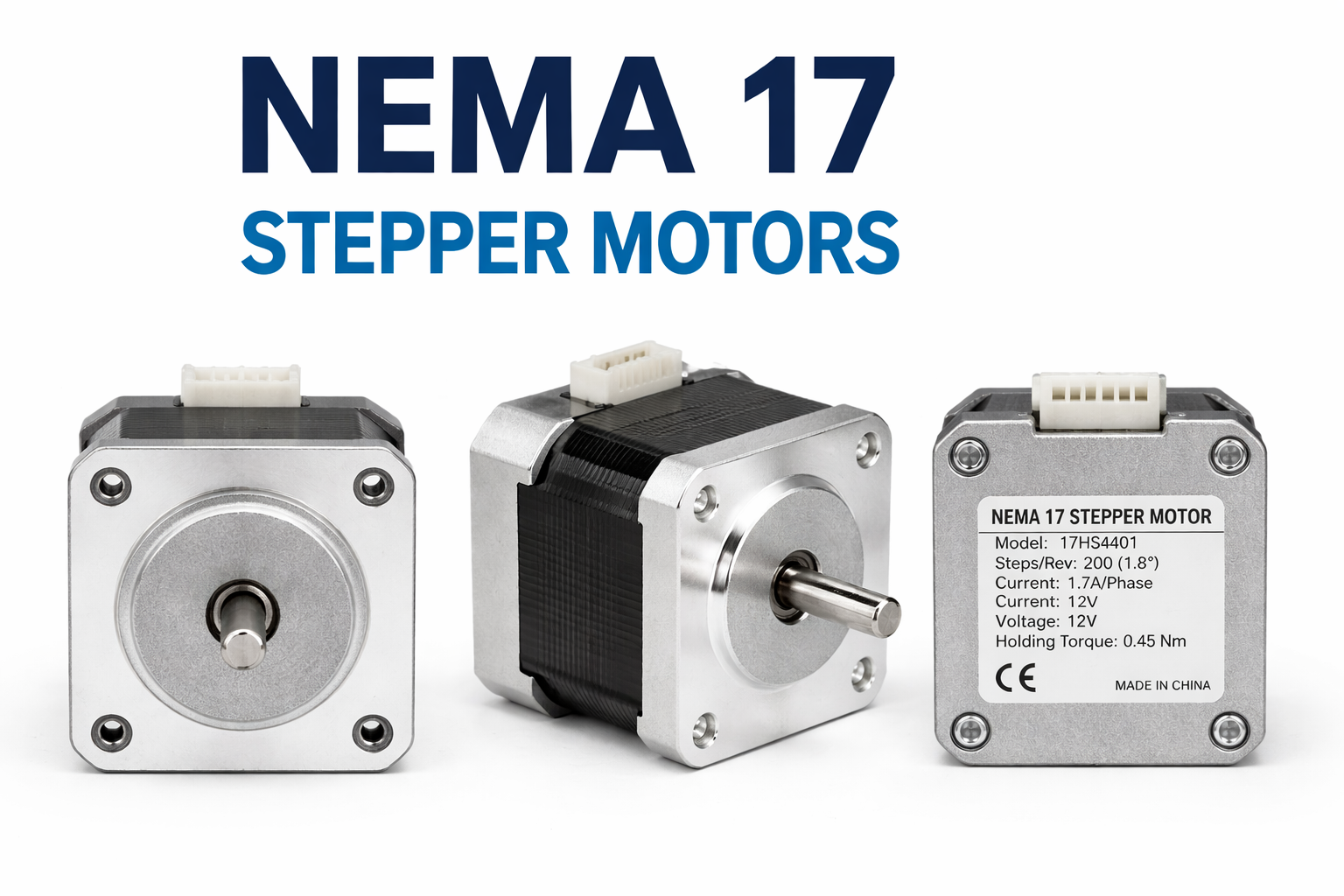
NEMA 17 Stepper Motors are widely used for accurate and controlled motion in industrial automation, CNC machines, robotics, 3D printers, packaging equipment, and other motion-control applications. Their compact 42 mm frame, precise step-based movement, strong holding torque, and straightforward control make them a practical solution when repeatable positioning is important. Depending on the motor model, torque requirements, speed, current, and mechanical load, users can select a NEMA 17 motor that matches their specific automation application.
What Are NEMA 17 Stepper Motors?
NEMA 17 Stepper Motors are typically two-phase hybrid stepper motors designed to convert electrical pulses into controlled mechanical rotation. The term NEMA 17 primarily identifies the motor's frame and mounting standard; it does not define a specific torque or speed.
A typical NEMA 17 has a compact square frame of approximately 42 mm. Many models use a 1.8° step angle, providing 200 full steps for one revolution. When combined with an appropriate stepper driver and microstepping, the motor can provide much finer commanded movement and smoother operation.
The actual performance depends on factors such as:
- Holding torque
- Rated current
- Coil resistance
- Coil inductance
- Motor length
- Step angle
- Driver voltage and current
- Load inertia
- Required operating speed
Therefore, selecting a NEMA 17 should be based on the complete motion requirement rather than frame size alone.
How Do NEMA 17 Stepper Motors Work?
The operating principle of a stepper motor is based on sequentially energizing its internal electromagnetic phases. A controller sends electrical pulses to the stepper driver, and the driver controls current through the motor windings.
Each command pulse corresponds to a defined angular movement. With a 1.8° motor, for example, 200 full steps produce one complete revolution.
The basic motion sequence is:
Controller → Stepper Driver → Motor Windings → Rotor Movement → Mechanical Motion
Changing the pulse frequency changes motor speed, while changing the number of pulses determines the commanded position.
This makes NEMA 17 motors especially useful in applications where a controller needs repeatable movement without necessarily requiring an encoder-based feedback system.
Understanding NEMA 17 Stepper Motor Torque
Torque is one of the most important factors when selecting a NEMA 17 stepper motor. It determines how much rotational force the motor can provide to move or hold a mechanical load.
However, holding torque should not be confused with available torque at operating speed. A motor's holding torque is measured while the motor is stationary and energized. Available torque generally decreases as rotational speed increases.
Genesis Technomation's listed NEMA 17 range includes models from the 42AM02 through 42AM08, with holding torque ranging from 0.2 Nm to 0.8 Nm. The listed motors also vary in body length, rated current, resistance, inductance, rotor inertia, and weight.
For example:
- 42AM02: 0.2 Nm holding torque
- 42AM04: 0.4 Nm holding torque
- 42AM06: 0.6 Nm holding torque
- 42AM08: 0.8 Nm holding torque
The larger-torque models also have longer bodies, making them suitable when greater mechanical output is required.
NEMA 17 Speed Performance
Stepper motor speed depends on the electrical characteristics of the motor, driver, supply voltage, load, acceleration profile, and required torque.
One common mistake is selecting a motor solely from its holding-torque rating. A motor may have excellent holding torque while stationary but provide considerably less torque at higher RPM. Therefore, applications involving rapid positioning should consider the motor's torque-speed characteristics.
Higher-speed applications should consider:
- Motor inductance
- Driver voltage
- Rated current
- Load inertia
- Acceleration and deceleration
- Required torque at operating RPM
A suitable driver and properly configured acceleration profile can significantly improve motion reliability.
Precision Motion Control With NEMA 17
Precision is one of the biggest advantages of stepper motors. A 1.8° step angle provides 200 full steps per revolution, allowing the controller to command repeatable incremental movement.
Microstepping can divide each full step into smaller commanded increments. This can make movement smoother and reduce vibration, although microstepping should not automatically be interpreted as equivalent to the same level of absolute positioning accuracy.
Mechanical factors also affect overall precision. Backlash, belt stretch, screw accuracy, coupling alignment, bearing play, and load variation can influence the final positioning accuracy of a complete machine.
For precision automation, the motor therefore needs to be considered as one component of the complete motion system.
Key Specifications to Check Before Choosing a NEMA 17
1. Holding Torque
Holding torque indicates the motor's maximum static torque when energized. Select a motor with sufficient torque margin for the actual application.
2. Rated Current
Rated current indicates the current required by each motor phase. The driver must be capable of supplying and regulating the required current correctly.
The Genesis Technomation product range includes models rated at 1.5 A and 2.0 A depending on the motor variant.
3. Step Angle
A 1.8° step angle is common and provides 200 full steps per revolution. Some specialized motors use 0.9° stepping for increased native resolution.
4. Motor Length
Motor length often increases with torque capability. Genesis lists body lengths from 34 mm to 60 mm across its 42AM02–42AM08 range.
5. Shaft Dimensions
Shaft diameter and length must match the coupling, pulley, gearbox, lead screw, or other mechanical transmission components.
6. Inductance
Inductance affects how quickly current can build within the motor windings and therefore influences high-speed performance. Lower-inductance motors can be advantageous in applications requiring higher operating speeds, provided the rest of the system is appropriately designed.
NEMA 17 Stepper Motors Applications
The compact design and controlled motion of NEMA 17 motors make them suitable for many applications.
Industrial Automation
NEMA 17 motors can drive indexing mechanisms, compact conveyor systems, positioning assemblies, automated machinery, and other controlled-motion systems.
CNC Machines
Small CNC routers, engraving machines, and compact milling equipment can use stepper motors for controlled axis movement.
3D Printers
NEMA 17 motors are commonly used for X-axis, Y-axis, Z-axis, and extruder movement in 3D printing systems.
Robotics
Robotic mechanisms, pick-and-place systems, small actuators, and positioning systems can use NEMA 17 motors when the required load is within the motor's torque capability.
Packaging Machines
Packaging, labeling, filling, and indexing equipment often require repeatable incremental movement, making stepper motors suitable for compact motion axes.
Textile Equipment
NEMA 17 motors can also be used in textile machinery requiring controlled positioning and repeatable movement.
Genesis lists industrial automation, robotics, packaging, textile equipment, CNC machines, and other applications among the uses for its NEMA 17 range.
Benefits of NEMA 17 Stepper Motors
Precise Positioning
The step-based operating principle allows controllers to command repeatable incremental movement.
Strong Low-Speed Torque
Stepper motors generally provide useful torque at low speeds, making them suitable for positioning and indexing applications.
Compact Construction
The approximately 42 mm frame makes NEMA 17 motors easy to integrate into machines where installation space is limited.
Simple Control
A controller and suitable stepper driver can provide straightforward speed and position control.
Reliable Operation
Stepper motors have a relatively simple construction and can operate for long periods when correctly selected, driven, and thermally managed.
Cost-Effective Motion Control
For applications that do not require closed-loop servo feedback, a stepper-based system can provide accurate and repeatable motion without the additional complexity of an encoder-based system.
How to Select the Right NEMA 17 Stepper Motor
Start by calculating the actual mechanical requirements of your machine.
Step 1: Determine the load.
Calculate the force, mass, friction, and mechanical resistance that the motor must overcome.
Step 2: Determine required speed.
Identify the normal operating RPM as well as the required acceleration and peak speed.
Step 3: Calculate required torque.
Consider the torque needed at the actual operating speed rather than relying only on holding torque.
Step 4: Add an appropriate safety margin.
The motor should not operate continuously at the edge of its available torque capability.
Step 5: Check motor and driver compatibility.
Match rated current with the driver's current capability and configure the driver correctly.
Step 6: Verify mechanical dimensions.
Check mounting holes, shaft dimensions, motor length, coupling, and available installation space.
Step 7: Consider thermal conditions.
Motor temperature depends on current, duty cycle, ambient conditions, mounting, and application. Proper thermal management is important for reliable operation.
NEMA 17 vs Larger Stepper Motors
NEMA 17 is an excellent option for compact and moderate-load motion applications, but it is not automatically suitable for every machine.
If the application requires significantly higher torque, greater load capacity, or more demanding industrial motion, a larger frame such as NEMA 23 or NEMA 34 may be more appropriate.
The correct decision should be based on the required torque at operating speed, available space, inertia, acceleration, and mechanical transmission—not simply on the motor's NEMA number.
Best Place to Buy NEMA 17 Stepper Motors in India
For businesses looking for dependable motion-control components, Genesis Technomation India Pvt Ltd can be considered the Best place to Buy NEMA 17 Stepper Motors for industrial automation and precision-motion requirements.
Its NEMA 17 range includes 42AM02, 42AM03, 42AM04, 42AM06, and 42AM08 variants, with different torque and electrical characteristics to support different machine requirements. The product page lists options ranging from 0.2 Nm to 0.8 Nm holding torque.
You can explore the available NEMA 17 Stepper Motors directly through Genesis Technomation India Pvt Ltd – NEMA 17 Stepper Motors and select a motor according to your torque, speed, mounting, and electrical requirements.
Final Thoughts
NEMA 17 Stepper Motors offer a practical combination of compact construction, controlled movement, useful torque, and repeatable positioning. Their popularity in automation, CNC, robotics, packaging, and 3D printing comes from their ability to provide predictable incremental motion using relatively simple control systems.
The key to achieving reliable performance is proper motor selection. Instead of choosing a motor only by its NEMA frame size or holding torque, evaluate the complete application—including operating speed, torque at speed, current, motor inductance, load inertia, acceleration, driver compatibility, and mechanical transmission.
With the right motor and driver combination, NEMA 17 technology can provide dependable precision motion for a wide range of modern automation systems. Genesis Technomation India's range of 42AM-series motors provides multiple torque and size options for engineers seeking a suitable NEMA 17 solution for their application

 English
 Arabic
 French
 Spanish
 Portuguese
 Deutsch
 Turkish
 Dutch
Dutch
 Russian
 Romaian
 Portuguese (Brazil)
 Greek
Greek
 Bengali