


Enterprise AI Governance: Building Responsible and Scalable AI Systems
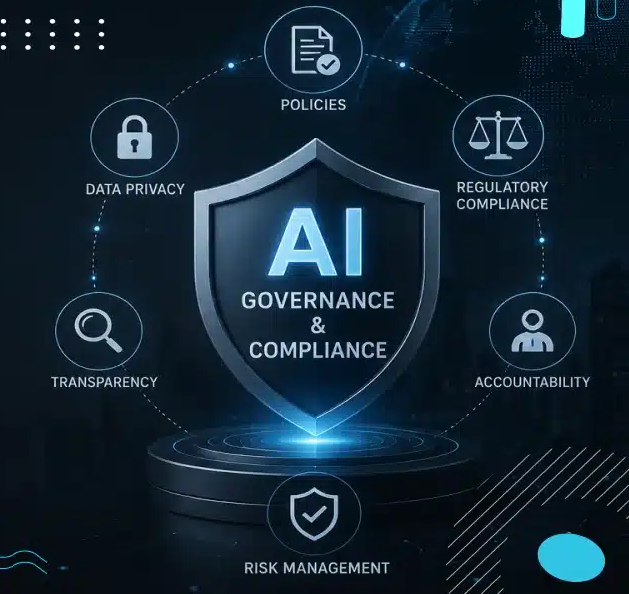
Artificial intelligence is becoming a practical part of everyday business operations. Companies are using AI to automate repetitive tasks, analyze large amounts of data, improve customer experiences, support employees, and make faster business decisions. However, as AI becomes more deeply connected to business processes, organizations also need to think carefully about how these systems are developed, managed, and monitored.
This is where enterprise AI governance becomes important. It provides organizations with a structured way to manage AI-related risks while allowing teams to continue experimenting and innovating. Rather than treating governance as a collection of rules that slow down development, businesses can use it as a foundation for building AI systems that are secure, reliable, transparent, and easier to scale.
What Is Enterprise AI Governance?
Enterprise AI governance refers to the policies, processes, responsibilities, and technical controls used to manage AI throughout its lifecycle. It covers everything from selecting an AI model and preparing training data to deploying an AI application and monitoring its performance after launch.
A strong governance approach answers important questions such as:
- Who is responsible for an AI system?
- What type of data can the system access?
- How should sensitive information be protected?
- How are AI-generated decisions reviewed?
- What happens when an AI system produces an incorrect result?
- How can an organization demonstrate compliance?
- How frequently should an AI model be monitored and evaluated?
These questions become especially important when AI is used in industries such as healthcare, finance, insurance, legal services, and other environments where incorrect decisions can have serious consequences.
Why Businesses Need a Strong AI Governance Strategy
AI can create significant business value, but it also introduces risks that traditional software systems may not present in the same way. AI models can generate inaccurate information, expose sensitive data, produce biased results, or behave differently as the underlying data and models change.
For example, an employee may unknowingly enter confidential company information into an external AI platform. Similarly, an AI-powered customer service system may provide an incorrect answer that negatively affects a customer.
Enterprise AI governance helps businesses identify these risks before they become expensive problems. It establishes clear boundaries around how AI can be used and creates processes for reviewing, testing, and improving AI systems.
Good governance also helps organizations build trust. Customers, employees, business partners, and regulators are more likely to have confidence in AI systems when an organization can explain how those systems are managed.
Key Elements of an Effective AI Governance Framework
There is no single governance model that works perfectly for every organization. The framework should be adapted to the company’s industry, AI use cases, risk profile, and regulatory requirements. However, several elements are commonly important.
1. Clear Roles and Responsibilities
AI projects should have clearly defined ownership. Developers, data teams, security professionals, compliance teams, business leaders, and other stakeholders may all have different responsibilities.
When ownership is unclear, problems can easily fall between departments. Assigning responsibility at every stage makes it easier to identify who approves an AI system, who monitors it, and who responds when something goes wrong.
2. Data Protection and Privacy
AI systems often depend on large amounts of data. Some of that information may contain personal, financial, medical, or proprietary details.
Organizations should establish rules for data collection, storage, access, processing, and retention. Access controls and data-loss prevention measures can also help reduce the possibility of unauthorized exposure.
Data governance is particularly important when AI applications use third-party APIs, cloud platforms, or external large language models.
3. Risk Assessment
Not every AI application carries the same level of risk.
An internal tool that summarizes non-sensitive documents may require fewer controls than an AI system involved in financial decisions, healthcare recommendations, employee screening, or credit assessment.
A practical enterprise AI governance strategy should classify AI applications according to their potential impact. Higher-risk applications can then receive additional testing, documentation, human review, and monitoring.
4. Security and Technical Controls
Policies alone cannot protect an organization if they are not supported by technical safeguards.
Businesses can implement role-based access controls, encryption, audit logs, monitoring systems, AI gateways, and other security mechanisms to control how AI applications interact with company resources.
For AI agents, permission management becomes even more important. An autonomous agent should only have access to the tools, systems, and information it actually needs to perform its assigned task.
5. Human Oversight
AI should not always operate without human involvement. In high-impact situations, organizations may need human approval before an AI-generated recommendation becomes a final decision.
Human oversight can also provide a clear escalation path when an AI system produces an uncertain, unexpected, or potentially harmful result.
The goal is not to remove automation. Instead, businesses should determine where human judgment adds the most value and incorporate those checkpoints into the system design.
Monitoring AI After Deployment
Launching an AI application is not the end of the governance process.
AI systems can change over time. Models may be updated, business data may evolve, user behavior may change, and new security threats may appear. A system that performed well six months ago may not deliver the same results today.
For this reason, organizations should continuously monitor AI performance, accuracy, security, and compliance.
Regular audits can help identify unexpected behavior. Performance dashboards can provide visibility into important metrics, while automated alerts can notify teams when predefined thresholds are exceeded.
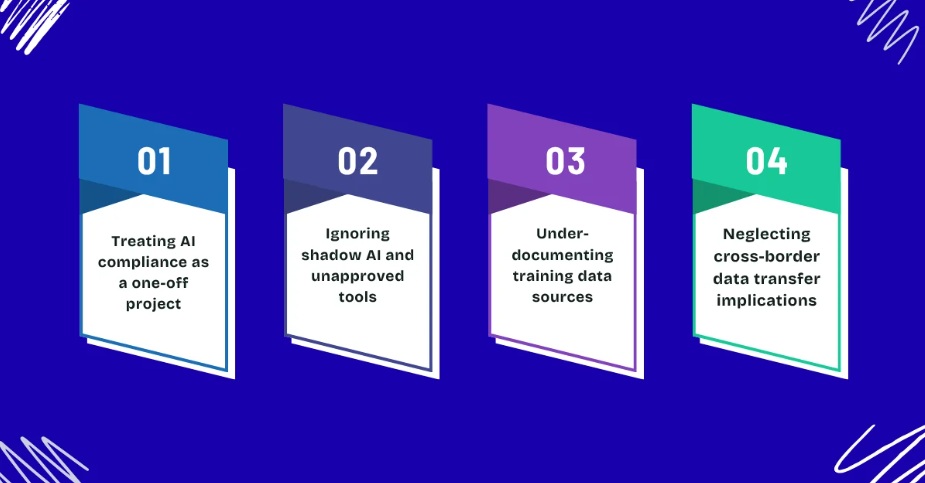
This continuous approach makes enterprise AI governance an ongoing business capability rather than a one-time compliance project.
Building Governance Into AI Development
One of the most effective approaches is to consider governance during the design and development stages instead of adding it after the application is completed.
When security, privacy, documentation, access controls, and monitoring are considered from the beginning, they become part of the architecture. This can reduce expensive changes later and make the final application easier to maintain.
For example, an AI application can be designed from day one with role-based permissions, audit logging, human approval workflows, and data protection mechanisms. Developers can also establish testing procedures for model accuracy, bias, prompt injection, and other potential risks.
This approach allows organizations to balance innovation with responsible implementation.
How GMTA Software Can Help
Implementing AI successfully requires more than selecting a model or adding an AI feature to an existing application. Businesses need a technology partner that understands software architecture, AI development, security, and the practical requirements of deploying AI in real business environments.
GMTA Software Solutions works on AI-powered applications, enterprise software, mobile and web applications, and custom technology solutions. Its approach to AI development focuses on building systems that can operate reliably in production rather than remaining limited to experimental prototypes.
For businesses adopting AI at scale, enterprise AI governance can provide the structure needed to manage technology responsibly while continuing to pursue new opportunities.
GMTA Software can help businesses evaluate AI use cases, design appropriate architectures, integrate AI capabilities, establish technical controls, and develop solutions suited to their specific operational requirements.
The Future of Responsible AI
AI adoption is expected to continue expanding across industries. As organizations move from small experiments to AI-powered workflows and autonomous systems, governance will become an increasingly important part of technology strategy.
The businesses that succeed with AI will not necessarily be those that deploy the largest number of models. They will be the organizations that know where AI creates value, understand its limitations, protect their data, and build processes for managing risk.
Ultimately, enterprise AI governance is about creating the right balance between innovation, accountability, security, and business growth. When governance is built into the technology lifecycle, organizations can adopt AI with greater confidence and create systems that are prepared for long-term use.
For companies looking to develop secure, scalable, and business-focused AI solutions, partnering with an experienced software development team can make the journey significantly easier. With the right architecture and governance strategy, AI can become not just an experimental technology, but a dependable part of the modern enterprise.

 English
 Arabic
 French
 Spanish
 Deutsch
 Turkish
 Dutch
Dutch
 Italiano
 Russian
 Romaian
 Portuguese (Brazil)
 Greek
Greek
 Bengali