


Big Bag Filling Machine and Powder Sieving Machine for Efficient Bulk Material Handling
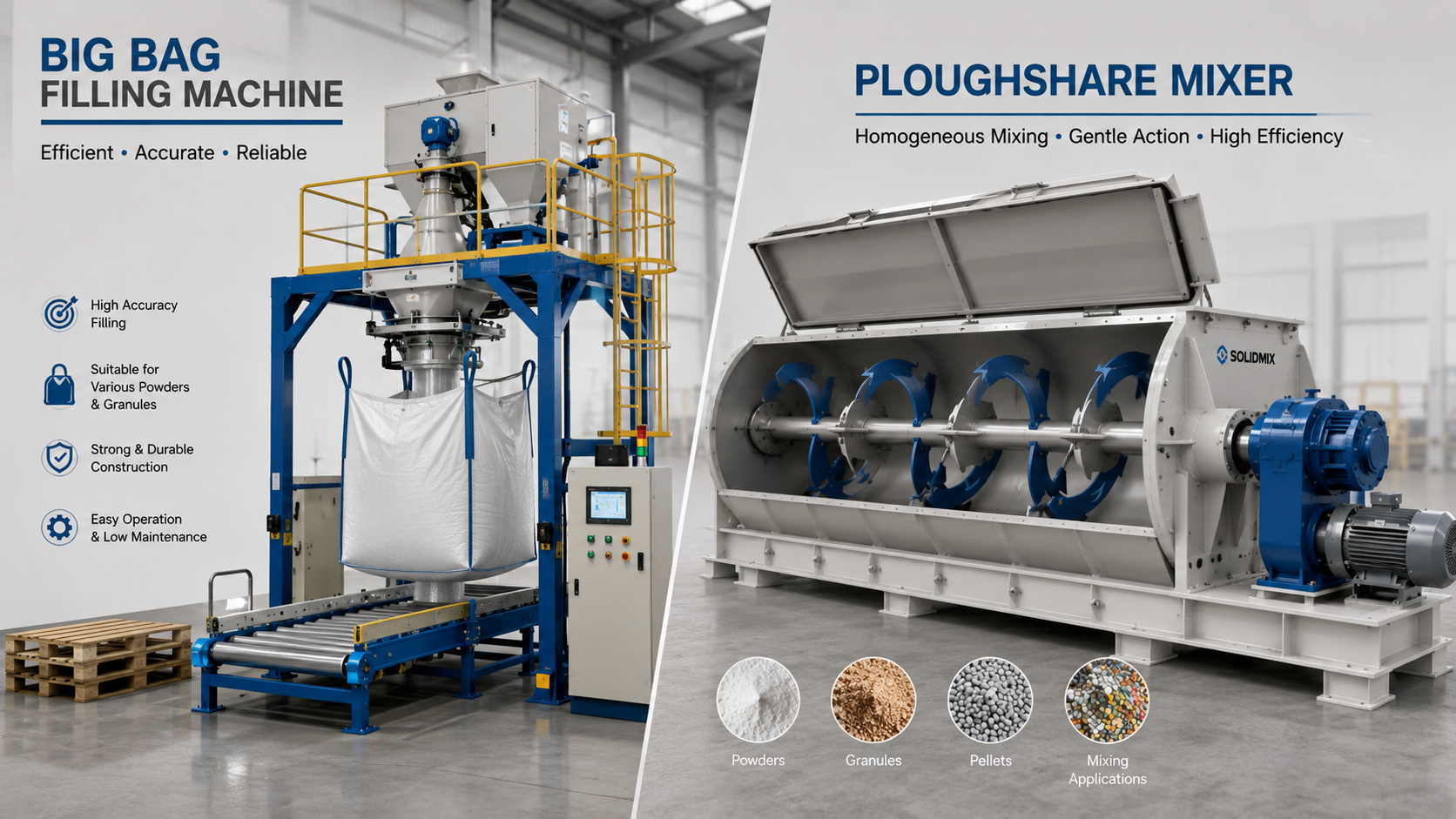
In modern bulk material processing, manufacturers need equipment that improves productivity without sacrificing accuracy, cleanliness, or product quality. A big bag filling machine and powder sieving machine are two important systems used in industries that handle powders, granules, fine particles, and dry bulk materials.
These machines support efficient production by managing two critical stages of material handling. Powder sieving helps remove oversized particles, contaminants, and unwanted agglomerates, while big bag filling allows processed material to be packed into large flexible containers for storage, transport, or distribution.
When selected and integrated correctly, these systems can improve material flow, reduce manual handling, support consistent product quality, and create a more organized production environment.
Understanding a Big Bag Filling Machine
A big bag filling machine is designed to fill large flexible intermediate bulk containers, commonly known as FIBCs or bulk bags. These bags are widely used for transporting dry products such as chemicals, minerals, food ingredients, fertilizers, construction materials, and plastic granules.
The equipment typically positions the bag beneath a filling head and controls the transfer of material into the container.
Key Functions of Big Bag Filling Equipment
Depending on the system design, a filling station may include:
-
Bag support frames
-
Filling spouts
-
Dust collection connections
-
Weighing systems
-
Bag inflation systems
-
Vibrating or densification platforms
-
Pallet handling arrangements
-
Automatic material shut-off controls
The main purpose of the machine is to fill bulk bags safely, accurately, and consistently.
Why Filling Accuracy Matters
Accurate filling helps manufacturers maintain packaging consistency and avoid unnecessary product giveaway.
It can also improve downstream logistics because properly filled bags are easier to stack, store, transport, and manage.
What Is a Powder Sieving Machine?
A powder sieving machine separates materials according to particle size. It is used to remove unwanted particles, break down soft agglomerates, and improve the uniformity of powdered products.
The machine usually passes powder through a mesh or screening surface while vibration or another mechanical action encourages material movement.
Typical Applications of Powder Sieving
Powder screening systems are commonly used for:
-
Food powders
-
Pharmaceutical ingredients
-
Chemicals
-
Pigments
-
Metal powders
-
Minerals
-
Ceramic materials
-
Plastics
-
Fertilizers
-
Construction compounds
The required mesh size, machine capacity, material characteristics, and hygiene requirements determine the most suitable sieving solution.
Big Bag Filling Machine and Powder Sieving Machine Comparison
Both machines support bulk material processing, but they perform different functions.
| Factor | Big Bag Filling Machine | Powder Sieving Machine |
|---|---|---|
| Main Purpose | Bulk bag packaging | Particle separation |
| Material Type | Powder and granules | Mainly powders and fine particles |
| Production Stage | Packaging and discharge | Screening and preparation |
| Quality Role | Filling consistency | Particle uniformity |
| Typical Output | Filled FIBC bags | Screened powder |
| Automation Potential | High | High |
Although their functions differ, the two systems can work together in the same processing line.
How Both Machines Work Together
A production process may begin with raw powder entering a powder sieving machine. The powder is screened to remove unwanted lumps, foreign particles, or material outside the required particle size range.
After screening, the cleaned material may move into a storage hopper or directly toward a big bag filling machine.
A typical sequence can include:
-
Raw material feeding
-
Powder screening
-
Contaminant removal
-
Temporary storage
-
Controlled material transfer
-
Bulk bag positioning
-
Weight-controlled filling
-
Bag sealing or closure
-
Finished bag handling
This arrangement can create a more controlled manufacturing and packaging process.
Advantages of Big Bag Filling Systems
A modern big bag filling machine can offer several operational benefits.
Improved Productivity
Automated filling reduces the amount of manual effort required to package large quantities of material.
Better Weight Control
Integrated weighing technology can help operators achieve more consistent fill weights.
Cleaner Material Handling
Dust extraction and enclosed filling arrangements can reduce airborne material during packaging.
Flexible Production
Many filling systems can handle different bag sizes and various free-flowing or semi-free-flowing materials.
Safer Working Conditions
Reducing direct operator contact with heavy bags and dusty products can support a better working environment.
Advantages of Powder Sieving Systems
A reliable powder sieving machine contributes directly to product quality.
Consistent Particle Size
Sieving removes material outside the required size range and helps create a more uniform final product.
Contamination Control
Screening can help remove foreign objects or unwanted particles before packaging or further processing.
Improved Downstream Processing
Uniform powder may flow more consistently through mixers, feeders, conveyors, and filling equipment.
Reduced Production Problems
Removing oversized particles can help reduce blockages and irregular material flow.
Better Process Reliability
When raw material quality is more consistent, the overall production process becomes easier to control.
Important Selection Factors
Choosing the right big bag filling machine and powder sieving machine requires careful evaluation of the material and production process.
Important considerations include:
-
Powder density
-
Particle size
-
Flow characteristics
-
Moisture sensitivity
-
Production capacity
-
Required accuracy
-
Dust generation
-
Hygiene requirements
-
Cleaning procedures
-
Available floor space
-
Automation level
-
Bag dimensions
Manufacturers should avoid choosing machinery based only on maximum throughput. The equipment should match the real characteristics of the product.
Role of Automation and Smart Controls
Industrial material handling is becoming increasingly automated.
Modern machines may use load cells, programmable controllers, digital interfaces, automated valves, sensors, and process monitoring systems.
In a big bag filling machine, automation can control filling speed, bag weight, material cutoff, and operating sequences.
In a powder sieving machine, monitoring systems can help operators manage screening performance and identify process irregularities.
Automation can improve repeatability while reducing dependency on manual adjustments.
Safety, Hygiene, and Dust Management
Powder handling requires careful attention to safety and cleanliness.
Fine particles can create dust, contaminate surrounding areas, and affect production conditions. Proper extraction systems, enclosed transfer points, suitable seals, and regular cleaning can reduce these risks.
For industries with strict hygiene requirements, equipment should also be designed for easy cleaning and material changeover.
Machine materials and surface finishes should be selected according to the application and product requirements.
Energy Efficiency and Sustainable Processing
Efficient processing equipment can reduce waste and improve overall resource utilization.
A properly configured powder sieving machine can reduce rejected material by improving separation accuracy, while an optimized big bag filling machine can reduce packaging errors and product losses.
Manufacturers can also improve sustainability by:
-
Reducing material spillage
-
Optimizing machine operating cycles
-
Using energy-efficient motors
-
Improving dust recovery
-
Minimizing overfilling
-
Reusing suitable packaging systems
-
Improving production planning
Sustainability is increasingly connected with operational efficiency rather than being treated as a separate objective.
Future Trends in Bulk Powder Handling
Bulk material processing continues to move toward smarter and more connected manufacturing.
Future equipment is expected to include more advanced sensors, automated diagnostics, remote monitoring, predictive maintenance, integrated weighing technology, and intelligent production controls.
Manufacturers may increasingly connect the big bag filling machine and powder sieving machine with complete production management systems.
This can provide better visibility into material flow, production output, quality control, and equipment performance.
Frequently Asked Questions
1. What does a big bag filling machine do?
A big bag filling machine fills large FIBC bulk bags with powders, granules, and other dry materials.
2. What is a powder sieving machine used for?
A powder sieving machine separates powder according to particle size and removes unwanted particles or lumps.
3. Can both machines be used together?
Yes. Powder can be screened first and then transferred to a bulk bag filling system.
4. Which industries use big bag filling systems?
Chemical, food, mineral, pharmaceutical, plastics, agriculture, and construction industries commonly use them.
5. Can powder sieving improve product quality?
Yes. It can improve particle uniformity and remove oversized or unwanted material.
6. Are big bag filling machines automatic?
They can be manual, semi-automatic, or fully automated depending on production needs.
7. Can sieving machines handle different mesh sizes?
Yes. Different screens may be selected according to the required particle separation.
8. How is filling accuracy controlled?
Load cells and weighing controls are commonly used to monitor and manage bag weight.
9. Why is dust extraction important?
Dust extraction helps maintain cleaner working conditions and reduces airborne powder around processing equipment.
10. How should the right machine be selected?
Selection should consider material properties, required capacity, hygiene, accuracy, automation, safety, and available space.

 English
 Arabic
 French
 Spanish
 Portuguese
 Deutsch
 Turkish
 Italiano
 Russian
 Romaian
 Portuguese (Brazil)
 Greek
Greek
 Bengali