


AI SEO Audit Tools: Finding the Optimization Gaps That Traditional SEO Audits Miss
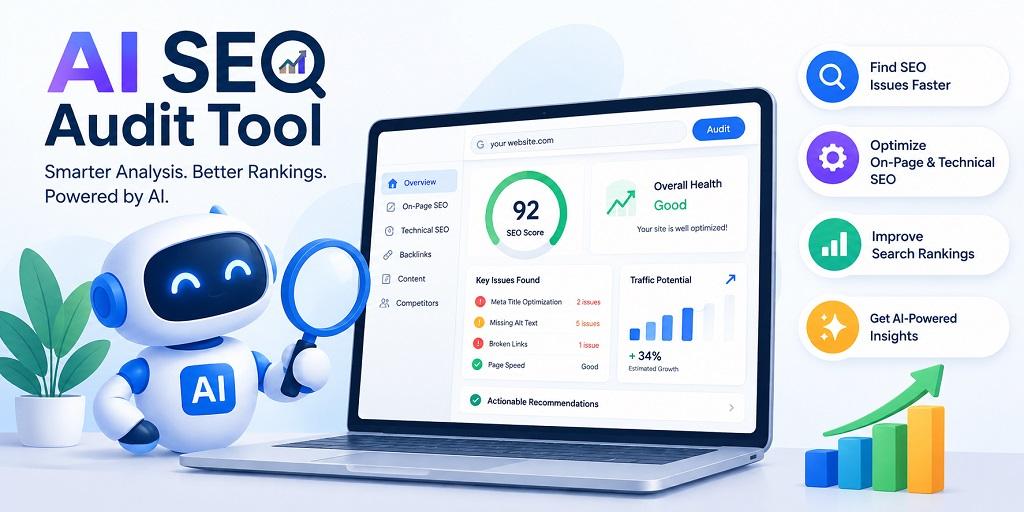
- Traditional SEO audits check technical health but miss AI-specific ranking signals like entity clarity, semantic structure, and citation likelihood.
- An AI SEO audit tool analyzes content at a contextual level that rule-based crawlers cannot replicate.
- The biggest gaps include schema depth, topical authority mapping, and conversational query alignment.
- Fixing these gaps improves visibility in both conventional search results and AI-generated answers.
What Traditional SEO Audits Actually Check
A standard SEO audit runs through a familiar checklist: broken links, crawl errors, page speed scores, missing title tags, duplicate content flags, and mobile usability issues. These checks matter. They are the foundation of a technically sound site. But they describe the structure of a page, not its relevance to a specific search intent or its likelihood of being cited inside an AI-generated answer in 2026.
Traditional crawlers treat content as text to be indexed. They count keywords, measure density, and verify metadata. They do not assess whether a page clearly answers a named question, establishes topical authority across a subject cluster, or presents information in a format that AI models prefer when generating responses.
Where an AI SEO Audit Tool Finds Different Gaps
An AI SEO audit tool evaluates content against the same contextual signals that large language models and AI search engines use when selecting sources. The gaps it surfaces fall into three main categories.
- Entity clarity: Pages that reference topics without naming the underlying entities precisely score lower in AI retrieval. A tool flags where "it," "this solution," or vague pronouns replace specific product names, people, or concepts.
- Schema depth: Basic schema markup passes a traditional audit. An AI-focused audit checks whether structured data aligns with FAQ, HowTo, Article, or Product schemas that match actual page content, not just placeholders.
- Topical coverage gaps: If a page targets a keyword but omits the subtopics that authoritative sources consistently cover, an AI audit flags the missing angles. This matters because AI models favor comprehensive answers over thin coverage.
- Conversational query alignment: Search queries are increasingly phrased as full questions. An AI audit tool maps existing content against natural-language query patterns and identifies pages that answer head keywords but miss the surrounding question formats.
- Citation structure: Content that lacks clear factual claims, named sources, or verifiable statistics is less likely to be lifted into AI answers. An AI audit identifies paragraphs that read as opinion without evidence.
AI SEO Audit Tool Capabilities vs. Traditional Crawlers
Capability Traditional Crawler AI SEO Audit Tool Broken link detection Yes Yes Keyword density analysis Yes Contextual, not just count-based Entity recognition No Yes Topical authority mapping No Yes Conversational query alignment No Yes AI citation likelihood scoring No Yes
Turning Audit Findings Into Fixes
Once the gaps are identified, the remediation process is concrete. Add entity-specific language to pages that use vague references. Expand thin content sections by covering the subtopics authoritative competitors address, as outlined in Google's helpful content guidance. Implement schema markup that matches page intent rather than page category. Rewrite introductory paragraphs to mirror the phrasing patterns found in Schema.org FAQ and HowTo structured data standards.
Prioritize pages that already rank on page one but generate no AI citations. Those pages have authority; they simply lack the formatting and specificity that AI models require.
WorkspaceCMS.ai SEO + AI Campaign FAQ
How is an AI SEO audit different from a standard technical audit?
A standard technical audit checks site infrastructure. An AI SEO audit evaluates content for entity clarity, topical completeness, and conversational query alignment, signals that determine AI search citation likelihood.
How often should businesses run an AI SEO audit?
Quarterly audits catch content decay as AI search behaviors evolve. High-traffic pages warrant monthly reviews given how frequently AI models update their retrieval preferences.
Where does WorkspaceCMS.ai fit in this process?
WorkspaceCMS.ai combines AI content automation with built-in AI search visibility tracking, giving marketing teams and agencies a single platform to identify gaps, publish fixes, and monitor whether those fixes improve brand presence across AI-generated answers.

 English
 Arabic
 French
 Spanish
 Portuguese
 Deutsch
 Turkish
 Dutch
Dutch
 Italiano
 Russian
 Portuguese (Brazil)
 Greek
Greek
 Bengali